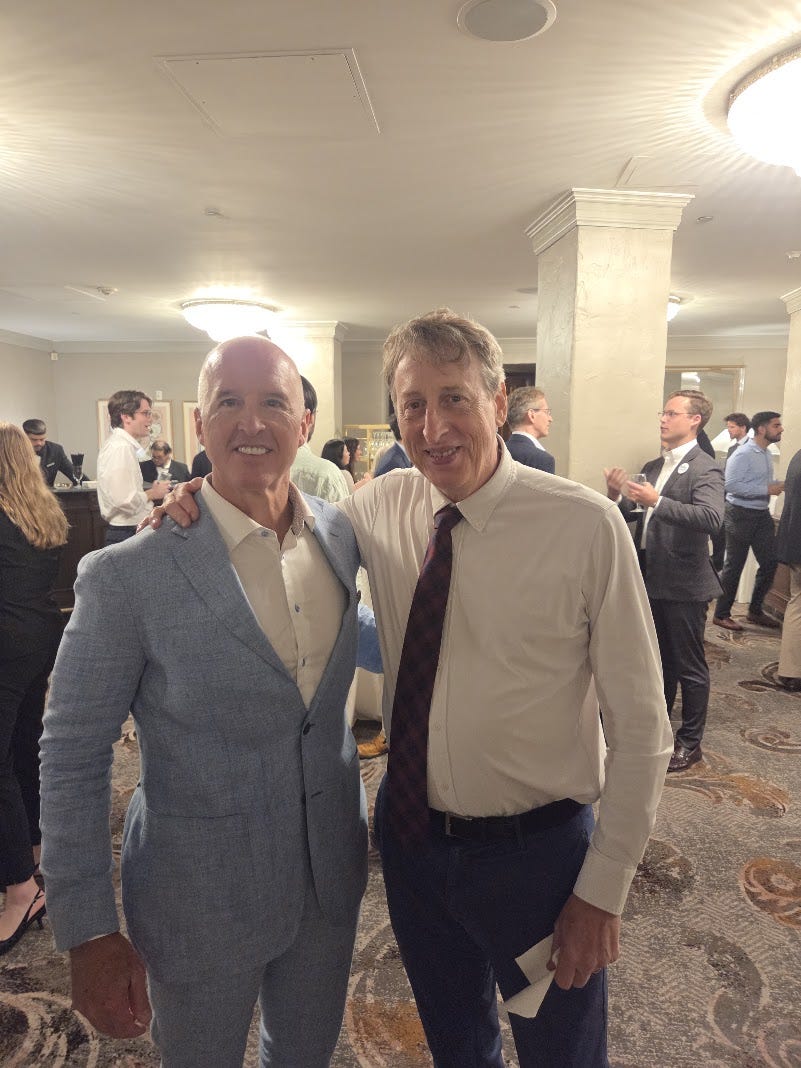

Jonathan Engler entered the COVID era cautiously, “for a few months, (he) did sort of buy into the thing,” he said. That confidence broke when governments committed to lockdowns without reckoning with their social cost. “As (he) saw what these lockdowns were doing to people, (Jonathan) started to think, this is a bit weird. Is this really necessary?”
The turning point came when the UK government announced a suppression strategy tied explicitly to vaccination. Engler called the plan “completely insane” and began examining the assumptions beneath it. What he found, he said, was “a huge amount of faulty assumptions and junk science,” paired with a rising hysteria that crowded out dissent. From that moment, he rejected the dominant narrative and joined others doing the same.
Engler became involved with PANDA, Pandemic Data and Analytics, a group formed to interrogate lockdown policy using data rather than fear. He later wrote PANDA’s position statement, arguing that the evidence did not support the claim that a pandemic, in the classical epidemiological sense, had occurred. “There was no pandemic,” he said. “So to have the word pandemic in there was wrong.” The group eventually dropped the expansion of its name, retaining PANDA as a neutral label.
By late 2020, Engler was asked to co-chair the UK-based HART group, the Health Advisory and Recovery Team, alongside Claire Craig. The group included clinicians, psychologists, economists, and educators, and published frequent analyses during the crisis. Its weekly newsletter reached tens of thousands and was used by other dissident groups attempting to understand policy decisions in real time. Engler later learned that HART had been monitored by the UK Army’s 77th Brigade. “We were obviously a target,” he said. “Which makes us annoyed, but also pleased.”
Engler argues that the UK’s partial restraint, compared with other European states’, mattered. Mask rules allowed exemptions, and broad vaccine mandates were ultimately abandoned. “There was nearly a vaccine mandate for all healthcare workers. They cancelled it weeks before it took effect. I think we were a substantial part of stopping that.” He believes similar pressure helped prevent vaccination from being pushed into younger age groups. “I’m proud to say we probably saved the hearts of thousands of children.”
At the core of Engler’s critique is skepticism toward what he calls an oversimplified virus model. He does not claim that illness does not occur, but he questions whether respiratory disease is well explained by the idea of discrete pathogens spreading cleanly from person to person. “The foundational science that underpins most of that explanation is pretty lacking,” he said. He points to a century of failed transmission experiments, from Spanish flu studies to the Salisbury Common Cold Unit, where deliberate exposure rarely produced illness. “For the model to be true, you would not expect decades of experiments to be a complete litany of failure.”

Engler rejects binary framing about whether viruses “exist.” He sees that framing as a distraction. “The more nuanced question is whether the virus model has explanatory power for what we actually observe,” he said. He argues that testing technology, not biology, created the appearance of novelty in SARS-CoV-2. “When they started testing everywhere, they found it in huge quantities,” he said. “Yet there was no prior signal of excess death or respiratory illness.”
Much of Engler’s work now focuses on psychological drivers of illness, particularly the nocebo effect. Unlike a placebo, which improves symptoms through positive expectation, a nocebo worsens them through fear. “It’s not talked about very much,” he said, “but it is a well-described phenomenon.” During COVID, he argues, fear-based messaging was relentless. People were told that mild symptoms could be deadly, and surveys showed wildly inflated perceptions of risk.
Engler cited clinical examples where belief alone produced measurable physiological collapse, including a trial participant whose blood pressure crashed after overdosing on placebo medication, then normalized immediately once told the truth. Another case from the Common Cold Unit involved a volunteer who developed cold symptoms after being told he received infectious material, then recovered instantly when corrected. “These are not purely psychological effects,” Engler said. “They are measurable physiological responses.”
Today, Engler writes on medicine, psychiatry, and pharmaceutical expansion, arguing that modern health care increasingly medicalizes normal human states. He sees patterns repeated across blood pressure, cholesterol, anxiety, ADHD, obesity, and drug dependence. “The industry looks for chronic conditions, then gradually expands the definition to pull in more of the population.”
Engler earns nothing from this work. His Substack remains free, and he collaborates frequently with Norman Fenton, Martin Neil, and Jessica Hockett. He accepts that his views place him outside institutional favor. “I don’t think this is about being contrarian,” he said. “It’s about asking whether the story we were told actually fits the evidence.”
Transcript Summary of this podcast episode ⤵Full Transcript (Auto-Transcribed)
We were told extraordinary measures were necessary. I bought into some of it at first. As a clinician, I watched friends and patients suffer from the lockdowns and the policies touted as science. I started reading. I found flawed assumptions, poor tests, and a public health creed that prized suppression until a vaccine over basic risk calculus. That was not medicine. That was theater.
Mass testing created the appearance of a flood. Bayes theorem explains why tests in low-risk settings deliver many false positives. The same technology used to hunt novelty revealed ubiquity once it was turned on. That alone changed what we reported as reality. Deaths and hospital visits did not rise uniformly before testing expanded. Places with open-air living and no testing showed little change. Testing did not merely measure an event. Testing reshaped the narrative.
Fear is not an abstract variable. Nocebo is real. Expecting doom makes people sicker. Placebo is not mystical. Expectations alter physiology. Clinical trials that hinge on narrow surrogate endpoints mask harms that only show up when you look at whole people over time. We accept lower blood pressure and lower cholesterol as good enough proof without demanding all-cause outcomes. That convenience is costly.
Big medicine has a habit of converting normal life into chronic markets. Psychiatry, weight, cholesterol, and aging become diagnosis categories to be treated forever. New drugs push people into other drugs. The patient loses.
I stand for medical freedom and truth. Patients deserve honest risk-benefit math. Medicine should protect autonomy, not manufacture fear. We must demand transparent science, real outcomes, and a return to care that sees the whole person. Only then will trust and health be restored. Doctors must refuse to bend science into policy that strips dignity and narrows freedom and rights unjustly.
Join us at 5 pm ET weekdays on America Out Loud Talk Radio. Listen on iHeart Radio, our world-class media player, or our free apps on Apple, Android, or Alexa. Discover all the episodes on podcast networks, i.e., Apple Podcasts, Spotify, Pandora, TuneIn, Stitcher, and iHeart. You’ll find them the day after they air on talk radio, available on podcast. Extraordinary voices for extraordinary times.
Discover more from Randy Bock MD PC
Subscribe to get the latest posts sent to your email.