
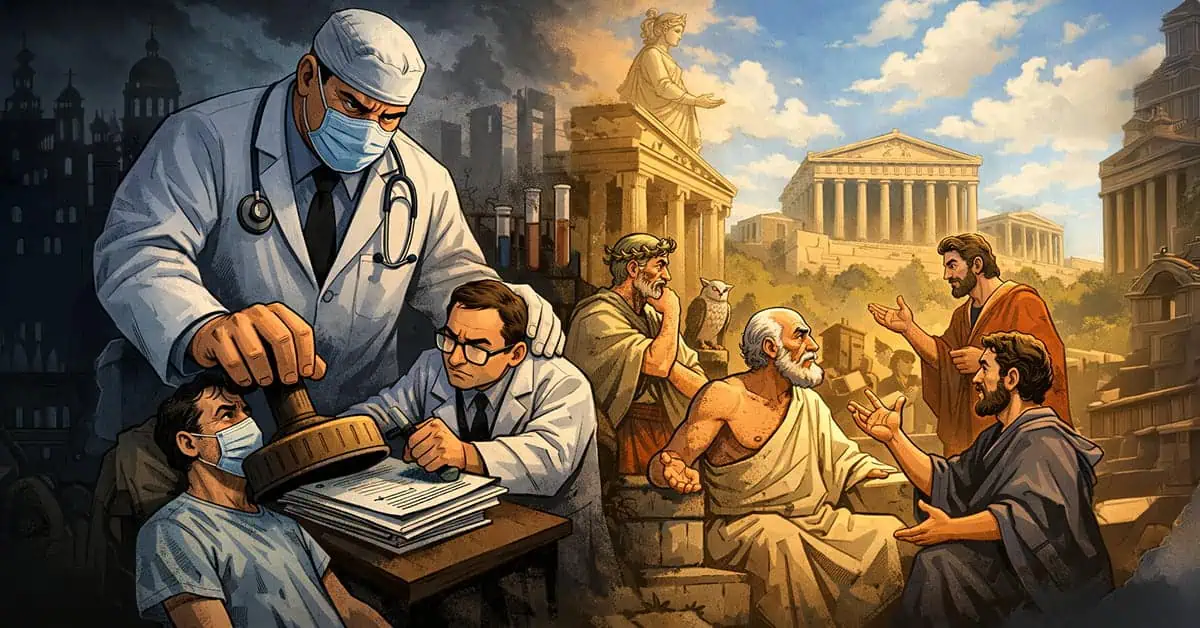
Modern medicine suffers less from ignorance than from misplaced authority. It no longer fails because it lacks tools or data, but because it has drifted away from the intellectual framework that once allowed knowledge to grow through open contest rather than coercion. That framework did not originate in modern regulatory bodies or peer-review committees. It emerged in ancient Greece, where public argument, emerging concepts of citizenship, and reasoned dialogue began to replace tribal authority and priestly decree. The loss of that tradition of contestable authority, rather than any shortage of expertise, explains much of what now feels brittle, paternalistic, and unaccountable in medicine and science.
Greek medicine arose in a world that understood uncertainty. Disease frightened people because outcomes remained unpredictable and remedies remained incomplete. That uncertainty forced seriousness. Healing became a moral practice before it became a technical one. Observation and judgment mattered. Ethics compensated for limited accuracy.
The physical remnants of ancient Greek medicine reflect that posture. Healing spaces organized care rather than surrendered to fate. Patients rested; practitioners observed; interventions occurred cautiously. Excavated instruments show intent rather than mysticism. Tweezers, probes, and other tools aimed at precision appear alongside symbolic elements that acknowledged danger and renewal rather than denied them.
Snakes captured that dual meaning. They represented both threat and regeneration. Language followed observation. The Greek word ‘herpes’ means ‘snake’– and was applied to the skin blister eruptions that crept and returned. Into that environment entered Hippocrates. His contribution did not rest on cures or techniques, but on structure. “The Hippocratic Oath is a bond between the doctor and the patient.” It did not tell physicians what to think. It told them whom to serve.
That design resembles constitutional architecture. Founders do not predict future dilemmas. They create guardrails that allow progress without domination. The U.S. Constitution did not anticipate antibiotics, genomics, or pandemics, yet it limited authority and preserved agency. Hippocratic medicine did the same for healthcare. It allowed science to advance without dissolving trust.
Greek thought extended beyond medicine into politics and epistemology: arguments refining truth; ideas advancing through contest, not decree. That habit shaped representative government and later constitutional republics. It also shaped science. Scientific revolutions followed the Greek pattern. Debate preceded consensus. Replication validated claims. Authority followed evidence rather than preceding it. The system worked because it tolerated doubt.
Modern medicine increasingly rejects that lineage. During COVID, physicians frequently aligned with state mandates even when individual benefits remained unclear. “Doctors went along with the state more than with your best interest.” That shift reflected structure more than intent. Systems rewarded compliance.
That posture revealed medicine’s underlying “paternal model of medical care” (a term I came up with myself, but which apparently preexists; see Medical Paternalism). Authority flows downward. Adults receive directives once reserved for children. The physician’s role shifts from advocate to enforcer.
This transformation connects directly to medicine’s separation from the marketplace. “(under FDR) The purchase of health insurance was put at arm’s length.” Individuals stopped choosing; insurers and governments came to mediate care. Patients paid indirectly and lost leverage.
The result resembles a freemium model “where you become the product.” Data, diagnoses, and dependency sustain systems that benefit from continuity rather than resolution. Addiction medicine illustrates the pattern. Methadone and Suboxone represent iterations of “the old lady who swallowed the fly.” Each intervention perpetuates the problem it claims to solve. Maintenance replaces recovery.
The same structural flaw corrupts science itself. “Peer review (intended as an impartial check on truth) has hardened into a guild.” Authority substitutes for adjudication, engendering errors that persist as the challenge becomes disloyalty.
That failure surfaced starkly in debates over Zika and microcephaly. JAMA’s chief editors acknowledged the validity of my work yet refused publication because “this would be a bad time to sow doubt in the public health establishment (Dr. Fauci et al.).” That admission inverted science’s purpose. “Your job as a medical journal’s editor IS ‘to sow doubt’.” Without doubt, science ossifies.
Sports adjudicate visibly. Science increasingly hides judgment behind credentials. The solution does not require abandoning modern medicine or modern science. It requires restoring structure. Medicine needs advocates, not overseers. Science needs challenge, not silence. Greek civilization endured because it built frameworks that allowed correction without collapse. Those frameworks still work. They simply require remembering why they existed.
Please see my
- Peer Review Is a Guild; Restoration of Scientific Integrity Entails a Truth- “Marketplace“
- Randall Bock: “How to Fix Science” | Tom Nelson’s Video
Transcript Summary of this podcast episode ⤵Full Transcript (Auto-Transcribed)
Personal medical freedom is in crisis. For decades, medicine has drifted from a private covenant between doctor and patient into an industrial system that treats people as units on a ledger. I have seen the consequences up close. I lost my practice after challenging the prevailing dogma on addiction and won my license back by defending the right to speak and treat patients honestly.
The Hippocratic bond matters. Patients need an advocate who puts their health first, not a bureaucratic checklist. Addiction is often a reaction to trauma and loss. Treating it as a life sentence of maintenance therapy turned many clinics into long-term dispensing mills. Methadone and Suboxone were sold as fixes. Too often, they become substitute industries that enslave people to a new normal. Tapering to sobriety is hard work. It restores agency. It respects the person.
Medicine also adopted a freemium mindset. We accept invisible trades every day. Tech companies sell attention for free services. Medicine has its versions. Funding streams, industry partnerships, and career incentives shape what is studied and what is promoted. The result is paternalism dressed as expertise. Parents, teachers, and doctors telling children what is best without clear evidence erodes trust.
Science should be self-correcting. Too often, it is a closed guild. Peer review became a club that rewards insiders and punishes dissent. That must change. We need open data, replication bounties, and public adjudication where claims are scored transparently. Call it a republic of evidence. Give skeptics a seat at the table. Reward accuracy and penalize gatekeeping.
Public health must earn trust. That starts with honest risk discussions and respect for individual choice. I still believe doctors are teachers and advocates first. Rebuild the bond. Let patients choose. Make science accountable. Freedom in medicine is not a slogan. It is the only way to keep care humane and truthful.
Join us at 5 pm ET weekdays on America Out Loud Talk Radio. Listen on iHeart Radio, our world-class media player, or our free apps on Apple, Android, or Alexa. Discover all the episodes on podcast networks, i.e., Apple Podcasts, Spotify, Pandora, TuneIn, Stitcher, and iHeart. You’ll find them the day after they air on talk radio, available on podcast. Extraordinary voices for extraordinary times.
Discover more from Randy Bock MD PC
Subscribe to get the latest posts sent to your email.