

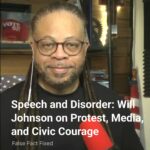
In a country where political protest increasingly spills into disorder, Will Johnson — host of Live From America — argues that free speech only survives if citizens are willing to exercise it, even when it costs them.
Free speech America is not merely a constitutional guarantee — it is a daily act of civic courage that is increasingly costly to exercise. That is the driving argument behind a wide-ranging conversation between Will Johnson, Texas-based conservative commentator and host of Live From America on the LFA Network, and physician-commentator Dr. Randy Bock. Drawing on his decade-long career as a street interviewer, viral content creator, and frequent target of political harassment, Johnson makes the case that the freedom to speak — and the willingness to use it — defines this moment in American public life more than any single policy debate.
Johnson’s biography reads like a case study in political migration. Born in Arkansas and self-identified as a Democrat, he moved to California, registered as an independent, and found himself shut out of the state’s closed primary system. Forced to choose, he picked conservatism — not out of party loyalty, but out of mounting disagreement with what he was observing. He has not looked back.
What motivates me is the division that we are seeing in our country. The polarization and the animosity inspired me to speak up and say something.— Will Johnson, Live From America
Table of Contents
Free Speech America Is Under Pressure — Johnson’s Firsthand Account
The episode that best captures Johnson’s central argument is deceptively simple. He is standing on an American street corner, holding an American flag, on American soil. He is told — by passers-by, by people he approaches for conversation — that he is the one provoking violence. Not those shouting at him. Not those attempting physical intimidation. Him. Because of the flag.
For Johnson, this single encounter encapsulates the crisis of free speech America in 2026. The First Amendment provides a legal guarantee; what it cannot provide is a cultural environment willing to honor that guarantee in practice. The right to speak exists on paper. What is eroding, he argues, is the social permission — and physical safety — required to actually use it.
I am standing on a corner holding an American flag in America, and I have been told that I am the one provoking violence.— Will Johnson
Dr. Bock reinforces the observation through a childhood analogy: the older brother who continuously moves the imaginary boundary lines in a shared bedroom, always discovering a new justification for why whatever his younger sibling does is the source of conflict. The rules shift perpetually; the punishment is constant. Johnson recognizes the pattern immediately. The “you provoked me” logic is not reasoning — it is a power move designed to make any expression of dissent into evidence of aggression, effectively eliminating the possibility of opposition.
Why Free Speech America Requires More Than the First Amendment
The First Amendment restrains government. It says nothing about the behavior of private platforms, cultural institutions, employer pressure, or activist crowds. Johnson’s argument — one shared by a growing number of voices across the political spectrum — is that the erosion of free speech America is happening not primarily through legislation but through social pressure, algorithmic suppression, and the normalization of hostility toward dissenting viewpoints.
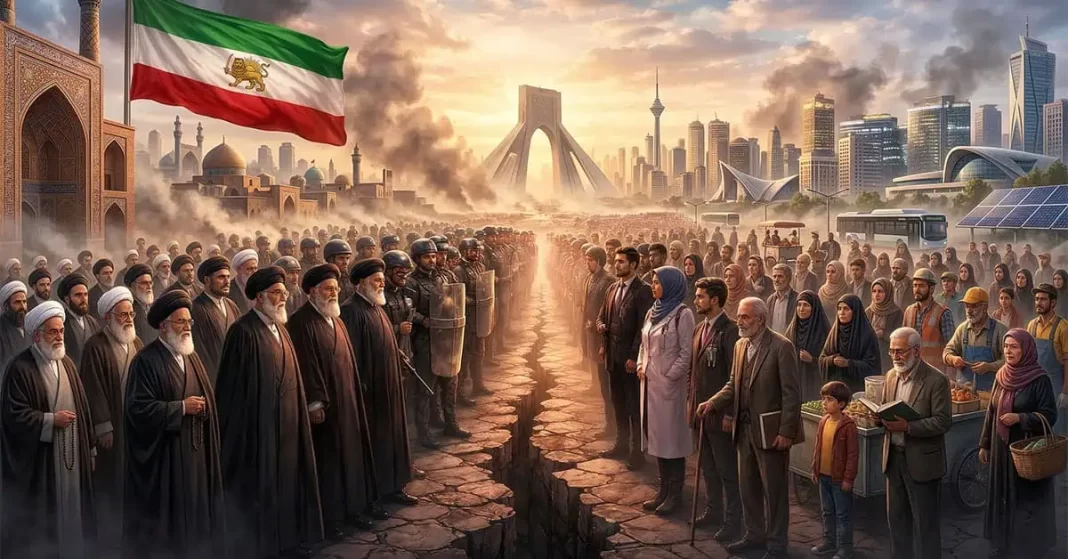
Bock frames the structural problem in classical terms. Aristotle’s concern with pure democracy was not that citizens should be silent, but that majority will exercised without constitutional structure becomes mob tyranny. The American constitutional republic was designed to route conflict through frameworks of law and procedure. Without those frameworks, protest becomes disorder, and disorder becomes the mechanism by which the loudest and most aggressive voices crowd everyone else out — a direct threat to any meaningful conception of free speech America.
The football analogy makes the point vividly. The same aggression that constitutes a street brawl becomes a commercially successful, legally structured sport when referees, rules, and shared frameworks are applied. Players who have been colliding for three hours shake hands and pray together at the final whistle — because structure channels conflict rather than suppressing it. Remove the structure, and the game becomes a brawl.
Key Takeaways — The Free Speech America Argument
- The First Amendment is a legal floor, not a cultural guarantee. Free speech America requires both legal protection and a social environment willing to tolerate disagreement.
- The “you provoked me” framing eliminates accountability from aggressors and places it on those who merely speak, assemble, or display national symbols.
- Constitutional structures are what transform conflict into civil discourse — without them, popular will becomes mob tyranny.
- Johnson’s flag encounter is not an isolated incident. It is a microcosm of a pattern playing out across American civic life.
✦ ✦ ✦
Conservative Censorship and the Silencing of Free Speech America Online
Johnson identifies 2018 as the year he noticed something shift fundamentally in how social media treated conservative content. After two years of building a Facebook following of over 150,000, his reach began collapsing — not because his audience had left, but because the platform had stopped showing his content to them. Shadow banning, reduced distribution, and outright removals followed.
His diagnosis of why this happens is blunt. A significant portion of the political left has adopted the position that speech it finds objectionable should not be countered — it should be made invisible. Not “I disagree and here is why,” but erasure. “They had it in their minds,” Johnson explains, “that if I don’t like what you’re saying, no one should like it. If I don’t want to see it, no one should hear it.”
“If I don’t like what you’re saying, no one should like it. If I don’t want to see it, no one should hear it.” — Will Johnson
This is where conservative censorship intersects directly with free speech America as a practical matter. The platforms hosting public political discourse are not constitutional public squares — they are private companies. But they have become the infrastructure through which political life is conducted. Removing voices from those platforms does not silence them legally; it silences them functionally. And the pattern of whose voices disappear, Johnson argues, is not random.
Bock observes a parallel uniformity at the institutional level: news anchors across different networks reading near-identical language on the same day; Supreme Court justices appointed by Democratic presidents voting as a synchronized bloc regardless of the legal specifics of any given case, while conservative justices range across independent positions. The left, both men suggest, prizes ideological cohesion; the right prizes individual reasoning, for better and for worse.
✦ ✦ ✦
Political Protest 2026: Dissent Versus Disorder
Johnson draws a careful line between legitimate protest and what he calls “anti-lawless protest” — demonstrations whose actual aim is not to change policy but to destabilize civic functioning. He is emphatic that he supports disagreement. He believes vigorous public debate is democracy’s most valuable feature. What he opposes is the conversion of that disagreement into physical intimidation, property destruction, and targeted aggression — and the selective refusal by authorities to respond.
The implication for political protest in 2026 is direct: dissent is legitimate and necessary; disorder is neither. The erosion of the distinction between the two is itself a threat to free speech America, because it creates conditions where peaceful assembly becomes indistinguishable from confrontation in the public mind — and where speaking up at all begins to feel like an act of provocation.
Four Arguments on Protest, Disorder, and Free Speech America
- Reframing violence as reaction: Claiming opposing viewpoints cause ensuing violence removes accountability from those who act violently.
- Chosen battlegrounds: Johnson argues that certain protest locations are selected for agitation value, not genuine policy engagement.
- Constitutional instrumentalization: Legal frameworks are invoked selectively — championed when useful, dismissed when inconvenient.
- Physical safety as a prerequisite: Genuine free speech requires not just legal protection but an environment where speech can occur without immediate physical retaliation.
✦ ✦ ✦
Civic Courage: The Real Personal Cost of Speaking Up
The most sobering part of the conversation is Johnson’s account of what his public work has cost him personally. The local police department contacted his parents — in another state — to conduct a wellness check, prompted by the volume of death threats he was receiving online. He has been physically struck during street interviews. He has had channels deleted and content removed.
He keeps going out with the camera.
His advice to anyone who wants to do similar work is practical and revealing. Be patient. Never retaliate when situations escalate. Walk away before things turn physical. Pray before you go, because you are stepping into environments that may turn dangerous. Understand that the goal is not confrontation — it is documentation, and the demonstration that civil disagreement remains possible even now.
Someone needs to say something. I know I am not the only one. But someone needs to say something.— Will Johnson
Both men ground their commitment in the same conviction: that free speech America does not sustain itself automatically. It requires citizens willing to exercise it even when the exercise is costly — who understand that silence, however comfortable, is not neutral. It is, in effect, concession.
✦ ✦ ✦
From a Popeye’s Parking Lot to a National Platform
Johnson’s media career began almost by accident in 2015. Waiting in a parking lot while his wife went inside a Popeye’s restaurant, he had five minutes to himself and went live on Facebook. He was wearing a shirt that read “Hillary for Prison” — only the word “Hillary” was visible on camera. Viewers flooded the comments. When they learned the full message, the video exploded. By morning it had 5,000 views. It kept climbing.
What sustained the growth was not ideology but recognition. Johnson was saying things out loud that his audience knew from their own daily lives and had rarely heard acknowledged in public. He was naming double standards plainly, without academic framing. He was calling fake news fake news before that phrase entered mainstream political vocabulary.
“People started paying attention like, ‘Wow, he’s saying the same thing that we’re saying and no one else is saying this.'” The observation applies as much to his current work as to its origins. The audience for honest commentary on free speech America is not looking for ideology — it is looking for recognition of what it already sees.
✦ ✦ ✦
Free Speech America and the Soft Bigotry of Low Expectations
The interview extends into two related territories: the politicization of public schools and the paternalism Johnson experienced firsthand in California’s technology sector.
On schools, Bock describes art classes during the Bush era repurposed for anti-war political poster production — a pattern that has intensified since, now extending to debates over gender identity curricula and the deliberate exclusion of parents from health decisions about their own children. The school, both men argue, has come to see itself as holding supervisory authority over children that supersedes parental rights.
Johnson’s sharpest commentary concerns voter ID requirements. Having voted since the age of 18, he finds the suggestion that Black Americans are uniquely unable to obtain government identification both patronizing and unsupported by evidence. It is, he argues, a textbook example of what Michael Gerson called the “soft bigotry of low expectations” — racism presenting itself as concern.
“The liberals there treated me like I couldn’t achieve anything unless they held my hand or they allowed me — and I was running circles around people.” — Will Johnson on Silicon Valley
That personal experience — an IT professional in California’s tech industry, treated as someone whose competence required liberal authorization rather than standing on its own merits — was what converted his irritation into action. Not abstract ideology. A lived encounter with the practical condescension of paternalistic politics, which, he argues, is the same impulse driving efforts to suppress free speech America more broadly: the belief that some voices need to be managed, curated, or silenced for the good of everyone else.
✦ ✦ ✦
What Johnson’s Platform Means for Free Speech America Going Forward
Defending Free Speech America One Conversation at a Time
By the close of the interview Johnson summarizes his mission with characteristic directness. He wants to keep America free — not as political branding, but as a functional daily reality. The freedom to bear arms if one chooses. The freedom to walk to the corner store. The freedom to state plainly, on any platform, that a biological male who identifies as a woman is still, biologically, a male. The freedom to say unpopular things without being silenced, deplatformed, or threatened with violence.
He does not present himself as a movement leader or party operative. He is one citizen who picked up a selfie stick in a parking lot in 2015 and has not put it down — because the conversations he is recording in the street have not yet found their way into the institutions that are supposed to represent the people having them.
In an era when conservative censorship is documented and debated, when political protest in 2026 tests the boundary between dissent and disorder daily, and when the culture around speech is as contested as the law protecting it, Johnson’s approach — patient, persistent, camera always rolling — represents one definition of what civic courage looks like in practice.
Free speech America has never been a self-sustaining condition. It has always depended on the willingness of ordinary citizens to exercise the freedom they have been guaranteed — loudly, publicly, and at real personal cost when necessary. Johnson’s work, whatever one thinks of his politics, is a living demonstration of that principle.
📚 Related Resources, Videos, and Links
Discover more from Randy Bock MD PC
Subscribe to get the latest posts sent to your email.