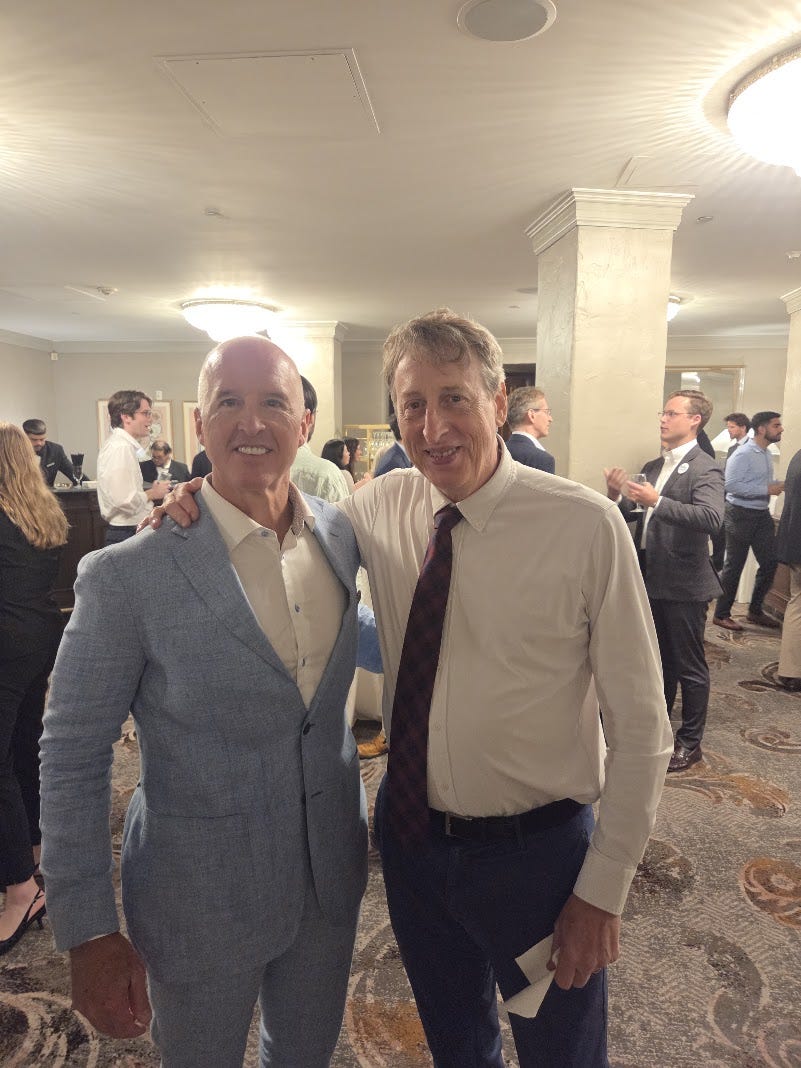


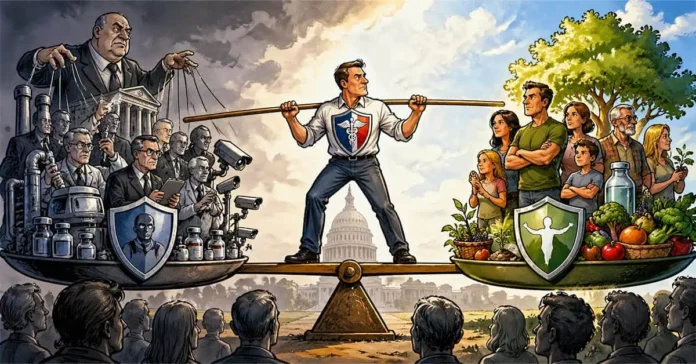

Patriek Karayil speaks in systems language, and he does it well. He introduced himself as a founding member of ARPA-H, later involved with the presidential transition team, and now working as a strategic adviser within HHS, while also helping build the MAHA Institute. He framed MAHA as both an internal government effort and an external movement, and that distinction is not cosmetic. “There’s MAHA within government, and there’s MAHA outside of government,” he said, and the difference explains much of the tension inside the project.
Inside government, MAHA functions as a set of priorities, an organizing schema imposed on a sprawling bureaucracy. “It’s really an organizing principle around perhaps like five interlocking pillars,” Karayil explained, listing nutrition reform, environmental toxins, vaccine safety, chronic disease prevention, and healthcare transparency. Outside government, the same brand expands into something more ideological and more flexible. MAHA Action amplifies; the MAHA Institute sharpens positions. “The political think tanks are meant to take much more of a drastic position so that it’s sort of a signal or a signpost where HHS needs to go,” he noted.
That is the architecture. The harder question is philosophical. I framed it bluntly. “The overriding principle of being a conservative is, if you had to make it into a slogan, it’s like, ‘leave me alone!’” I said, though I added that I am not antisocial, not withdrawn, not living on a mountain. “I don’t want to be left alone all the time, but I don’t like being told what to do either.” That instinct collides with another strain of modern governance. “The left is: “(if) I don’t like something, nobody can do it.” Health policy now lives in that uneasy overlap.
Karayil’s response was measured. He acknowledged the tension without trying to dissolve it. “It’s a delicate balance between the government’s taking more of an outsized role… or being more hands-off,” he said, settling on a middle position where federal actors signal, and states codify. That answer carries weight. The federal government changes direction every election cycle; states, once committed, tend to hold their line. “Anything the states can do is effectively a force multiplier,” he added.
We kept returning to incentives. I raised the analogy of driving and insurance. “We all pay different amounts of car insurance… but I frankly don’t care too much what the other guy’s doing, except when he crashes into me,” I said. Health is not quite that simple. Costs spill over; risk pools blur responsibility. Karayil agreed that the system is misaligned. “Healthcare spend is actually an all-time high… and the overall healthcare outlook is actually an all-time low,” he said, pointing to a structure that rewards activity rather than outcomes.
His proposed correction runs through transparency and incentives. “If we all had full transparency into all of the out-of-pocket costs… that asymmetry would disappear,” he argued. Patients would shop; providers would compete; prices would compress. He also pointed to outcome-based reimbursement, a shift away from billing for visits toward payment for results.
Diet entered the conversation as well, and here I pushed back. “I just always have a little bit of skepticism about the major effects of dietary change and seeing food as medicine,” I said, noting that elite athletes often thrive despite imperfect habits. Karayil did not dispute the outliers. He reframed the issue. “There are always going to be individuals many standard deviations outside of the norm… but we’re not seeing the kids who are sidelined by metabolic disease,” he replied.
Still, I cautioned against overreach. “A lot of the solutions… have their own ancillary problems,” I said, invoking the cascade problem. Karayil’s answer leaned toward restraint. “Most of what’s being done is really just removing things,” he said, listing mandates, dyes, loopholes, and conflicts of interest. Subtraction, not accumulation.
Vaccines dominated the latter part. Karayil spoke as a father. “I would really like to see informed consent be the norm,” he said, describing his inability to send his children to school in Maine. His structural concern followed. “What we really want is… manufacturer liability… in just about anything except for vaccines,” he said.
I agree, and add: “I’ve given out thousands of vaccines… and I’ve taken dozens of them myself”. I do not reject vaccines; I reject inflated threat framing. “If there’s a random zombie apocalypse virus… I’d pretty much want everyone to get it,” I said, drawing a boundary for mandates. “A lot of these things are very, very far from zombie apocalypse level,” and policy should reflect that.
Karayil returned to trust. “What they’re reacting to is not necessarily the existence of policies… ” It’s that people making those calls are likely compromised,” he said. That lands. I put it more sharply. “Our arbiters are either craven, purchased, captured, or… short-sighted.”
Karayil framed the task cleanly. “How do you start to untether all of these… and remove these elements that these captured individuals have really perpetrated?” If MAHA stays there, it has a chance. If it drifts into command-and-control, it becomes what it claims to oppose.
Discover more from Randy Bock MD PC
Subscribe to get the latest posts sent to your email.