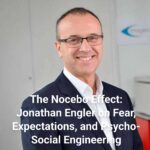

The Nocebo Effect: Can Fear and Negative Expectations Make Us Sicker?
What happens when fear becomes part of the treatment environment?
Can repeated warnings about disease, symptoms, danger, and uncertainty influence how people experience their own bodies?
And where is the line between legitimate public-health communication and messaging that unintentionally—or deliberately—creates a harmful psychological environment?
These questions sit at the center of Jonathan Engler’s recent work on the nocebo effect, public-health messaging, and the psychological consequences of fear.
Engler’s argument is not that illness is imaginary or that viruses do not exist. Rather, he asks a more uncomfortable question: How much of what people experience is shaped by the biological disease itself, and how much can be influenced by expectations, fear, social pressure, and the information environment surrounding it?
That question matters because the nocebo effect is a recognized phenomenon in medical research. Studies have found that negative expectations and contextual cues can contribute to real adverse symptoms and can affect treatment outcomes.
Table of Contents
What Is the Nocebo Effect?
The simplest way to understand the nocebo effect is to think of it as the negative counterpart of the placebo effect.
A placebo response can involve improvement associated with expectations, context, or treatment rituals beyond a treatment’s specific pharmacological action. A nocebo response moves in the opposite direction: negative expectations and contextual information can contribute to worsening symptoms or adverse experiences.
Researchers distinguish between the broader nocebo response and the more specific nocebo effect. The latter refers to the portion attributable to mechanisms such as expectation, conditioning, and observational learning.
This does not mean that symptoms are fake.
Pain, fatigue, nausea, itching, and other bodily experiences can be genuine even when psychological or contextual mechanisms contribute to them. A recent systematic review found that nocebo effects can be reliably induced across a range of somatic health outcomes, although the magnitude varies considerably between circumstances and individuals.
That distinction is crucial.
The mind is not necessarily creating an imaginary illness. Instead, expectations and emotional states can interact with the brain-body system in ways that influence what a person actually experiences.
Jonathan Engler’s COVID-19 Question
Engler entered the COVID era cautiously. As described in the interview, he initially accepted much of the conventional narrative before becoming increasingly concerned about the consequences of lockdowns and other interventions.
His focus eventually moved beyond individual policies to a larger question about how societies respond to perceived threats.
Engler became associated with PANDA, Pandemic Data and Analytics, and later co-chaired the UK-based HART group with Claire Craig. These groups brought together professionals who challenged various aspects of pandemic policy, including lockdowns, modeling, mandates, testing, and communication.
His central concern is the interaction between public policy, social psychology, medical expectations, and health outcomes.
This is where his interest in the nocebo effect becomes particularly important.
Fear Is Not Merely an Emotion
Fear can change behavior.
But the more interesting question is whether fear can also influence physical experience.
Research conducted during the COVID era provides reasons to take that question seriously.
One study examining people who had not tested positive for COVID-19 found that greater worry was associated with greater self-reported COVID-like symptoms, although the researchers emphasized that additional research was needed to isolate a true nocebo effect.
Another study found that certainty about being infected and anxiety were associated with increased reporting of COVID-like symptoms. The researchers reported that these factors explained a substantial proportion of the variance in symptom reporting in their sample.
A separate longitudinal study also examined whether beliefs about COVID could predict subsequent COVID-like symptoms, reflecting the broader scientific interest in expectations and symptom perception during the pandemic.
These findings do not prove that pandemic messaging caused particular illnesses.
They do, however, demonstrate why the psychological environment surrounding a disease deserves scientific attention.
The Information Environment Can Become Part of the Medical Environment
Traditional medicine often concentrates on the physical characteristics of disease.
But patients do not encounter diseases in a laboratory vacuum.
They encounter them through doctors, hospitals, family members, television, social media, government announcements, news headlines, warning labels, online searches, and conversations with friends.
All of these can influence expectations.
Research on nocebo phenomena specifically recognizes that information from clinicians, other patients, media, and the internet can contribute to negative expectations and adverse experiences.
That creates an important ethical problem.
Patients need accurate information about risks.
But communicating risk is not psychologically neutral.
If every headache becomes a potential neurological emergency, every cough becomes a potential catastrophe, and every ordinary bodily sensation is interpreted through the lens of severe disease, people may become hypervigilant about their bodies.
The result can be a feedback loop:
Warning → fear → heightened attention → symptom perception → greater fear → greater symptom attention.
Understanding that loop does not mean dismissing symptoms.
It means taking the patient’s psychological environment seriously.
The Pandemic and the Psychology of Risk
COVID-19 created an unusually intense information environment.
People were repeatedly exposed to statistics, death counts, infection numbers, risk warnings, changing guidance, images of overwhelmed hospitals, predictions of future waves, and messages emphasizing personal responsibility.
Some communication was undoubtedly necessary.
The difficult question is whether the cumulative effect of such messaging was always considered.
Engler’s argument is that public-health authorities should have been more attentive to the possibility that fear itself could become a health-related variable.
This is not an entirely fringe scientific concern.
A review of nocebo research found that the way information is presented can influence negative expectations, while experimental research has shown that negative suggestions and expectations can contribute to adverse outcomes.
The challenge is therefore not simply what information should people receive?
It is also:
How should that information be communicated?
Nocebo Does Not Mean “It’s All in Your Head”
This is one of the most important misconceptions to avoid.
Calling something a nocebo effect does not mean telling a patient, “Your symptoms aren’t real.”
Quite the opposite.
The symptoms can be completely real.
The scientific question concerns the mechanism producing or amplifying them.
Researchers describe nocebo responses as involving psychological and physiological processes associated with expectations, conditioning, learning, and contextual cues.
This is why the nocebo effect is relevant to modern medicine.
If expectations can worsen symptoms, then communication itself becomes part of clinical practice.
A physician does not merely prescribe a drug.
The physician also communicates a story about the drug.
A diagnosis is not merely a label.
It can also become a story about what the patient should expect from the future.
When Medicine Turns Risk Into Identity
Engler’s critique extends beyond COVID.
He questions what he sees as a broader tendency within modern medicine to transform increasingly large portions of ordinary human experience into medical problems.
This raises difficult questions.
When does normal variation become pathology?
When does temporary distress become a chronic condition?
When does identifying a risk help a person—and when does it cause that person to become preoccupied with the risk?
And when does a healthcare system begin creating incentives for people to see themselves primarily through diagnoses?
These are not questions that can be answered simply by declaring medicine either “good” or “bad.”
Modern medicine has produced extraordinary advances.
But medicine also has to confront the possibility that diagnostic labels, expectations, and treatment environments can influence how people experience health and illness.
That is one reason nocebo research matters.
The Nocebo Effect and Medical Communication
The implications extend directly into the doctor-patient relationship.
Imagine two patients receiving identical information.
One doctor says:
“This treatment has several possible side effects. Most people tolerate it well, and we’ll monitor you carefully.”
Another says:
“This treatment can cause severe problems. You could experience pain, nausea, dizziness, fatigue, headaches, and a number of other symptoms.”
Both physicians may technically be communicating risk.
But they are not necessarily communicating it in the same psychological environment.
Research has long suggested that the content and framing of medical information can influence expectations and adverse experiences.
This does not justify withholding information.
Patients have a right to informed consent.
Instead, it suggests that informed consent should also be intelligent communication.
The goal should be neither false reassurance nor unnecessary alarm.
It should be accurate information delivered in a way that preserves proportion.
Could Public Health Create a Nocebo Environment?
This is one of the most provocative questions raised by Engler’s perspective.
If negative expectations can influence symptoms, what happens when millions of people are simultaneously exposed to messages emphasizing danger?
The answer is not straightforward.
Public-health communication can save lives by encouraging appropriate behavior.
Fear can also sometimes motivate people to take genuine risks seriously.
But excessive fear can have costs.
The scientific literature does provide evidence that anxiety, worry, and negative expectations can be associated with greater symptom reporting, while also emphasizing that establishing causality in real-world pandemic populations is difficult.
That distinction should remain front and center.
It is reasonable to investigate whether messaging contributes to nocebo responses.
It is not reasonable to assume that every symptom reported during a pandemic was caused by fear.
The Evidence Is More Complicated Than the Debate
An important point often lost in polarized discussions is that nocebo research does not provide a universal explanation for illness.
For example, a 2024 study investigating whether confirmation of COVID-19 infection status was associated with subsequent Long COVID symptom reporting found no clear evidence of a strong nocebo effect in its cohort.
That finding matters.
It reminds us that scientific inquiry should not simply replace one simplistic narrative with another.
The proper question is not:
“Was COVID real, or was it psychological?”
Nor is it:
“Were all pandemic symptoms caused by fear?”
The better questions are more precise:
- Which symptoms are explained by biological infection?
- Which are influenced by expectation?
- How much does anxiety alter symptom perception?
- How does communication change treatment outcomes?
- Which interventions reduce harm?
- Which interventions create unintended harms?
- How should uncertainty be communicated?
These are empirical questions.
The Danger of a Self-Reinforcing Health Narrative
One of the deeper implications of the nocebo effect is that health narratives can become self-reinforcing.
A person hears that a condition is dangerous.
They become vigilant.
They notice sensations they previously ignored.
Those sensations reinforce their belief that something is wrong.
They seek more information.
The information increases their concern.
The cycle continues.
This does not mean the person is imagining everything.
It means that attention, expectation, interpretation, and physiology can interact.
That is precisely why the nocebo effect deserves more attention in medical education and public-health communication.
What Should We Learn From Jonathan Engler’s Argument?
Engler’s challenge ultimately goes beyond COVID.
It is a challenge to the assumption that health policy can be evaluated solely by looking at its intended biological effects.
Every intervention also has social and psychological consequences.
Lockdowns affect social connection.
Warnings affect anxiety.
Diagnoses affect identity.
Risk communication affects expectations.
Medical labels affect how people interpret symptoms.
And public-health messaging can influence the psychological environment in which people experience illness.
These effects deserve measurement.
They should not automatically be dismissed as irrelevant because they are difficult to quantify.
A Better Model of Health
Perhaps the most useful lesson from the nocebo effect is that human health cannot be reduced to either biology or psychology.
It is an interaction.
Biology matters.
Environment matters.
Behavior matters.
Expectations matter.
Social relationships matter.
Medical communication matters.
And the stories people hear about their health can sometimes become part of the health experience itself.
That does not mean doctors should stop warning patients about genuine risks.
It means that risk communication should be accurate, proportional, transparent, and psychologically informed.
Fear should not become a substitute for evidence.
And uncertainty should not automatically be converted into catastrophe.
Conclusion: The Power of Expectations
Jonathan Engler’s exploration of the nocebo effect raises an uncomfortable but important possibility: sometimes the attempt to protect people from disease can itself create psychological conditions that influence how people experience health.
The scientific literature supports the existence of nocebo phenomena. Negative expectations, conditioning, and contextual information can contribute to real adverse experiences, and research during COVID-19 provides evidence that worry and beliefs about infection were associated with symptom reporting.
But the evidence also cautions against overreach. Not every symptom is a nocebo, and nocebo research does not eliminate biological explanations for disease.
The real lesson is more nuanced.
What we believe about health can influence how we experience health—but beliefs are only one part of a much larger biological and social picture.
That makes the nocebo effect more than a medical curiosity.
It makes it a question about how doctors communicate, how governments communicate, how journalists communicate, and how societies respond to uncertainty.
And perhaps the most important question is this:
When we tell people what to fear, are we also telling their bodies what to expect?
Frequently Asked Questions
What is the nocebo effect?
The nocebo effect describes adverse health outcomes associated with negative expectations, contextual cues, conditioning, or other psychosocial mechanisms rather than the specific pharmacological action of a treatment.
Can the nocebo effect cause real symptoms?
Yes. Nocebo-related responses can involve genuine symptoms such as pain, nausea, fatigue, itching, and other unpleasant experiences. Research suggests these effects can occur through psychological and physiological mechanisms involving expectations and learning.
Is the nocebo effect the same as imagining an illness?
No. A nocebo response is not simply “imagining” symptoms. It describes measurable changes associated with expectations and contextual factors. The symptoms can be subjectively and physically real even when psychological mechanisms contribute to them.
Did COVID-19 messaging cause a nocebo effect?
Research has found associations between COVID-related worry, beliefs about infection, anxiety, and symptom reporting. However, determining how much of the symptom burden was specifically caused by a nocebo mechanism is more difficult, and the evidence does not support attributing all COVID-related symptoms to nocebo effects.
Who is Jonathan Engler?
Jonathan Engler is a British physician and commentator whose COVID-era work focused on pandemic policy, public-health communication, evidence, and the psychological effects of fear and expectations. In the interview, he discusses his involvement with PANDA and HART and his continuing interest in the nocebo effect.
Why does the nocebo effect matter in medicine?
It matters because communication and expectations can influence treatment experiences, symptom reporting, adherence, and perceptions of risk. Understanding these effects may help clinicians communicate risks honestly while reducing unnecessary negative expectations.
Related Resources
- Sanity Unleashed: Jonathan Engler’s writing and related discussions.
- PANDA: Pandemic Data and Analytics and Engler’s published work.
- https://pandata.org/author/dr-jonathan-engler/
- HART Group: Information about the organization’s contributors and work.
- Jonathan Engler on X: Updates and commentary from Engler.
Discover more from Randy Bock MD PC
Subscribe to get the latest posts sent to your email.