
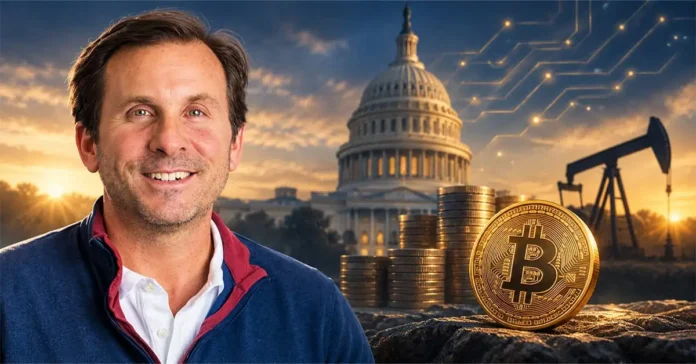
John Tamny likes to begin where conventional economics ends. The national debt approaches $40 trillion, yet Treasury markets do not behave as though the republic is approaching insolvency. Tamny treats that discrepancy as evidence. If lenders continue to finance Washington on ordinary terms, he asks why. His answer is that the federal government has taxing access to the richest people on earth. The debt therefore represents confidence in future tax extraction. For Tamny, the loss lies elsewhere: capital paid to Washington cannot finance the improbable company, strange invention, or founder who looks foolish until he does not.
That premise carries him into Silicon Valley. Venture capital finances uncertainty, and most of what it finances will fail. Tamny states the point without embarrassment: “They’re investing in the impossible.” The winners must be large enough to pay for the losers. This is also the basis of his defense of Elizabeth Holmes. He does not deny that Theranos failed; he rejects audacity itself as evidence of fraud. “Elizabeth Holmes’ only error was that she raised too much money in pursuit of her vision,” he says. I press the harder question, whether aspiration becomes fraud when a founder materially misrepresents what exists.
My own angel investments make the argument less abstract. Good pitches fail. Intelligent investors get seduced. Products run into regulatory barriers, capital shortages, technical problems, or facts nobody anticipated. A society that wants innovation must tolerate losses because discovery has no guaranteed route. Tamny extends that logic to taxation. Wealth is the pool from which speculative capital comes; taxation transfers part of that pool from people willing to fund uncertain futures to government, which generally purchases known goods and maintains known systems.
The difference becomes clearer in a hardware store. Years ago, bicycling behind the Iron Curtain in Hungary, I needed an ordinary nut and bolt. The shelves were nearly empty. The store had one crude box containing essentially one usable choice. There was no merchant racing to fill an unmet need. Tamny calls the anti-growth model “stasis.” Entrepreneurs look at what exists and ask how to replace it; bureaucracies are built to preserve what already exists. Growth, in this sense, means accumulating information about how to solve problems that remain unsolved.
From there, Tamny moves to oil, Venezuela, and American energy independence. He considers energy independence economically backward because productive countries can buy what others produce more cheaply. A nation does not become poorer by importing oil any more than a household becomes poorer because it does not drill its own well. He also rejects the usual account of OPEC’s pricing power. “The biggest driver of the price of oil is the value of the U.S. dollar,” he says, pointing to the volatility that followed the dollar’s break from gold in 1971.
That opens his broader monetary argument. Tamny says presidents have more influence over the dollar than economists admit; Treasury policy, exchange intervention, and presidential signaling matter. He praises the relative dollar stability of the Reagan and Clinton periods and argues that commodity inflation often begins with currency devaluation. His analogy is physical. A foot is a unit of length, not an asset whose value should float. Currency, he says, should serve as a stable measure of value in much the same way.
Bitcoin does not escape his criticism. Tamny calls it revolutionary technology and lousy money. Its fixed supply, usually presented as its virtue, leaves its purchasing power unstable when demand changes. He expects private digital money to matter, but successful currency will need a stable unit that people can use for contracts and prices. Private issuers, he argues, could face a discipline governments evade: devalue the unit and customers can leave.
He ends with another contrarian case, this time for California. His next book argues that the state’s high housing costs partly signal concentrated wealth and demand. He says elite talent continues to flow toward California, New York, and Massachusetts, while technology lets other residents seek cheaper housing elsewhere. The connecting idea across debt, Theranos, oil, money, and California is consistent. Tamny distrusts political narratives when prices, capital flows, and human ambition tell a different story. He wants markets taken seriously, especially when they make both parties uncomfortable.
Discover more from Randy Bock MD PC
Subscribe to get the latest posts sent to your email.