

The opioid crisis began before OxyContin. My case for restoring sobriety as the goal of treatment. Drs. Keith Ablow and Randy Bock are on the case.
When Keith Ablow asked me about the origins of America’s opioid crisis, I began with the treatment that the familiar history leaves out: methadone maintenance. My argument concerns what happens when medicine accepts continued dependence as its destination. In my own practice, I prescribed Suboxone with an endpoint. I wanted the patient to finish taking it and resume a life whose mornings did not begin with securing an opioid. As I put it: ‘And I had one, one direction, which was downward.
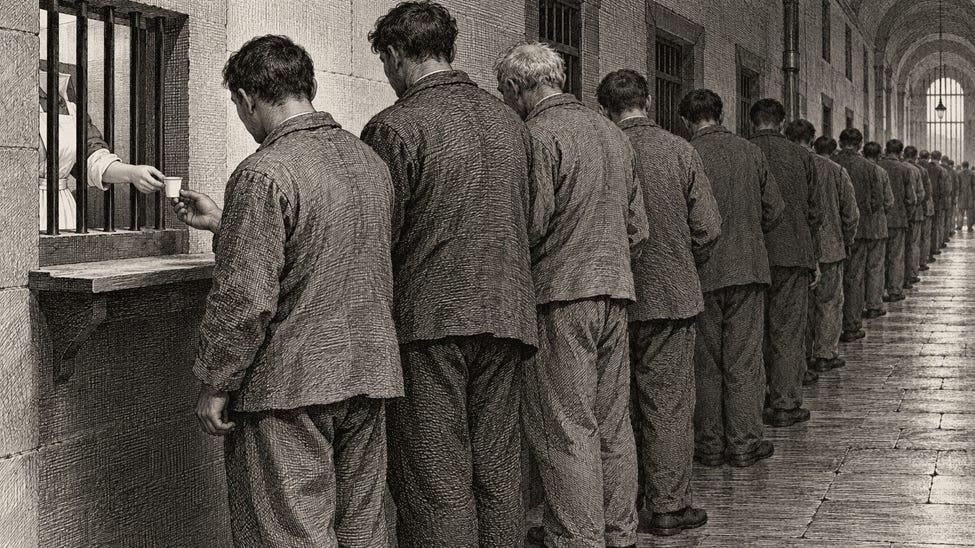
The usual account of America’s opioid crisis begins with prescription painkillers, moves to heroin, and ends with fentanyl. I argue that it leaves out the policy change that preceded those waves: methadone maintenance. In “Methadone Maintenance Ignited America’s Opioid Crisis,” I examine the earlier expansion of dependence and the medical decision to manage it indefinitely. The crisis’s history includes the institutions established to treat it.
My argument begins with a distinction between suppressing disruptive behavior and ending addiction. “The concept of methadone was to get people not from their addiction, but to get people from other behaviors.” A patient who no longer steals to buy heroin has made an improvement. Whether he has recovered is a separate question. The treatment’s stated purpose determines whether anyone keeps asking it.
New York’s heroin problem helped establish a national treatment model. In my historical account, fear of crime gave maintenance political appeal: supply the opioid legally, and the patient would have less reason to steal. I question what happened when that arrangement became an enduring medical system. The patient’s dependence could persist while the surrounding institutions counted his continued attendance as evidence of successful care.
I call that arrangement the methadone industrial complex. It does not require physicians to gather secretly and agree to harm patients. It requires a payment structure, a protected practice, and a doctrine that makes continued prescribing the expected outcome. The patient returns; the clinic receives payment. His becoming independent interrupts that revenue. Good intentions do not remove the incentive to define success as continued participation.
The selective treatment of Purdue Pharma belongs in this account. In “Empowered by the State, Condemned by the Crisis: The Purdue Paradox,” I examine the government’s promotion of broader pain treatment and its subsequent condemnation of a company operating within that environment. My objection concerns the selective assignment of responsibility. A corporate defendant makes a convenient target while government-supported maintenance escapes comparable scrutiny.
My own prescribing experience gave me a different objective. I used Suboxone for roughly eight years, with declining doses and an expectation of sobriety. “And it wasn’t for everybody, but people liked it. They managed to get off drugs completely.” That is a report of my practice, not a promise that every patient will follow the same timetable. It is evidence that some patients wanted an exit and used it.
Medication could help them approach that exit, but they needed something to live for afterward. “People need scaffolding. They need a kind of framework to get out from where they are.” Work, family, honest relationships, and obligations provide that framework. Recovery asks a patient to keep commitments when he feels discouraged. A physician’s helping him includes expecting conduct that makes those commitments possible.
Low expectations can make dependence seem like the patient’s natural condition. I described the result as “a gilded cage of methadone.” Its occupants may receive the necessities of life while losing the expectation that they can build one themselves. “You’re going to give them everything to look like a life,” I said. “You cannot fool people.” They know the difference between being supplied and achieving something.
I would change the system gradually, with attention to the people whose routines and relationships have formed around it. “You would have to taper people off. You’d have to give them time.” Ending maintenance requires helping patients establish another way of living.
Keith brought the psychiatric consequence into focus. He compared excessive protection to a mother’s encouraging her anxious child to remain in the basement, where she would care for him indefinitely. The child avoids immediate distress but remains afraid of the world. Keith’s question applies directly to addiction treatment: does our care help a patient gain strength, or does it make his dependence permanent? By the end, he favored a gradual change: ‘It’s going to be more work to do the right thing. But isn’t that always the case?
That work belongs within medicine. “Doctor is a teacher,” I said. “He’s not a wizard.” We can help patients develop capacities they have ceased to trust. A painful beginning does not settle the outcome: “People who grow up without love, it is a sad, sad situation. But that does not consign them to a life without love.”
Discover more from Randy Bock MD PC
Subscribe to get the latest posts sent to your email.