
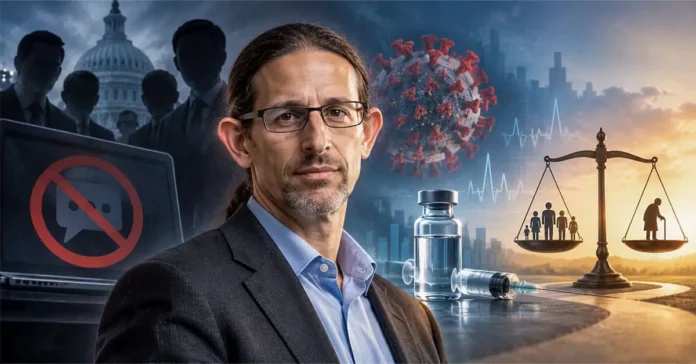
February 2023, MIT professor Retsef Levi called for the suspension of COVID-19 vaccination. The position sounded inflammatory because public-health authorities had placed the vaccines beyond ordinary scientific dispute. Levi’s argument was less radical than the response to it; he asked that a medical product be judged by its demonstrated benefits, known injuries, unresolved safety signals, and the different risks faced by different patients.
Levi brought an unusual background to the question. He was a professor of operations management whose work included health-care analytics, biologic manufacturing, and risk management; before entering academia, he had served for nearly 12 years as an Israeli military intelligence officer. He studied systems in which weak signals can precede serious failure, and in which waiting for conclusive proof may become its own dangerous decision.
He had initially trusted the vaccine approval process. The speed of development surprised him, but he assumed that the Food and Drug Administration had accepted no fundamental compromise. His confidence weakened as myocarditis appeared, repeated boosters became policy, and each original claim retreated under pressure from events. As Levi put it, “The advertised and promised paradigms of what efficacy and safety of these vaccines have completely collapsed.”
The vaccines had been promoted as a means of stopping infection and producing vaccine-induced herd immunity. They did neither. Levi explained that an injected vaccine, which generated antibodies mainly in the blood, had little prospect of providing durable sterilizing immunity at the mucosal surface where a respiratory virus enters and spreads. The virus also changed faster than manufacturers could reformulate, test, produce, and distribute updated doses. “I think that by now it’s clear that that’s been a false prophecy,” he said.
The final defense concerned severe disease and death. Levi cited Joseph Fraiman and his colleagues’ reanalysis of the Pfizer and Moderna randomized trials, which found more serious adverse events among vaccine recipients than among placebo recipients. The analysis did not establish every possible effect of vaccination; it did challenge the claim that the trials had demonstrated a favorable balance of serious benefit and serious harm across the general population.
Levi then examined emergency-medical-service data from Israel. He and his colleagues found a 25 percent increase in cardiac-arrest calls among people aged 16 to 39 during the first half of 2021, when Israel conducted its mass-vaccination campaign. No comparable increase had appeared during 2020. He did not present temporal correlation as proof of causation; he called for health authorities to test the signal against individual vaccination records, infection histories, clinical findings, and autopsies. “This was dismissed and was not followed through,” he said.
Studies from Thailand and Switzerland supplied another warning. Researchers measured cardiac indicators before and after vaccination and found elevated troponin in a proportion of recipients far greater than the reported incidence of clinically recognized myocarditis. A patient can sustain myocardial inflammation without dramatic symptoms; an apparently healthy young man may then exercise while carrying an unrecognized cardiac injury. Levi considered repeated dosing a renewed exposure to that risk. “Every time you take this vaccine, every dose, it’s basically a Russian roulette,” he said.
The institutional answer was censorship. YouTube effectively destroyed my channel after I published the interview; LinkedIn expelled me. Neither platform conducted the investigation Levi had requested. The platforms instead enforced a transient orthodoxy whose boundaries were established by institutions that were themselves withholding data, revising claims, and avoiding the necessary comparison of risks.
Within weeks, official policy began moving toward Levi’s risk-stratified position. In March 2023, the World Health Organization placed healthy children and adolescents in its low-priority group. WHO advised countries to consider disease burden, cost-effectiveness, competing health priorities, and opportunity costs before vaccinating them. The change did not amount to WHO’s accepting every element of Levi’s safety argument; it did abandon the premise that every healthy child required the same intervention.
The central failure concerned medicine’s replacing judgment with command. An elderly man with diabetes and pulmonary disease did not face the same COVID-19 risk as a healthy child; previous infection, age, sex, comorbidities, and personal preference all mattered. Public health compressed those differences into one instruction, while physicians were encouraged to treat compliance as a clinical virtue. Levi described the result plainly: “We basically broke maybe one of the most sacred principles of effective medicine, which is the autonomy of the doctor and the patient.”
The consequences reached beyond one product. Institutions demanded trust while concealing uncertainty, minimizing injury, and punishing questions that should have initiated research. Such conduct threatened confidence in vaccines with established records of benefit because the public could see that the word “vaccine” had become a political category instead of a scientific one. Each product still required its own evidence, indication, risk calculation, and patient.
In June 2025, Levi became a voting member of the CDC’s Advisory Committee on Immunization Practices. The same federal structure that had once treated his position as marginal now gave him a seat on the committee that evaluates American vaccine policy. That appointment did not settle every scientific question; it exposed the folly of treating unsettled questions as punishable speech.
Levi estimated that undoing the damage would take 10 to 15 years. Repair will require more than changing recommendations; medicine must recover the habit of admitting uncertainty before certainty becomes impossible to maintain.
Discover more from Randy Bock MD PC
Subscribe to get the latest posts sent to your email.