

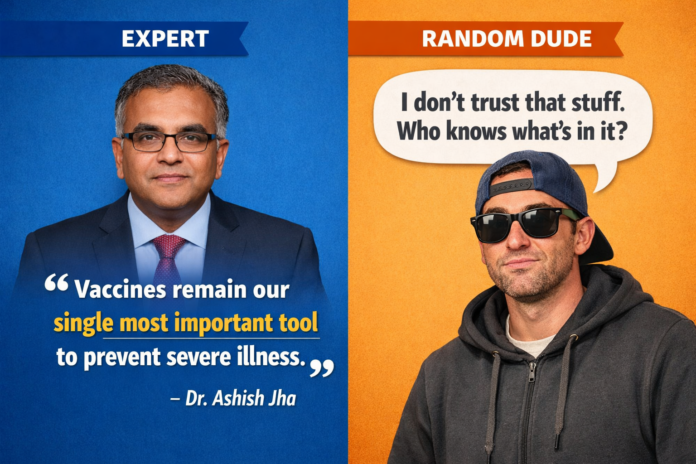
When Dr. Ashish Jha, a Harvard School of Public Health physician and Biden administration COVID-19 response team member, posed the question “Who are you going to listen to—the government public health apparatus, physicians, or just some random dude on Twitter?”—he assumed the answer was obvious. But was it?
As we look back at the pandemic response, an uncomfortable truth emerges: many of those “random dudes” asking reasonable questions were ignored, while much of the medical hierarchy and academia marched in lockstep with policies that made little physical or medical sense at the time—or now.
This is the story of how credentials don’t always equal correctness, and why questioning authority in medicine isn’t just acceptable—it’s essential.
Table of Contents
The Nicaragua Nobody Wanted You to Know About
Let’s start with an inconvenient truth that disappeared from most media coverage: Nicaragua’s COVID victory.
When COVID-19 arrived in 2020, Nicaraguan President Daniel Ortega faced a harsh reality. As Latin America’s third-poorest country, three-quarters of jobs existed in the informal economy. If people didn’t work, they didn’t eat. Shutting down the economy would mean starvation.
So Nicaragua took a different path. No lockdowns. No economic shutdowns. The economy kept moving.
The Western press responded with predictable outrage. The BBC, New York Times, and The Guardian lobbed criticism, questioning where Ortega had disappeared to, implying disaster was imminent. Yet Nicaragua did no worse—and frankly better—than most Latin American neighbors who implemented strict lockdowns.
Honduras, with its militarized quarantine, saw police violence, over 1,000 arrests, and vehicle confiscations according to human rights organizations. Both Honduras and El Salvador had higher recorded infection levels than Nicaragua despite their draconian measures.
Meanwhile, Nicaragua’s economy recovered swiftly from the pandemic, with GDP growing 10% in 2021—better than other Latin American countries that endured far more upheaval.
Here’s the most telling detail: Nicaragua isn’t even listed on Worldometer’s COVID tracking anymore. The story simply vanished because it didn’t fit the approved narrative.
When Expert Predictions Missed by a Factor of Ten
Remember Neil Ferguson from Imperial College London? His pandemic death predictions, which heavily influenced Boris Johnson’s lockdown decisions, were off by roughly an order of magnitude—ten times too high.
Many policy proposals were formulated under blanket misapprehension of the actual dangers. The virus unfortunately unleashed itself in perhaps the worst spots to study its true nature: New York City’s diverse Queens borough where communities don’t communicate extensively, and elderly-skewed regions like Bergamo outside Milan.
These initial observations skewed global policy for years, even as contradictory evidence mounted.
The Absurdities We Were Told to Accept
Let’s catalog some pandemic policies that came from credentialed experts, not “random dudes”:
- Police arresting a solo paddleboarder in the ocean, away from all humans
- Officers pursuing a lone saxophone player outdoors
- Governor Whitmer banning people from certain supermarket aisles—you could buy food but not seeds or flowers
- NFL player Cole Beasley, unvaccinated, forced to quarantine after testing negative because he contacted a fully vaccinated teammate who had the virus
- Public health advice from Toronto recommending glory holes for safer sex during COVID-19
- Spending $100 million to convert convention centers into field hospitals that were never used
- Bulldozing skate parks with sand to make them unusable
- Closing outdoor playgrounds and parks
These weren’t suggestions from random internet commenters. These were official policies from credentialed public health authorities.
The Omicron Problem Nobody Wants to Acknowledge
Here’s what the “random dudes” recognized that official channels still won’t admit: Omicron is not COVID-19.
Omicron’s genetic sequence looks so different from other COVID-19 variants that experts call it an “orphan”—it’s not directly related to the original strain or other Greek letter variants. It exists in the same way many common colds existed prior.
Coronavirus has always been part of the common cold complex. We’ve never had vaccines for the common cold, and we’ve never vaccinated people after infection for respiratory viruses that have already circulated widely.
Yet the current bivalent vaccine contains two components:
- One for original COVID-19, which doesn’t exist anywhere on earth except possibly in laboratories
- One for Omicron strains, which represent a common cold-level threat
Even new studies show the bivalent booster protecting against both the original virus and Omicron variants is not significantly better than its predecessor. More importantly, the predecessor wasn’t doing much at all against current strains, which makes perfect sense—the original SARS-CoV-2 is no longer circulating.
Dr. Jha’s Misleading Claim About Vaccine Protection
Dr. Jha stated: “If you’re up to date with your vaccines and get treated if you have a breakthrough infection, your risk of dying from COVID is now close to zero.”
This is a red herring. Your chance of dying from Omicron is basically zero anyway, regardless of vaccination status, especially if you’re not elderly or severely immunocompromised.
This type of statement creates false attribution—implying the vaccine created the protection when the virus itself became less dangerous.
The Financial Incentives Nobody Questions
Before 2020, Moderna’s stock price sat at $14. During the COVID pandemic and vaccine push, it reached $430—a 30-fold increase. It’s since come down but remains dramatically elevated.
Pfizer also did exceptionally well during the pandemic phase and received another boost from the new booster rollout.
These financial incentives don’t automatically mean the science is wrong, but they’re relevant context that credentialed experts rarely acknowledge when pushing vaccine recommendations.
Dr. Jha’s Pin Tweet and Hospital Claims
Dr. Jha’s pinned tweet from January 2022 asks: “If you are vaccinated and boosted, why should you care what others do? Because we all need a functioning healthcare system. Vaccines keep hospitals from becoming dysfunctional during a surge.”
Is this true?
In 2020, the year without vaccines, hospitals were never systemically overloaded. Yes, Queens had initial stress in early 2020, but beyond that, the “two weeks to slow the spread” that turned into two years never resulted in the hospital collapse we were told vaccines would prevent.
Healthcare workers who got sick during 2020 developed natural immunity—which has always been fuller and more robust than vaccine-based immunity. Yet when vaccines arrived, healthcare workers who didn’t want vaccination on top of natural immunity were fired from hospitals and the military.
The logic doesn’t hold. If we needed a functioning healthcare system, why fire experienced immune workers?
The Mask Mandate Recommendation in November 2022
An HHS-authorized report from November 2022 recommended the return of mask mandates and social distancing. For what? For why?
This recommendation supposedly aimed to prevent “long COVID,” despite ongoing debates about that condition’s definition and prevalence. We’ve had long-term post-illness syndromes for years—chronic mononucleosis, fibromyalgia, chronic fatigue syndrome. Every era has its chronic syndrome.
How can anyone definitively know about “long COVID” when COVID-19 hasn’t been around long enough to establish long-term patterns, and people experienced significant depression and isolation during lockdowns that could explain many symptoms?
When Credentials Became Political Requirements
Dr. Jha’s 2020 interview revealed something interesting about his background and current positioning. He described his New Jersey high school as “perfectly frank, racist” and said he was “very confused because I felt like I should be ashamed of being an Indian.”
Yet the facts tell a different story. He arrived in New Jersey at age 14 in 1984. By graduation in 1988, he had become:
- Editor-in-chief of the school newspaper
- Valedictorian of his class
- Admitted to Columbia University
For someone supposedly facing institutional racism, he thrived remarkably well. His family chose to come to Canada, then chose the United States over Canada, then chose New Jersey. He excelled academically and in leadership positions.
This isn’t to dismiss any individual experiences of prejudice—teenagers can certainly be cruel. But the narrative of systemic oppression doesn’t match the objective outcomes.
Why mention this? Because for political appointees in the current environment, there seems to be a required dog whistle—an acknowledgment of institutional racism and victimhood that must be signaled to obtain certain positions.
This matters because it suggests that political loyalty and narrative adherence may matter more than scientific accuracy in these appointments.
What Fauci Said in 2004 vs. What He Says Now
In 2004, Dr. Fauci stated about someone who had the flu for 14 days: “She’s as protected as anybody can be because the best vaccination is getting infected yourself. If she really has the flu, she definitely doesn’t need a flu vaccine. The most potent vaccination is getting infected yourself.”
Reuters attempted to fact-check this quote, claiming it doesn’t contradict Fauci’s current pandemic stance recommending vaccination after infection.
This is absurd. The contradiction is crystal clear. In 2004, Fauci acknowledged natural immunity as superior. In 2020-2022, he advocated vaccination regardless of prior infection.
Dr. Jha is doing exactly the same thing. He should go back and listen to that 2004 statement from “that random dude Dr. Fauci.”
Who Actually Got It Right?
When we examine the pandemic response honestly, many credentialed experts got major decisions catastrophically wrong:
- Lockdowns that destroyed economies without stopping viral spread
- School closures that devastated children’s development and learning
- Mask mandates without solid evidence of effectiveness
- Firing healthcare workers with natural immunity
- Vaccine mandates for people who already had COVID-19
- Ignoring natural immunity in policy decisions
- Suppressing early treatment discussions
- Censoring dissenting scientific voices
Meanwhile, many “random dudes” on Twitter correctly argued:
- Natural immunity is robust and long-lasting
- Lockdowns would cause more harm than benefit
- Children were at minimal risk
- Outdoor transmission was negligible
- The virus would become endemic regardless of interventions
- Vaccine mandates for the previously infected made no sense
The Random Dude Versus the Expert
So who should you trust with your medical advice? The question itself is flawed.
You shouldn’t blindly trust either credentialed experts or random internet commenters. You should evaluate arguments on their merit, examine the evidence, consider the incentives, and make informed decisions.
Credentials establish a baseline of knowledge but don’t guarantee correct analysis, especially when political pressures, financial incentives, and career considerations enter the equation.
Some of the best pandemic analysis came from credentialed scientists who were smeared as “random dudes” because they challenged the official narrative. Dr. Jay Bhattacharya of Stanford, for instance, was vilified for the Great Barrington Declaration, which advocated focused protection instead of lockdowns—a position that looks increasingly vindicated by evidence.
The Lesson Moving Forward
The pandemic revealed something crucial about modern medicine and public health: institutional credibility and individual expertise aren’t the same thing.
Institutions can be captured by politics, groupthink, and financial interests. Individual experts can be correct even when they contradict institutional consensus.
The solution isn’t to reject expertise—it’s to demand that experts actually engage with evidence and arguments rather than dismissing critics as “random dudes.”
When Dr. Jha poses the choice as “America’s physicians or some random dude on Twitter,” he’s creating a false dichotomy. Many of those random dudes ARE physicians, epidemiologists, statisticians, and scientists. They just happen to disagree with his policy preferences.
If Dr. Jha believes his positions are correct, he should defend them with evidence and logic, not credentials and authority. The invitation stands for him or any other public health official to debate these issues openly.
A Random Dude’s Thanksgiving Message
As this random dude wishes you a Happy Thanksgiving, here’s what we should be thankful for: the virus turned out to be far less dangerous than the worst predictions, and despite catastrophic policy errors, humanity survived.
We should also be thankful for the random dudes who asked difficult questions, challenged flawed policies, and refused to accept arguments from authority when the evidence pointed elsewhere.
Credentials matter. Experience matters. But truth matters most.
And sometimes the random dude asking uncomfortable questions is closer to the truth than the credentialed expert defending indefensible policies.
The question isn’t whether you trust the random dude or the expert. The question is whether you’re willing to think critically about evidence regardless of who presents it.
That’s not just good medicine—it’s good citizenship.
ADDITIONAL RESOURCES MENTIONED
– Book: “Overturning Zika: The Pandemic That Never Was” by Dr. Randall Bock
– Follow on Twitter and platforms at RandyBock.com
– Join the conversation at Viral Conversation on Facebook
AUTHOR BIO
Dr. Randall Bock is a family physician, medical writer, and author of “Overturning Zika: The Pandemic That Never Was.” His work examines public health policy, pandemic response, and medical decision-making. Despite being labeled a “random dude” by some public health officials, his analysis has been cited by Stanford Professor Dr. Jay Bhattacharya and published in peer-reviewed medical journals.
Reference’s
https://unherd.com/2022/11/nicaraguas-inconvenient-covid-victory/
https://nypost.com/2022/11/16/why-im-hoping-for-another-covid-lockdown/
Discover more from Randy Bock MD PC
Subscribe to get the latest posts sent to your email.