

What if the real measure of addiction recovery wasn’t how long someone remained in treatment, but whether they eventually became capable of living independently?
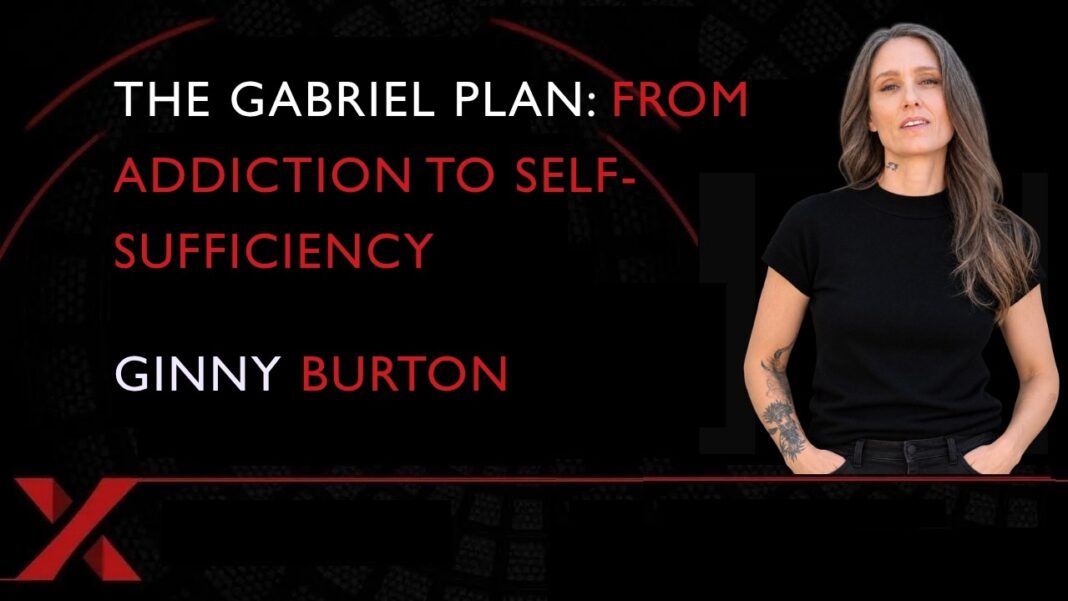
That question lies at the heart of an extraordinary conversation with Ginny Burton, author of The Gabriel Plan: 10 Points to Recover Our Nation. Her story challenges conventional assumptions about addiction, incarceration, rehabilitation, and the institutions responsible for helping people rebuild their lives.
Burton’s journey began in childhood. By seven, she had been exposed to drugs. By twelve, she was using hard street drugs, and by fourteen, she was smoking crack cocaine. Her life became consumed by addiction, criminal activity, incarceration, and the destruction of important family relationships.
Today, nearly fourteen years removed from her last period of active addiction, Burton works inside correctional facilities teaching people how to change the patterns of thinking and behavior that contributed to their destructive lives.
Her central argument is straightforward but controversial: Addiction recovery should be about developing personal agency, accountability, stability, and self-sufficiency—not simply managing someone’s dependence indefinitely.
A Childhood That Became a Lifetime of Addiction
Burton describes growing up in a family affected by addiction. Her father went to prison when she was four, and her relationship with drugs began when she was just seven years old.
Interestingly, she had tested as gifted at the age of three and loved learning. But intellectual ability offered little protection against the environment in which she was raised.
Seeking acceptance and love, she followed the behavioral patterns modeled around her.
By twelve, she was using hard street narcotics. At fourteen, she was smoking crack cocaine. Her own involvement with incarceration began around the same period.
For more than three decades, the pursuit of drugs increasingly dominated her existence.
She describes the experience without attempting to excuse her actions. Her addiction affected not only herself but also her children, family members, and other people who became victims of her behavior.
Her children eventually entered the system because she could not provide the care they needed.
As Burton explains, she became someone she had never intended to become.
The distinction matters. Her story is not simply about someone making bad decisions. It is about how destructive environments, learned behavior, psychological dependence, and repeated patterns can combine to shape an entire life.
She eventually recognized that changing her circumstances required more than simply stopping drug use.
It required changing the person she had become.
The Turning Point: Incarceration and the Space for Clarity
At forty, Burton faced her fourth prison sentence. This time, however, something was different.
She says she was seeking death when her arrest interrupted the course of her life.
Looking back, she identifies incarceration as the event that repeatedly created an opportunity to reconsider her behavior.
Her explanation is unusual:
“Incarceration creates a separation which creates a space of clarity.”
Burton argues that prison removed her from the environment she had been unable to manage independently. For the first time, she had an opportunity to examine her thoughts, internal messages, motivations, and habits without the constant pressures of the world in which she had been living.
But she makes an important distinction: incarceration itself did not teach her how to rebuild her life.
Earlier prison sentences had interrupted her destructive behavior, but when she returned to familiar surroundings, she often returned to familiar patterns.
The missing ingredient was instruction.
Separation created the opportunity for change. Learning what to do with that opportunity made change possible.
This distinction is central to her philosophy of addiction recovery.
A temporary interruption is not the same as rehabilitation. Removing someone from a destructive environment may create clarity, but that person still needs the skills, knowledge, and personal discipline necessary to build a different life.
From Addiction Treatment to a Program for Change
Today, Burton takes the lessons from her experience into correctional facilities, where she teaches people to examine and change the internal processes that organize their behavior.
She is careful about how she describes her work.
She does not call it a conventional treatment program. She calls it a change program.
The objective is to teach people how to choose differently and develop lives they actually want to live.
Her approach emphasizes several areas:
- Examining destructive thought patterns and internal messaging.
- Understanding the relationship between environment and behavior.
- Developing personal accountability.
- Learning to navigate difficult circumstances without returning to destructive habits.
- Building stability and self-sufficiency.
- Restoring family relationships and meaningful community connections.
The emphasis is on developing the individual rather than simply managing the symptoms of addiction.
Burton believes people need to understand why they repeatedly make destructive choices and acquire the ability to respond differently.
Her experience also informs her criticism of systems that measure success primarily through continued participation in services.
For her, a successful recovery should eventually make the individual less dependent on institutional intervention.
The Problem With Perpetual Addiction Treatment
One of the most contentious parts of the interview concerns the modern addiction treatment industry.
Burton questions the increasing emphasis on long-term management, particularly when medication and continuing treatment become the central components of a person’s recovery.
She argues that the system can become more concerned with maintaining participation than helping people develop the capacity to leave it.
This raises an important question:
If someone remains dependent on a treatment system indefinitely, has that system accomplished everything it should?
Burton believes the focus should shift toward outcomes such as personal stability, independence, responsibility, and the ability to function outside institutional support.
She also expresses concern about the growing role of pharmaceutical interventions in detoxification and addiction treatment.
Her preferred model begins with appropriate detoxification and individualized assessment. She supports using pharmaceutical interventions when appropriate to help someone through the initial stages of withdrawal, but advocates an abstinence-based approach as the broader objective of her program.
It is important to distinguish her position from a claim that every medication or treatment approach is inappropriate. Medication decisions require individualized medical assessment, and some people benefit substantially from evidence-based medication treatment.
The larger question she raises is whether treatment programs have a meaningful plan for helping people build lives beyond their initial intervention.
Treatment should have a destination.
The Difference Between Harm Reduction and Human Flourishing
Burton and host Randy Bock discuss the growing influence of harm reduction and medication-assisted treatment.
Their disagreement with aspects of these approaches centers on a philosophical question: Are we helping people escape destructive behavior, or are we primarily making it possible for them to continue living within it?
Burton believes that people must sometimes experience the consequences of their choices to develop the motivation and capacity to change.
She argues that removing every uncomfortable consequence can interfere with learning and personal responsibility.
This is not an argument that people should be abandoned, denied medical care, or exposed to unnecessary suffering.
Rather, it challenges the assumption that making someone more comfortable necessarily means making that person’s life better.
The conversation highlights a distinction between reducing immediate harm and achieving longer-term recovery.
Those objectives do not have to be mutually exclusive. But Burton believes the treatment system must be judged by whether it ultimately helps people develop agency and independence.
For someone whose entire life has revolved around obtaining drugs, simply changing the circumstances of drug use may not address the deeper behavioral and personal problems.
The goal should be more than survival.
It should be the ability to build a meaningful life.
A Conspiracy of Interests or a System of Institutional Incentives?
Another major theme of the interview is the financial structure surrounding addiction treatment.
Burton is particularly concerned about the pharmaceutical industry, treatment providers, insurance companies, and other organizations that participate in the addiction treatment economy.
She describes experiences that led her to believe that some industry participants deliberately pursue the expansion of medication-based treatment.
Bock offers a related but somewhat different interpretation: a system does not necessarily require a coordinated conspiracy to produce harmful outcomes.
He describes it as a “conspiracy of interests.”
Different organizations can pursue their own financial or institutional objectives. Pharmaceutical companies seek customers, providers seek revenue, insurers establish reimbursement structures, and government agencies develop programs.
Each participant may have its own incentives.
The combined result, however, can be a system that rewards continued participation without adequately rewarding successful independence.
This distinction is important.
One does not need to prove that every organization is deliberately working against recovery to ask whether the incentives of the system are aligned with the interests of the people it serves.
The most important question becomes:
Does the treatment provider have an incentive to help the patient become independent, or does its business model depend on continued dependence?
Burton wants to create an alternative environment in which institutions can benefit financially from human flourishing rather than human decline.
Her argument is that strengthening individuals at the bottom of society can eventually change the market itself.
When people become stable and self-sufficient, their needs and choices change. Institutions must respond to those changes.
Why Lived Experience Matters in Addiction Recovery
Burton also challenges the way institutions use the term “lived experience.”
She believes experience should mean more than having personally encountered addiction, homelessness, or poverty.
The important distinction is between experiencing a problem and understanding how to overcome it.
She gives an example involving poverty.
If an organization wants to develop a program to help people escape poverty, is it enough to consult people who are currently experiencing poverty?
Burton argues that the people who have successfully escaped poverty have knowledge that those still trapped in it may not yet possess.
The same principle applies to addiction recovery.
Someone who has experienced addiction may understand its realities. But someone who has successfully rebuilt a life after addiction can also offer practical knowledge about the process of change.
This does not mean professional education is irrelevant or that everyone with lived experience has the same expertise.
It means effective programs should combine professional knowledge with the practical wisdom of people who have successfully navigated the journey.
Burton believes the people developing recovery programs must understand not only the problem but also the pathway out.
The Gabriel Plan: Ten Points to Recover Our Nation
Burton’s book, The Gabriel Plan: 10 Points to Recover Our Nation, expands these ideas beyond addiction treatment.
Her vision concerns how institutions throughout society should approach people who are struggling.
Rather than building systems around perpetual dependency, she wants institutions to educate, equip, and stabilize individuals so they can become the strongest versions of themselves.
Several principles emerge from her discussion.
1. Personal accountability
Accountability should not be understood exclusively as punishment. Burton describes it as a system of checks and balances that should operate at every level of society.
2. Individual stability
People need the internal and external resources required to navigate life without continually returning to destructive patterns.
3. Education and instruction
Creating separation from a destructive environment is not enough. People need practical instruction about how to live differently.
4. Self-sufficiency
The objective should be to develop people who can take responsibility for their lives rather than remain permanently dependent on services.
5. Family reunification
Recovery should help individuals restore meaningful relationships and rebuild the family connections damaged by addiction and destructive behavior.
6. Community safety
Stable individuals and stronger families contribute to safer, healthier communities.
7. Experienced leadership
People who have successfully overcome the challenges being addressed should have meaningful roles in developing solutions.
The broader argument is that social institutions should be measured by the improvements they produce in people’s lives, not simply by the size of their budgets or the number of people enrolled in their programs.
Burton believes society has the resources to do better.
What is missing, in her view, is a commitment to outcomes that prioritize human flourishing.
Rethinking Addiction Recovery: What Should Success Look Like?
The conversation between Burton and Bock raises questions that extend well beyond one woman’s experience.
What should success in addiction treatment actually mean?
Is it the number of people enrolled in treatment programs? The number of prescriptions written? The number of treatment facilities operating? Or should success be measured by whether people are rebuilding their lives?
These are not necessarily competing measures, but they are not interchangeable.
A person can receive services without becoming more capable of managing life independently.
Likewise, someone can experience meaningful progress even when that progress does not fit neatly into an institutional measurement system.
Burton’s approach challenges policymakers, treatment providers, and social service organizations to think more seriously about the destination of their interventions.
She advocates individualized assessment, appropriate detoxification, an abstinence-based recovery philosophy, practical instruction, and the involvement of people who understand how to move beyond addiction.
Her position is controversial, particularly where it challenges established approaches to medication-assisted treatment. Nevertheless, the underlying question deserves serious consideration:
Are we building systems that help people recover, or systems that simply manage their problems?
From Prison to Purpose: Ginny Burton’s Message
Perhaps the most compelling aspect of Burton’s story is that she does not present herself as someone who was simply rescued by an institution.
She acknowledges the damage she caused, the people she hurt, and the responsibilities she failed to meet.
She also recognizes that incarceration repeatedly separated her from the environment in which she was destroying herself.
But she does not believe separation alone is a solution.
She had to learn how to think differently, make different choices, and construct a life that no longer revolved around drugs.
Today, she uses those lessons to help others.
Her work represents an attempt to turn personal experience into practical instruction and to challenge institutions to reconsider what they are trying to accomplish.
The Gabriel Plan is ultimately about more than addiction. It is about the relationship between individuals and the systems designed to serve them.
Burton wants those systems to produce people who are stronger, more stable, more responsible, and more capable of living independently.
That is a different standard of success from simply keeping people enrolled in services.
And it is a question worth asking of every institution that claims to exist to help.
The ultimate measure of addiction recovery should not be how successfully a system manages someone’s dependency. It should be whether that person eventually develops the ability to live a self-sufficient, meaningful, and responsible life.
About Ginny Burton
Ginny Burton is the author of The Gabriel Plan: 10 Points to Recover Our Nation and an advocate for personal accountability, addiction recovery, and institutional reform. Drawing on her own experience with addiction and incarceration, she works with people in correctional facilities to help them develop the skills and perspectives needed to build more stable lives.
Learn more about Ginny Burton:
- Official website: https://www.vginnyburton.com/
- Contact: https://www.vginnyburton.com/contact
- Substack: https://ginnyburton.substack.com/
- Organization: https://o-ut.org/
Frequently Asked Questions (FAQs)
1. What is the Gabriel Plan?
The Gabriel Plan is Ginny Burton’s framework for improving how society addresses addiction, poverty, incarceration, and other social problems. Its central objective is to help individuals develop stability, accountability, personal agency, and self-sufficiency.
2. Who is Ginny Burton?
Ginny Burton is an addiction recovery advocate, author, and educator who overcame decades of addiction and incarceration. She now teaches people in correctional facilities how to change destructive thought patterns and develop more stable lives.
3. What does Ginny Burton believe is missing from addiction treatment?
Burton believes many treatment approaches emphasize ongoing management without adequately teaching people how to develop independence. She advocates practical instruction, personal accountability, individualized assessment, and a focus on long-term self-sufficiency.
4. Why does Ginny Burton emphasize incarceration in her recovery story?
Burton explains that incarceration repeatedly separated her from the environment in which she was using drugs. That separation created an opportunity for clarity and reflection. However, she emphasizes that instruction and behavioral change were necessary to make that opportunity meaningful.
5. What is the difference between addiction treatment and a change program?
Traditional treatment programs can focus on managing substance use and providing ongoing services. Burton describes her approach as a change program because it emphasizes changing thought patterns, behavior, decision-making, and personal responsibility so individuals can build independent lives.
Discover more from Randy Bock MD PC
Subscribe to get the latest posts sent to your email.