


What if the biggest problem in addiction treatment isn't a lack of medication, but a lack of meaningful choices?
That question lies at the heart of a conversation with Percy Menzies, a pharmacist and founder of Assisted Recovery Centers of America (ARCA) in St. Louis, Missouri.

Menzies argues that the conventional approach to opioid addiction has placed too much emphasis on a limited set of treatment pathways while giving insufficient attention to withdrawal management, relapse prevention, patient choice, and the social conditions necessary for recovery.
His argument is particularly focused on the role of naltrexone, a medication that blocks opioid effects and can help prevent a return to opioid use after a patient has completed the necessary withdrawal process.
He does not argue that methadone and buprenorphine have no place in treatment. Instead, he questions whether patients are being offered enough alternatives and whether treatment systems place sufficient emphasis on helping people build lives beyond addiction.
For Menzies, the ultimate goal should be more than stabilizing drug use. It should be helping people recover their independence, relationships, purpose, and ability to find satisfaction in ordinary life.
Table of Contents
1. Opioid Addiction Treatment: Are Patients Being Given Enough Choices?
When someone arrives at a treatment center while actively using opioids such as heroin or fentanyl, the immediate challenge is often managing withdrawal, cravings, and the risks associated with continued use.
Methadone and buprenorphine are established medications used to treat opioid use disorder. They can reduce withdrawal symptoms and cravings, help stabilize patients, and reduce the risks associated with ongoing illicit opioid use.
Menzies questions why these medications can appear to dominate the treatment conversation while naltrexone receives less attention.
The distinction matters because these medications work differently.
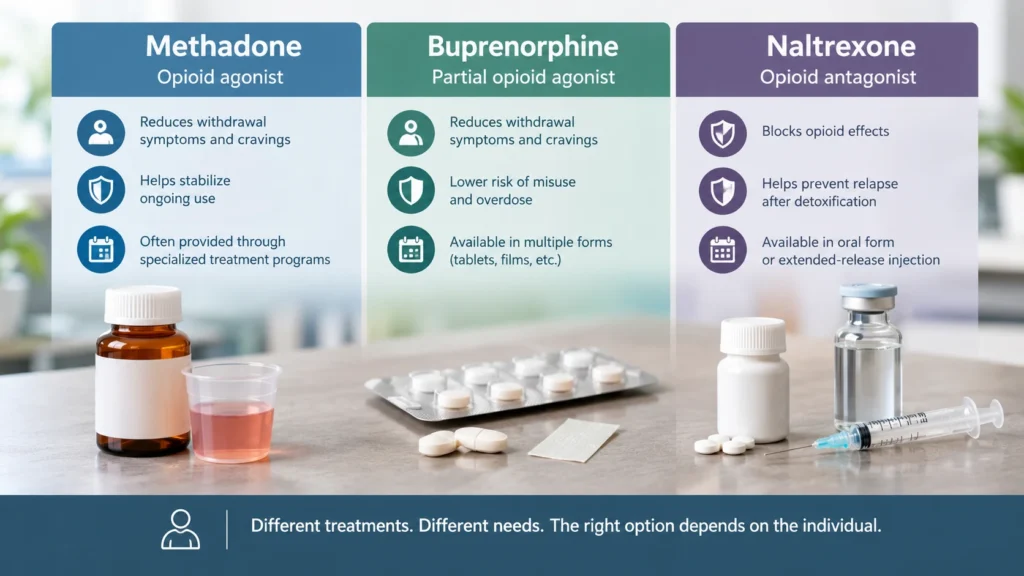
Methadone is an opioid agonist, while buprenorphine is a partial opioid agonist. Naltrexone, by contrast, is an opioid antagonist that blocks opioid receptors.
Naltrexone cannot simply be started while someone is still physically dependent on opioids. A patient generally needs to complete an appropriate opioid-free interval before beginning treatment, because starting it too soon can precipitate severe withdrawal.
That requirement creates a significant practical challenge: patients must get through withdrawal and reach the point at which naltrexone can be started safely.
Menzies believes the difficulty of this transition has contributed to naltrexone being overlooked.
His central complaint is not that every patient should receive naltrexone. It is that patients should have access to a genuine discussion of the available options.
The question is not whether one medication should replace every other medication. It is whether treatment should be designed around the individual patient rather than a single preferred pathway.
In a separate discussion of addiction treatment, Menzies has also described ARCA’s approach of offering patients a choice between buprenorphine and naltrexone, with an emphasis on explaining the characteristics of each option. Points
2. The Missing Link in Addiction Treatment: Better Withdrawal Management
One of the strongest criticisms Menzies makes in the interview concerns detoxification.
Opioid withdrawal can involve muscle aches, sweating, anxiety, restlessness, gastrointestinal symptoms, sleep disturbances, and intense cravings. Although withdrawal is not usually life-threatening in the same way that severe alcohol or sedative withdrawal can be, its physical and psychological effects can be extremely distressing.
For someone already struggling with unstable housing, financial insecurity, or limited social support, those symptoms can make it particularly difficult to remain engaged with treatment.
Menzies argues that inadequate withdrawal management can undermine the entire recovery process.
As he puts it in the interview:
“My contention is that we have failed terribly in offering meaningful detox.”
He questions whether treatment providers do enough to address the symptoms patients experience during withdrawal. He discusses supportive medications, fluids, and approaches intended to make the process more tolerable.
He also criticizes what he sees as a lack of progress in withdrawal protocols.
His broader point is that getting a patient through the first stage of treatment is not a minor administrative step. It can determine whether that person is able to continue with recovery at all.
When withdrawal symptoms are inadequately managed, a patient may return to opioid use to escape the discomfort. That can create a cycle in which the immediate need for relief repeatedly overwhelms longer-term intentions.
However, withdrawal management is not the same as comprehensive addiction treatment. Detoxification alone does not reliably prevent relapse, and patients need a plan for ongoing care.
The goal should be to make withdrawal safer and more manageable while helping each patient transition into appropriate continuing treatment.
This section reflects Menzies’s criticism in the interview; his claim that withdrawal protocols have remained largely unchanged should be understood as his assessment, not a universal finding about every treatment program.
3. Naltrexone: The Addiction Treatment Option Menzies Wants Reconsidered
Naltrexone is central to Menzies’s argument.
Unlike methadone and buprenorphine, naltrexone does not activate opioid receptors. Instead, it blocks them, reducing or preventing the effects of opioids.
It is available in oral form and as an extended-release injection. The injectable formulation is commonly known by the brand name Vivitrol.
For opioid use disorder, naltrexone can be an option for patients who have completed the required opioid-free period and are suitable candidates for treatment.
It is not a medication that can safely be started at any point during active opioid dependence. Appropriate assessment and timing are essential.
Menzies believes this distinction between treatment approaches has been misunderstood.
In his view, methadone and buprenorphine can help stabilize active opioid use, while naltrexone can serve as a relapse-prevention option after detoxification.
He argues that these approaches should be considered complementary possibilities rather than competing ideologies.
His frustration is clear when he discusses the historical reception of naltrexone:
“One is treatment. One is prevention.”
Menzies believes the potential of opioid antagonists has not received the attention it deserves.
In his broader account of addiction medicine, he argues that the field missed an opportunity to develop and expand the use of medications that work differently from opioid agonists.
That is a challenge worth examining. Treatment systems should evaluate medication options based on the evidence, the needs of individual patients, safety considerations, and meaningful outcomes.
At the same time, naltrexone is not a cure for addiction, and it is not the best choice for every patient.
Patients taking naltrexone for opioid use disorder can face a heightened risk of overdose if they attempt to overcome the blockade. Opioid tolerance also falls after a period without opioid use, increasing overdose vulnerability if a person returns to previously tolerated doses. Missed doses or discontinuation can create additional risks.
These considerations make patient education, follow-up, and overdose prevention essential parts of any treatment plan.
The important question is whether patients are receiving a balanced explanation of their options.
Why patient choice matters
A person who strongly prefers a non-opioid medication may respond differently to treatment than someone who needs the stabilization that methadone or buprenorphine can provide.
Others may begin with one medication and later consider a different option under medical supervision.
A flexible approach allows treatment decisions to account for personal circumstances, clinical needs, previous experiences, and patient preferences.
Rather than assuming that one pathway is suitable for everyone, clinicians should explain the benefits, limitations, and risks of available treatments.
That is the principle behind Menzies’s call for greater choice.
4. Is Addiction Treatment Becoming Indefinite Maintenance?
Menzies raises a difficult question about the relationship between treatment and recovery.
In his view, the widespread expectation that opioid treatment may continue indefinitely can lead people to believe that addiction is necessarily an incurable condition.
He challenges that assumption and argues that treatment should include a serious discussion of the possibility of greater independence.
He states:
“Because of our poor treatment, we have needlessly called it an incurable disease.”
This is one of the more controversial arguments in the interview.
It is important to distinguish Menzies’s criticism of treatment policy from the medical evidence supporting medications for opioid use disorder.
Methadone and buprenorphine are evidence-based treatments. For many people, continued treatment substantially reduces the risk of overdose and other harms. Longer-term use is not inherently a treatment failure, and patients should not be pressured to discontinue medications simply to meet an arbitrary definition of recovery.
Some people may eventually choose to taper medication with appropriate clinical support. Others benefit from continuing treatment for years or longer.
Both situations can represent meaningful progress when decisions are guided by the patient’s needs and safety.
The more useful question is whether the treatment plan remains responsive to the individual.
Is the person safer? Are cravings manageable? Is the patient able to maintain relationships, find employment, and participate in ordinary life? Are treatment decisions being made collaboratively?
These questions help move the discussion beyond the assumption that either lifelong maintenance or rapid medication discontinuation must be the only acceptable outcome.
Recovery should be measured by meaningful improvements in a person’s life, not by whether that person follows a predetermined timetable.
5. The Role of Treatment Incentives and Institutional Interests
Menzies also questions whether financial incentives influence the way addiction treatment is delivered.
He argues that systems can become attached to familiar models and that the economic structure of treatment may discourage innovation.
His concern is that the needs of patients can become secondary to the routines, financial arrangements, and institutional assumptions of treatment providers.
He puts the principle simply:
“We have to focus on outcomes and not on which is the most lucrative drug to use.”
This is a challenge to the wider healthcare system, not just addiction medicine.
Medical institutions can develop established ways of operating. Training, reimbursement arrangements, regulations, and professional habits can all influence which treatments are routinely offered.
But a claim that financial incentives have sidelined a particular medication requires evidence beyond the existence of those incentives. Different treatment approaches have different clinical requirements, and medication selection can reflect legitimate differences in patient suitability, safety, and effectiveness.
The right response is not to assume that every provider is motivated by profit. It is to demand transparency, compare outcomes, and ensure that patients are not unnecessarily denied reasonable treatment options.
A patient-centered system should make it possible to evaluate different approaches fairly.
It should also be willing to change when evidence shows that an established practice is not serving patients well.
6. Addiction Recovery Requires More Than Medication
Perhaps the most practical part of the interview concerns what happens after a patient begins treatment.
Menzies explains that ARCA assesses needs beyond medication. Patients may require stable housing, employment assistance, health coverage, transportation, and help navigating other social services.
These needs are not peripheral to recovery.
Someone without reliable housing may struggle to keep appointments, store medication safely, or maintain a stable routine. A person without transportation may be unable to attend treatment consistently. Someone facing unemployment or unresolved legal problems may find it difficult to build a sustainable life.
A prescription can address one part of the problem without resolving these wider difficulties.
Menzies’s approach recognizes that recovery takes place in the context of a person’s daily life.
In the interview, he describes how ARCA considers housing, employment, Medicaid enrollment, and other needs once a patient has been stabilized. are_we_treating_addictions_wrong
The principle is straightforward: treatment should help people build the practical conditions that make recovery possible.
That means looking beyond a negative drug test or attendance at a clinic.
It means asking whether someone has a safe place to sleep, a realistic path toward employment, access to healthcare, supportive relationships, and opportunities to pursue meaningful goals.
These factors do not replace medical care. They make it more likely that medical care can translate into lasting improvements.
Recovery and personal agency
Menzies emphasizes the importance of helping patients regain control over their lives.
The goal is not simply to keep a person connected to a treatment service. It is to help that person develop the stability and confidence needed to make decisions, maintain relationships, and pursue a future beyond substance use.
This requires a balance between support and independence.

People may need intensive help at the beginning of recovery. Over time, some will need less assistance as their circumstances improve, while others will continue to need ongoing medical or social support.
The important point is to avoid confusing the existence of support with the absence of progress.
Good treatment should provide help when it is needed while respecting the patient’s capacity to participate in decisions about their own future.
7. How Addiction Can Narrow the Experience of Pleasure
One of the most striking observations in the interview concerns the way addiction can reshape a person’s priorities.
Menzies explains that opioids can become the dominant source of relief or reward, leaving other parts of life feeling less important.
He describes this experience in vivid terms:
“Drugs will hijack the pleasure system and now we are focused only on one form of pleasure to feel normal.”
The point is not merely that a person continues to use a drug despite negative consequences.
It is that the drug can begin to occupy a disproportionate place in daily life. Relationships, work, food, hobbies, and personal goals may receive less attention as obtaining and using the substance becomes increasingly central.
This can leave someone feeling trapped in a narrow routine in which the drug provides temporary relief while the rest of life becomes harder to manage.
Recovery therefore involves more than stopping a particular behavior.
It can also involve rediscovering the ordinary sources of satisfaction that give life structure and meaning.
A meal with family. A full night’s sleep. A job completed well. A conversation with a friend. The ability to make plans without organizing the day around a substance.
These experiences may seem unremarkable, but they can become important parts of rebuilding a life.
Medication can help manage the clinical aspects of addiction. Counseling, social support, and practical assistance can help people address other challenges and establish new routines.
The wider goal is to create a life in which the drug no longer dominates every decision.
8. What Should Better Opioid Addiction Treatment Look Like?
Menzies’s argument raises several questions for treatment providers, policymakers, and families affected by addiction.
If withdrawal management is inadequate, more attention should be given to making it safer and more tolerable.
If patients are unaware of available medications, clinicians should explain the alternatives clearly and honestly.
If people leave treatment without housing, transportation, or other essential support, treatment programs should consider how to address those barriers.
And if financial or institutional arrangements affect which options are available, those arrangements should be examined transparently.
These principles do not require rejecting established treatments.
Methadone and buprenorphine remain important options for opioid use disorder. Naltrexone provides another option for appropriately selected patients who have completed the necessary opioid-free period.
The choice depends on clinical circumstances, patient preferences, the risks involved, and the support available.
A better system would not force patients into a single model of recovery. Nor would it assume that one medication can solve every aspect of addiction.
Instead, it would bring together appropriate medical care, careful withdrawal management, relapse prevention, patient education, and practical assistance.
It would also recognize that recovery is not always linear. Some people experience setbacks, and those setbacks should prompt reassessment and renewed support rather than the conclusion that recovery is impossible.
The central challenge is to build a system that measures success by what happens to patients over time.
Are they safer? Are they healthier? Are they able to rebuild relationships and find stability? Do they have meaningful opportunities to move forward?
These are the kinds of questions that should guide the debate.
Conclusion: Give Patients More Choices, Not Fewer
Percy Menzies’s central message is that addiction treatment should be more flexible, more attentive to the individual, and more focused on meaningful outcomes.
His criticism centers on what he sees as missed opportunities in withdrawal management, the limited use of naltrexone, and a treatment system that does not always give patients enough choices.
His broader vision extends beyond medication. He wants treatment providers to recognize the importance of housing, employment, social stability, and the personal agency needed to build a life beyond addiction.
Some of his criticisms of conventional treatment remain contested, particularly when they imply that long-term medication is unnecessary or that addiction should not be treated as a chronic condition. Those questions deserve careful consideration of the evidence and the needs of individual patients.
But his call for a more individualized discussion of treatment options raises an important issue.
People struggling with opioid addiction deserve accurate information, compassionate care, and access to appropriate evidence-based treatments. They also deserve to be treated as participants in their own recovery, not as passive recipients of a predetermined program.
The goal should be to help people become safer, healthier, and better equipped to live meaningful lives—not to assume in advance what recovery must look like for everyone.
As Menzies’s argument suggests, the most useful question may not be whether one treatment model is right and another is wrong.
It may be whether we are doing enough to ensure that every patient has access to the care, choices, and practical support they need.
Related reading
For more information about Percy Menzies and the work of Assisted Recovery Centers of America, visit the official ARCA website. ARCA
FAQs
1. What is the difference between methadone, buprenorphine, and naltrexone?
Methadone and buprenorphine act on opioid receptors and can reduce withdrawal symptoms and cravings. Naltrexone blocks opioid receptors and may help prevent a return to opioid use after a patient has completed the required opioid-free period. Each medication has different benefits, risks, and eligibility requirements.
2. Can naltrexone help treat opioid addiction?
Yes. Naltrexone is an established treatment option for appropriately selected people with opioid use disorder. It blocks opioid effects and can help prevent a return to opioid use. Patients must complete the required opioid-free period before starting treatment, and a healthcare professional should assess whether it is suitable for them.
3. Why does Percy Menzies criticize current addiction treatment?
Menzies argues that addiction treatment does not always provide adequate withdrawal management or sufficient choice among medications. He also believes recovery programs should address practical needs such as housing, employment, transportation, and access to healthcare.
4. Is detoxification enough to recover from opioid addiction?
No. Detoxification helps people manage withdrawal, but it does not by itself provide ongoing treatment or reliably prevent relapse. Continuing care may include medication, counseling, recovery support, and assistance with housing, employment, and other needs.
5. Does opioid addiction treatment have to continue for life?
Not necessarily. Treatment duration varies by individual. Some people benefit from long-term methadone or buprenorphine treatment, while others may consider different options under medical supervision. Decisions about continuing, changing, or stopping medication should be individualized and based on safety, clinical needs, and patient preferences.
Discover more from Randy Bock MD PC
Subscribe to get the latest posts sent to your email.