


Theodore Dalrymple and the Courage to Say What We See
What happens when an intellectual culture becomes afraid of obvious truths?
That question sits at the center of the work of Theodore Dalrymple, the pen name of British physician, psychiatrist, author, and social critic Anthony Daniels. His unusual perspective comes not primarily from academic theory but from decades of direct contact with people living through poverty, addiction, crime, psychiatric distress, dysfunctional relationships, and the consequences of destructive choices.
In a wide-ranging interview, Daniels revisits many of the themes that have defined his writing: the medicalization of ordinary human misery, the addiction disease model, personal responsibility, meritocracy, emotional exhibitionism, prejudice, judgment, and the reluctance of intellectuals to acknowledge what ordinary people can often see clearly.
His argument is uncomfortable precisely because it is simple.
People are capable of recognizing elementary truths, but intellectual culture can teach them to distrust what they see.
Daniels describes this problem as a form of intellectual cowardice—an unwillingness among influential thinkers and institutions to say plainly what experience may already have demonstrated.
Table of Contents
Who Is Theodore Dalrymple?
Anthony Daniels is widely known by the pen name Theodore Dalrymple. He is a retired physician and psychiatrist who worked in British hospitals and prisons and spent part of his early medical career traveling and practicing medicine in countries including Tanzania. He later became a prolific essayist and cultural critic.
The Manhattan Institute identifies Dalrymple as a senior fellow and contributing editor of City Journal. His books include Life at the Bottom, Romancing Opiates, In Praise of Prejudice, Spoilt Rotten, and Admirable Evasions.
His medical career is important because much of his cultural criticism emerged from what he observed firsthand.
He was not simply theorizing about poverty, addiction, crime, or social dysfunction from a university office.
He had patients.
He had prisoners.
He had addicts.
He had people who had attempted suicide.
And he listened to them describe their lives.
That experience became the foundation for many of his most controversial conclusions.
Travel as a Lesson in Judgment
One of the first ideas Daniels discusses is the importance of comparison.
He argues that travel can function almost as a philosophical exercise because it allows people to compare societies. In the interview, he recalls the idea attributed to Samuel Johnson that judgment is comparative. To understand one’s own society, Daniels argues, it helps to have encountered other ways of living.
His experience in Tanzania became particularly important.
Daniels remembers encountering extreme poverty without necessarily encountering the coarseness or vulgarity he associated with some wealthier societies.
That observation challenged a common assumption: that material poverty automatically explains every form of social dysfunction.
For Daniels, it did not.
He describes Tanzanians as extraordinarily well-mannered despite considerable poverty. He came away with the important realization that poverty, coarseness, and vulgarity are not synonymous.
That distinction matters because it moves the discussion beyond money.
A society can be materially poor without being socially degraded in every respect.
Conversely, a materially wealthy society can experience serious problems of behavior, family breakdown, irresponsibility, resentment, and cultural deterioration.
The lesson is not that poverty is irrelevant.
It is that money cannot explain everything.
When Aid Sustains the System It Was Supposed to Change
Daniels’s experience in Tanzania also influenced his thinking about government assistance and bureaucracy.
He recalls a country receiving substantial foreign assistance while remaining economically poor. His interpretation was that well-intentioned aid could sometimes sustain policies and institutions that were themselves contributing to economic failure.
The broader lesson is provocative:
Good intentions do not guarantee good outcomes.
An institution can receive more resources without becoming more effective.
A government program can grow even when the problem it was designed to solve remains.
A bureaucracy can become invested in the continuation of the problem because the existence of the problem helps justify the bureaucracy’s continued existence.
This idea appears repeatedly throughout Daniels’s worldview.
When a system fails, the instinct is often to provide more resources.
But sometimes the more important question is:
What incentives are keeping the system from working?
That question is uncomfortable because it requires looking beyond intentions and examining results.
Theodore Dalrymple on the Medicalization of Human Problems
Perhaps the most important theme of the interview is Daniels’s criticism of the medicalization of ordinary human problems.
After years of psychiatric practice, he became increasingly skeptical of treating every form of misery as evidence of a medical disorder.
Daniels argues that disappointment, unhappiness, destructive relationships, irresponsibility, and other forms of human suffering cannot automatically be transformed into medical problems without consequences.
His concern is not that genuine psychiatric illness does not exist.
His concern is what happens when the medical framework expands so far that people stop examining the circumstances and choices that contributed to their suffering.
The transcript captures his argument directly: if something that is not fundamentally medical is medicalized, people may stop thinking properly about their own situation and the situations of others.
This is a crucial distinction.
Compassion does not require abandoning judgment.
A person can suffer without being helpless.
A person can be harmed without being responsible for the harm.
A person can also participate in patterns that make their own circumstances worse.
These statements can all be true at the same time.
Addiction: Disease, Choice, Habit, or Learned Behavior?
Daniels’s views on addiction are among his most controversial.
His book Romancing Opiates: Pharmacological Lies and the Addiction Bureaucracy is specifically concerned with the way addiction is understood and institutionalized. The Manhattan Institute lists it among his major works.
In the interview, Daniels describes observations from his work in prison that made him question the official conception of addiction.
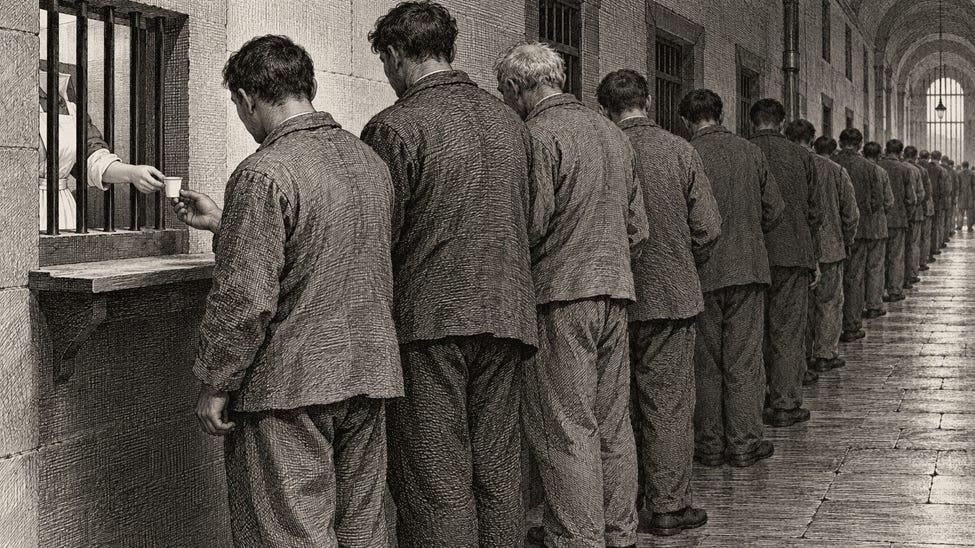
He noticed that prisoners experiencing withdrawal could behave very differently depending on whether they were interacting with other prisoners or seeking drugs from medical staff. He interpreted these observations as evidence that addiction involved more than a passive disease process.
Daniels then makes a more fundamental argument.
An injecting drug user does not simply wake up one morning with all the behaviors associated with injecting drug use.
There is learning involved.
There are social environments.
There are acquired techniques.
There are inhibitions to overcome.
There are opportunities and incentives.
There are repeated behaviors.
And there are choices.
As Daniels puts it in the interview, addiction is at least partly a matter of what a person does as well as what happens to that person.
That does not mean every person has identical freedom or identical circumstances.
It means that agency should not automatically disappear from the conversation.
The “Wrong Crowd” Explanation
Daniels recalls asking addicts why they started using drugs.
The answer he heard repeatedly was:
“I fell in with the wrong crowd.”
His response was deliberately provocative.
He would point out that he had met hundreds of people who had fallen in with the wrong crowd, but he never seemed to meet anyone who identified himself as a member of the wrong crowd.
The joke exposed a deeper problem.
The explanation places responsibility outside the individual.
It makes the person a passive recipient of circumstances rather than an active participant in a chain of decisions.
Daniels believed that this kind of explanation could reduce a person’s sense of agency.
That observation connects addiction to his larger critique of modern culture.
If every destructive outcome has an external explanation, then personal responsibility becomes increasingly difficult to discuss.
The Problem With Explaining Away Misery
Daniels does not deny that people can be genuinely unhappy.
Instead, he questions whether institutions always help people correctly identify why they are unhappy.
He argues that systems can encourage people to misidentify the source of their misery—and that this misidentification can reinforce the misery itself.
This is one of the strongest ideas in the interview.
Suppose someone is unhappy.
There are many possible explanations:
- a destructive relationship;
- poor choices;
- loneliness;
- addiction;
- family breakdown;
- lack of discipline;
- poverty;
- trauma;
- social pressure;
- genuine psychiatric illness;
- or some combination of these.
The temptation is to select the explanation that produces the least psychological discomfort.
If the problem is entirely external, the individual does not have to change.
If the problem is entirely medical, the individual may only need treatment.
But if the problem involves choices, habits, relationships, and behavior, then responsibility becomes unavoidable.
And responsibility is often uncomfortable.
Meritocracy and the Psychological Problem of Failure
Daniels extends this argument into the debate over meritocracy.
A meritocratic society can be uncomfortable because failure becomes harder to explain entirely through external forces.
If people believe that ability and effort matter, then an unsuccessful person may have to confront the possibility that some part of the outcome belongs to him or her.
Daniels describes this as psychologically difficult.
In the interview, he argues that when people fail within a partially meritocratic society, they may prefer to blame something outside themselves rather than confront personal responsibility.
That does not mean every failure is deserved.
It does not mean every social system is fair.
It does not mean inherited advantages, family circumstances, culture, luck, discrimination, or institutional barriers are irrelevant.
Rather, Daniels’s challenge is to the idea that external explanations should automatically replace individual agency.
No society can make everyone equally successful.
And no political arrangement can eliminate every inequality of talent, family background, personality, ambition, luck, or outcome.
The demand for perfect fairness can therefore become a demand to make reality conform to an impossible standard.
The Rise of Emotional Exhibitionism
Another striking part of the interview concerns changing attitudes toward emotion.
Daniels remembers a British culture in which public emotional display was often regarded as vulgar. People were expected to exercise restraint and speak with understatement.
He argues that the cultural expectation has changed dramatically.
Today, dramatic emotional expression can be interpreted as evidence of authenticity.
The louder the grievance, the more seriously it may be taken.
The more dramatic the emotional performance, the more legitimate the suffering can appear.
Daniels describes this as an arms race in the expression of emotion.
The danger, he argues, is that increasingly dramatic expression can produce insincerity and eventually even violence.
The underlying question is profound:
Does expressing an emotion prove that the emotion is justified?
Daniels’s answer is no.
Feeling something intensely does not automatically make the interpretation of that feeling correct.
A grievance can be real while its explanation is mistaken.
A person can be genuinely angry and still be wrong about why he is angry.
And emotional intensity cannot substitute for evidence.
Victimhood as an Intellectual Shortcut
Daniels connects the emotional culture to a broader therapeutic mindset.
If people are repeatedly encouraged to interpret themselves primarily as victims, they may begin to understand their lives through a framework of injury rather than agency.
This does not mean victims do not exist.
They obviously do.
Daniels himself describes encountering people who had suffered terrible abuse. He says he was shocked by the level of violence some patients experienced.
His argument is more subtle.
Simply telling someone, “You are a victim,” does not necessarily help that person understand how to change the circumstances of his or her life.
A useful explanation must distinguish between:
What happened to me?
and
What can I do now?
Those are different questions.
The first concerns causation.
The second concerns agency.
A culture that can only answer the first may leave people psychologically stranded.
In Praise of Judgment
Few parts of Daniels’s worldview are more controversial than his defense of prejudice.
He clarifies that his argument is not that people should cling stubbornly to irrational stereotypes.
Rather, he argues that humans inevitably operate using assumptions and probabilities.
We make judgments before possessing perfect information.
The important question is whether we are willing to revise those judgments when evidence contradicts them.
That distinction is critical.
A preconceived idea is not automatically a permanent belief.
It can be a provisional hypothesis.
Daniels illustrates the point with ordinary situations in which people instinctively estimate risk based on available characteristics. The point is not certainty. The point is probability.
In other words:
Judgment is unavoidable.
The real intellectual failure occurs when people either refuse to make judgments at all or refuse to revise them when evidence demands it.
Seeing Is Not the Same as Observing
This is where Daniels’s medical experience intersects with his philosophy.
He recalls the Sherlock Holmes distinction between seeing and observing.
People can look directly at something without understanding its significance.
The same is true of society.
We see behavior.
We see outcomes.
We see repeated patterns.
But seeing patterns requires intellectual honesty.
A person who is afraid of the conclusion may invent another explanation.
The interview provides several examples of this phenomenon.
Daniels describes patients and prisoners whose explanations for their circumstances seemed to reduce their own agency. Yet ordinary people listening to his observations could sometimes recognize the absurdity immediately.
That is why Daniels’s criticism ultimately extends beyond psychiatry.
It becomes a criticism of intellectual culture itself.
Why Ordinary People May See What Intellectuals Miss
The interview ends with one of Daniels’s most optimistic observations.
He says that people were capable of recognizing elementary truths.
They could accept them.
They could even laugh about them.
And that led him to conclude that the real problem was not necessarily the incapacity of ordinary people to understand reality.
The problem was the intellectual class that had become unwilling to speak plainly about it.
This is the meaning of intellectual class cowardice.
The cowardice is not necessarily fear of physical danger.
It is fear of social consequences.
Fear of being called cruel.
Fear of being accused of prejudice.
Fear of violating professional consensus.
Fear of offending a fashionable theory.
Fear of saying something that everyone privately understands but no one is supposed to say publicly.
The result can be an extraordinary inversion:
The ordinary person sees the obvious.
The intellectual explains why the obvious is impossible.
Theodore Dalrymple’s Optimistic Conclusion
Despite the harshness of his observations, Daniels does not end in despair.
In fact, the final note of the interview is optimism.
When asked for the positive lesson from Life at the Bottom, Daniels essentially returns to common sense. He says that people are capable of recognizing elementary truths.
His optimism rests on a simple proposition:
Human beings are not incapable of understanding reality.
They can observe.
They can judge.
They can reconsider.
They can laugh at absurdity.
They can accept uncomfortable truths.
And they can change.
The task, therefore, is not to construct an intellectual system that explains away every failure.
It is to recover the courage to distinguish between what is genuinely beyond our control and what remains within it.
What Theodore Dalrymple’s Argument Really Challenges
The most provocative part of Daniels’s philosophy is not any single claim about addiction, psychiatry, poverty, meritocracy, or prejudice.
It is the underlying assumption that compassion requires the suspension of judgment.
Daniels challenges that assumption.
He suggests that genuine compassion may sometimes require more honesty, not less.
If addiction involves agency, ignoring agency may make recovery harder.
If a destructive relationship contains recognizable warning signs, pretending not to see them may put someone at greater risk.
If ordinary misery is incorrectly transformed into medical illness, the person may never examine the real source of the problem.
If every failure is blamed on society, individuals may lose the incentive—or even the belief—that they can change their circumstances.
And if intellectuals refuse to say what experience appears to demonstrate, public discussion becomes increasingly detached from reality.
The alternative is not cruelty.
It is honest judgment combined with human sympathy.
The Intellectual Courage to Think Clearly
Theodore Dalrymple’s appeal comes partly from his willingness to make arguments that are unfashionable.
But his deeper contribution is methodological.
He asks us to observe before theorizing.
To compare societies before assuming our own arrangements are inevitable.
To distinguish illness from unhappiness.
To distinguish victimhood from agency.
To distinguish prejudice from stubbornness.
To distinguish equality from sameness.
And to distinguish compassion from the refusal to tell people uncomfortable truths.
His experiences as a physician, psychiatrist, prison doctor, traveler, and writer gave him a perspective that crossed boundaries between medicine and culture. His official biography likewise emphasizes how his medical work among struggling populations informed his broader social criticism.
That perspective remains relevant because the central problem he identifies is not confined to one political party or one profession.
It is a human temptation.
We want explanations that make us feel better.
We want systems that remove blame.
We want theories that make difficult realities simple.
And we often prefer comforting explanations to uncomfortable evidence.
Daniels’s challenge is therefore both political and personal:
Are we willing to look at reality long enough to recognize what it is telling us?
Final Thought: Against Intellectual Cowardice
The title of this conversation—“Intellectual Class Cowardice”—captures the central message.
Theodore Dalrymple is not arguing that every conventional belief is wrong.
He is arguing that conventional beliefs should not receive immunity from observation.
The cure for intellectual cowardice is not contrarianism.
It is courage.
The courage to make judgments.
The courage to admit mistakes.
The courage to recognize personal agency.
The courage to distinguish genuine illness from ordinary misery.
The courage to question institutional incentives.
The courage to acknowledge that human beings are imperfect.
And perhaps most importantly, the courage to say aloud what careful observation has already taught us.
As Daniels’s interview makes clear, his worldview is ultimately less pessimistic than it first appears. He believes ordinary people remain capable of recognizing elementary truths—and that recognition offers grounds for optimism.
That may be the most important lesson of all.
The problem may not be that society has forgotten how to think. The problem may be that too many people have become afraid to say what they already know.
About Theodore Dalrymple
Anthony Daniels, better known by his pen name Theodore Dalrymple, is a retired British physician and psychiatrist, author, journalist, and social critic. His books include Life at the Bottom, Romancing Opiates, In Praise of Prejudice, and Admirable Evasions. The Manhattan Institute lists him as a senior fellow and contributing editor of City Journal.
Further Reading
- Life at the Bottom: The Worldview That Makes the Underclass
- Romancing Opiates: Pharmacological Lies and the Addiction Bureaucracy
- In Praise of Prejudice: The Necessity of Preconceived Ideas
- Admirable Evasions: How Psychology Undermines Morality
- Spoilt Rotten: The Toxic Cult of Sentimentality
- https://www.city-journal.org/
- https://www.ralston.ac/people/anthony-m-daniels
- https://manhattan.institute/person/theodore-dalrymple
- https://www.bloomsbury.com/us/author/theodore-dalrymple
Discover more from Randy Bock MD PC
Subscribe to get the latest posts sent to your email.