

What happens when men lose the spaces where they can simply be men?
That is one of the central questions raised by James L. Nuzzo in a wide-ranging conversation about men’s health, sex differences, masculinity, sports, universities, and the disappearance of male-only spaces.
Nuzzo, an exercise physiologist with a PhD in physiology, describes a career that began in conventional academia but eventually moved outside the university system. After being “cancelled,” as he describes it, he turned increasingly toward independent writing and data-driven analysis through The Nuzzo Letter. His greatest response from readers, he says, has not come from ordinary exercise-science research but from his work examining men’s health and sex differences.
That response may reveal something larger.

There is an audience of men—and women—who believe that important questions about biological sex, male health, masculinity, and social organization have become unnecessarily difficult to discuss.
The interview explores why.
Table of Contents
James Nuzzo and the Search for Data About Men
Nuzzo grew up in rural Pennsylvania before studying exercise physiology and exercise science in the United States. He later moved to Australia, earned a PhD in physiology or exercise physiology in Sydney, and eventually settled in Perth.
His academic background matters because his approach is fundamentally empirical. He repeatedly returns to measurements, athletic performance, muscle strength, physiological differences, and data.
According to Nuzzo, however, the work generating the greatest public response is not necessarily the work he originally trained to do.
He says his biggest audience response comes from material about sex differences and men’s health, with readers contacting him, donating, and thanking him for publishing information they believe is difficult to find elsewhere.
That observation is important for understanding the broader conversation.
Men’s health is not simply a question of fitness or exercise. It encompasses physical health, mental health, social relationships, purpose, community, and the institutions through which men organize their lives.
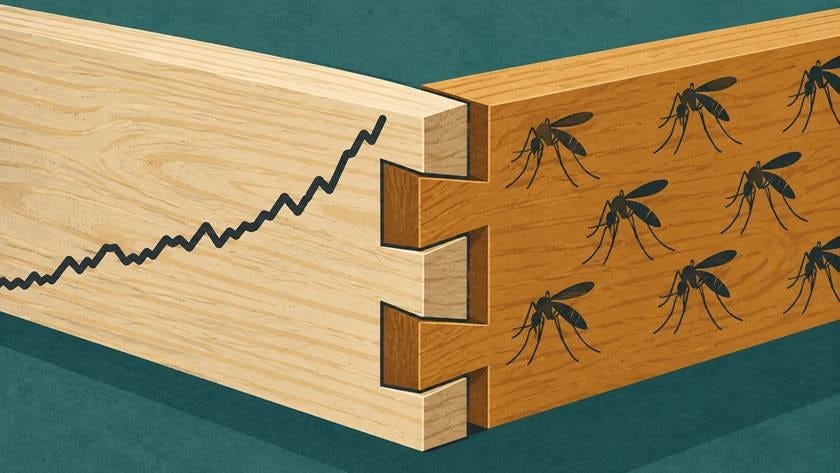
The demand for male-specific information appears to be real. Research into Google search behavior has found substantial public interest in men’s-health topics, including erectile dysfunction and prostate diseases, while newer trend data shows rapidly growing interest in men’s mental health.
Nuzzo’s experience suggests that the demand extends beyond conventional medical questions.
Men also want to understand what it means to be male.
Sex Differences Are Not Merely Cultural
One of the most important sections of the interview concerns biological sex differences.
Nuzzo’s specialty gives him a particular perspective here. His research has focused partly on differences in muscle strength between males and females.
His argument is straightforward: measurable physiological differences exist, and those differences cannot simply be wished away by changing terminology.
He describes research showing differences in physical strength before puberty and argues that these differences persist throughout life. He also points to an important distinction between upper- and lower-body strength, with the differences generally more pronounced in the upper body.
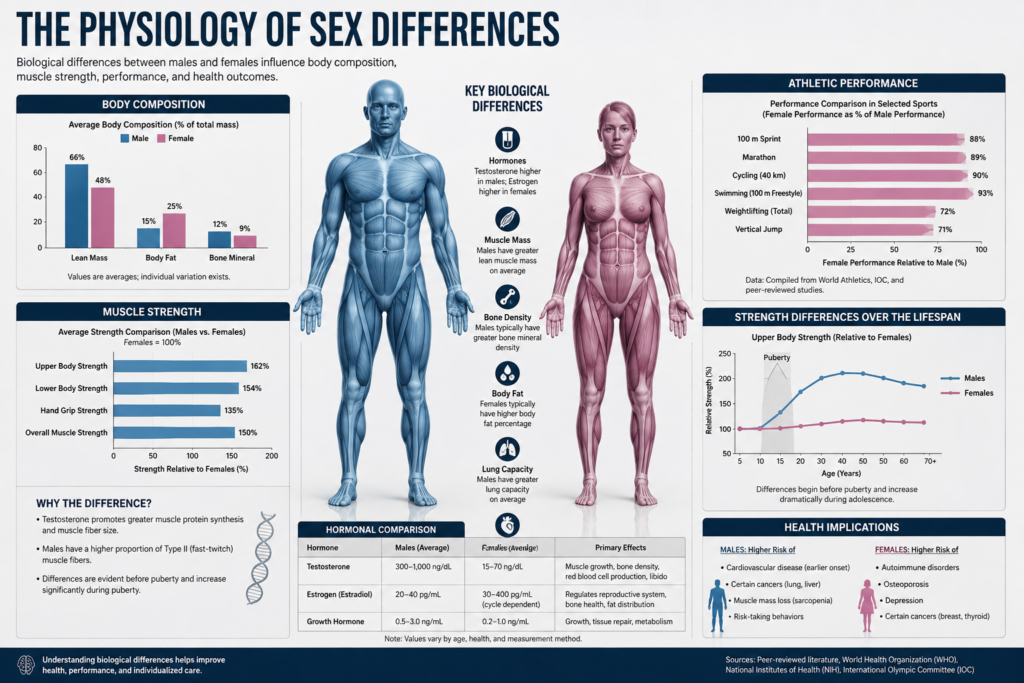
This is especially relevant to the debate over sports.
If athletic categories exist because male and female bodies differ in ways that affect performance, then biological sex cannot be dismissed as irrelevant to competition.
The interview discusses research examining track-and-field performance in boys and girls before puberty. Nuzzo describes work showing measurable differences in athletic performance even before the hormonal changes associated with puberty.
The point is not that every male is stronger than every female.
Nuzzo explicitly recognizes overlap between distributions. Individual women can outperform individual men. Individual differences obviously exist.
The larger issue is the difference between individual exceptions and population-level patterns.
That distinction becomes crucial when sports organizations establish categories designed to create meaningful competition.
Why Sex Differences Matter in Sports
The transgender-athlete debate has brought biological sex differences into public view in a way that few other subjects have.
For decades, sports have generally operated on the assumption that male and female bodies differ sufficiently to justify separate competitive categories.
Nuzzo argues that the underlying physiology has not suddenly changed simply because the language surrounding sex and gender has changed.
His discussion points to data showing measurable differences in athletic performance among boys and girls even before puberty. He also describes research on muscle strength showing sex differences that precede puberty and remain evident across the lifespan.
This creates an uncomfortable question:
If biological sex matters enough to justify protecting women’s sporting categories, why should the principle of sex-specific spaces be considered illegitimate for men?
That question becomes the bridge between sports and the larger subject of men’s spaces.
The Disappearance of Men’s Spaces
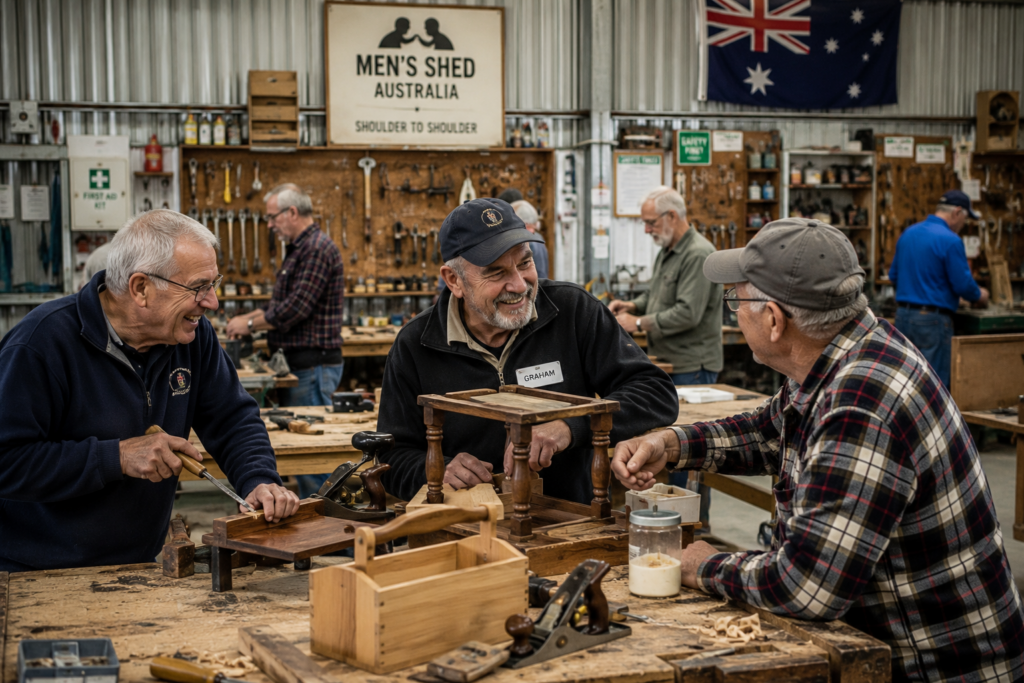
Perhaps the most memorable example in the interview is the Australian and British phenomenon known as men’s sheds.
The name sounds almost comically simple.
A men’s shed is essentially a community workshop where men can build things, use tools, work on projects, and spend time together.
But Nuzzo emphasizes that something important happens around those activities.
Men talk.
They discuss relationships. They discuss problems. They discuss mental health. They form friendships.
The conversation does not necessarily begin with a formal therapy session or a mental-health program. It emerges naturally from shared activity and male companionship.
Nuzzo describes men’s sheds as spaces that evolved naturally from men creating environments for their own well-being.
That may be one reason the idea matters beyond Australia.
Men often bond through doing rather than through explicitly discussing emotions.
Build something.
Repair something.
Play something.
Compete.
Watch sports.
Work on a project.
Then, almost incidentally, talk about life.
That informal structure can be extremely different from the institutional approach to mental health, where men may be expected to begin by verbalizing emotions.
The men’s shed model offers another possibility: community first, conversation second.
What Happens When Men’s Sheds Stop Being Men’s Spaces?
Nuzzo argues that the transformation of men’s sheds illustrates a larger pattern.
Men create a space.
The space becomes successful.
Women eventually enter the space.
The character of the space changes.
Men then create another space.
And the cycle begins again.
He acknowledges that men themselves bear some responsibility because they frequently fail to defend the boundaries of spaces they created. But he also suggests that men may hesitate to defend themselves because they anticipate ridicule or social criticism.
This is where the discussion moves beyond sheds.
The same question can be asked about universities, sports broadcasting, entertainment, clubs, and other institutions historically associated with male culture.
The issue is not whether women should participate in public life.
They obviously do.
The question is whether male spaces have any legitimate cultural function of their own.
Men’s Health Is More Than Medicine
The men’s-space argument connects directly to men’s mental health.
A man does not live only inside his body.
He lives within communities.
He needs friendship, purpose, responsibility, achievement, belonging, and often a sense that his contributions matter.
This makes the decline of male-only environments potentially significant even when those environments are not explicitly designed as health interventions.
A workshop can become a social network.
A sports club can become a brotherhood.
A fraternity can become a lifelong community.
A university debating society can teach a young man how to argue, disagree, and defend an idea without treating disagreement as personal hostility.
These institutions can create social capital that is difficult to measure but easy to recognize once it disappears.
What Universities Lost Along the Way
The conversation also turns toward universities.
The contrast Nuzzo describes is not simply between men and women. It is between different institutional cultures.
The interviewer recalls attending Yale when it was still predominantly male and describes an environment where debate, argument, and disagreement were normal parts of intellectual life.
The discussion recalls dining tables where students discussed and debated ideas rather than retreating into ideological enclaves.
Nuzzo argues that many younger men now feel increasingly alienated from academic institutions.
He describes former academics creating independent spaces through newsletters, speaking tours, and alternative intellectual communities after finding themselves increasingly uncomfortable within universities.
His assessment is that some men no longer feel that universities are places where they can freely discuss controversial subjects.
Whether one agrees with every part of that assessment, the phenomenon is worth examining.
A university should theoretically be a place where competing hypotheses can collide.
If students and academics become afraid to express unpopular conclusions, intellectual diversity suffers regardless of which political direction the pressure comes from.
The Problem With the Modern “Safe Space”
One of the interview’s underlying tensions is the difference between safety and intellectual challenge.
Nuzzo contrasts older academic environments—where speakers could be controversial and students could argue—with contemporary environments where some topics are treated as dangerous or unacceptable.
The result, he argues, is an environment in which people increasingly seek ideological agreement rather than intellectual confrontation.
That creates an interesting paradox.
A space can be socially comfortable while being intellectually sterile.
Conversely, a room full of disagreement can be intellectually productive.
The old university ideal was not necessarily that everyone would agree.
It was that everyone could argue.
That distinction matters for men because Nuzzo believes many men are attracted to environments built around competition, debate, strategy, evidence, and direct confrontation.
Why Sports Broadcasting Matters
The discussion extends beyond universities into sports broadcasting.
The interview argues that men often approach sports through statistics, rules, strategy, performance, and analysis. The speakers contrast that with broadcasting styles that increasingly emphasize personal stories and social narratives.
Whether this describes every male or female viewer is obviously another question.
But the broader observation is useful.
Different audiences can enjoy the same activity for different reasons.
For some people, sports are primarily stories about personalities.
For others, sports are systems.
What was the formation?
Why did the defense fail?
What was the percentage?
Was the penalty correct?
What adjustment should the coach make?
What happened in the fourth quarter?
Those details are not trivial to the person watching.
They are the point.
When a traditionally male-oriented environment changes its emphasis, longtime participants may feel that the activity they loved has changed—even if the institution itself remains.
Why Men May Be Building Their Own Alternatives
Nuzzo believes the rise of independent newsletters, podcasts, online communities, and alternative intellectual networks represents a response to this institutional transformation.
He points to former academics who have created independent platforms after leaving traditional academic environments.
The internet makes this possible in a way that previous generations could not have imagined.
A researcher no longer needs a university department to publish an argument.
A writer no longer needs a newspaper editor.
A commentator no longer needs a television network.
A community no longer needs a physical building.
That decentralization has enormous consequences.
It allows people who believe they have been excluded from established institutions to build alternatives.
But Nuzzo identifies a weakness.
These alternative communities remain fragmented.
There are newsletters.
Podcasts.
Independent researchers.
Men’s organizations.
Sports communities.
Online forums.
Private groups.
But they are not necessarily interconnected.
Nuzzo suggests that something is still missing: an institution capable of bringing these people together.
The Manosphere as a Reaction
The conversation also addresses the so-called manosphere and the broader masculine reaction to contemporary cultural politics.
Nuzzo’s interpretation is that movements centered on male identity do not simply appear from nowhere.
They emerge partly in response to institutions and cultural narratives that men perceive as hostile, dismissive, or uninterested in their concerns.
The important question, therefore, is not merely:
Why are men becoming angry?
It is also:
What happened before they became angry?
If men repeatedly hear that their concerns are illegitimate, their institutions unnecessary, their biological differences meaningless, and their traditional forms of community suspect, some will eventually look elsewhere.
That does not mean every reaction is constructive.
It does mean that reactions have causes.
The Argument for Male Spaces Is Not Necessarily an Argument Against Women
One of the most interesting parts of the interview is that Nuzzo does not argue for permanent separation between men and women.
In fact, he explicitly expresses concern about men and women becoming so separated that they fail to form the natural relationships that bind society together.
This is an important distinction.
A society can have:
- mixed institutions,
- male-specific institutions,
- female-specific institutions,
- family institutions,
- religious institutions,
- professional institutions,
- civic institutions,
without requiring complete segregation.
The existence of a men’s group does not automatically imply hostility toward women.
Likewise, the existence of women’s groups does not automatically imply hostility toward men.
The question should instead be:
What purpose does the space serve?
If a group helps people form friendships, develop skills, mentor younger members, discuss difficult problems, or build confidence, there may be a legitimate social reason for its existence.
The Case for Reciprocity
Nuzzo makes perhaps his sharpest argument when discussing women’s spaces.
If women believe they need sex-specific environments in certain circumstances, he argues, men should at least be able to make the same argument for themselves.
The interviewer captures his position directly: women wanting their own spaces provides an opportunity for men to say that men would also like spaces of their own.
This is fundamentally an argument about reciprocity.
A principle should not automatically become illegitimate merely because the other sex wants to use it.
If privacy, community, safety, or shared experience can justify a female-specific environment, similar reasoning may sometimes apply to male-specific environments.
The difficult part is determining where those boundaries are appropriate.
That is a debate worth having without assuming that one sex is inherently entitled to spaces while the other is inherently selfish for requesting them.
Biology and Culture Meet
The deeper theme running through Nuzzo’s arguments is that biology and culture cannot be separated as cleanly as modern discourse sometimes assumes.
Men and women are biologically different.
They can also develop different interests, social patterns, and institutional preferences.
That does not mean every difference is biological.
It does not mean every individual conforms to a group average.
And it certainly does not mean that men and women cannot share institutions.
But it does suggest that a society should be cautious about treating every sex difference as a social error requiring correction.
Nuzzo’s physiological argument is strongest when he stays with measurable data: muscle strength, athletic performance, physical development, and other observable characteristics.
His larger cultural argument then asks what happens when institutions deny or minimize the significance of those differences.
Why Men’s Health and Men’s Spaces Belong in the Same Conversation
This may be the most important takeaway from the interview.
Men’s health cannot be reduced to medical treatment.
A man can have access to a doctor and still lack community.
He can have a gym membership and still lack purpose.
He can have a job and still lack friendship.
He can live in a crowded city and still be socially isolated.
He can be surrounded by people and still have nowhere that feels like his own.
That is why the question of men’s spaces deserves attention.
The men’s shed is only one example.
The larger issue is whether modern society still provides men with environments where they can build, compete, debate, mentor, joke, cooperate, fail, improve, and form friendships without constantly being asked to justify the legitimacy of the space itself.
The Larger Crisis of Belonging
Toward the end of the conversation, the discussion becomes broader.
The speakers consider declining birth rates, social fragmentation, weakening institutions, welfare-state incentives, declining religious participation, and the erosion of shared identity.
Nuzzo argues that functioning societies require more than individuals pursuing private interests.
They require some form of shared identity and social trust. The conversation connects this to civic life and to the idea that a healthy society needs people to understand what they belong to and to work together.
This is where the conversation moves beyond the culture war.
The ultimate problem may not be whether men or women are winning.
It may be whether either sex is winning if the institutions that once connected people are disappearing.
Men Need Somewhere to Go
The disappearance of male spaces may ultimately be less about exclusion than about belonging.
Men need places where they can be useful.
They need places where competence matters.
They need places where older men can teach younger men.
They need places where friendship does not require a therapeutic vocabulary.
They need places where disagreement does not automatically become hostility.
They need places where they can pursue interests without assuming that those interests are evidence of some cultural defect.
And they need institutions that connect them to women and families rather than isolating them from both.
Nuzzo’s proposed answer is not complete. He admits that the alternative institutions forming today remain fragmented and that he does not know exactly what new institution might eventually connect them.
But identifying the problem is already significant.
The Challenge: Rebuild Without Retreating
The challenge ahead is therefore more complicated than simply recreating the past.
Men cannot simply retreat into isolated male enclaves.
Nor should they be expected to abandon every form of male community in the name of universal integration.
The better question is whether modern society can create both shared spaces and legitimate sex-specific spaces.
Can men have their sheds while women have their own organizations?
Can universities welcome everyone while still protecting genuine intellectual disagreement?
Can sports remain open to broad participation while maintaining meaningful competitive categories?
Can men and women share society without requiring every institution to become identical?
Those are not easy questions.
But they are better questions than pretending that sex differences do not exist.
James Nuzzo’s Larger Point
James Nuzzo’s work is ultimately an argument for observation.
Look at the data.
Look at athletic performance.
Look at physiology.
Look at men’s health.
Look at what men actually do when given the opportunity to create communities.
Then ask whether the evidence matches the prevailing narrative.
Sometimes it will.
Sometimes it won’t.
The important thing is to remain willing to examine the difference.

The discussion makes clear that Nuzzo’s greatest audience response comes when he publishes data on men’s health and sex differences.
That demand itself is revealing.
People are searching for answers.
Men are searching for explanations of their own lives.
Researchers are looking for places to publish uncomfortable findings.
Former academics are creating alternative intellectual communities.
And traditional institutions are being challenged by audiences that no longer accept their authority automatically.
Perhaps the disappearance of men’s spaces is therefore only half the story.
The other half is the creation of new ones.
The question is whether those new spaces will remain scattered online—or whether they will eventually become durable institutions capable of reconnecting men with one another, with women, with families, and with the wider society.
That may be the real challenge facing the next generation.
Learn More About James Nuzzo
Readers interested in Nuzzo’s work can explore his personal website at James L. Nuzzo’s website and read The Nuzzo Letter on Substack.
He is also active on X.
For scientific literature discussed in relation to exercise physiology and sex differences, readers should consult the underlying peer-reviewed research rather than relying solely on commentary or social-media summaries.
Final Thought
The most provocative question raised by James Nuzzo is not whether men and women are different.
The data can address many aspects of that question.
The harder question is what society should do with those differences.
If men and women have different interests, different patterns of physical development, different social experiences, and sometimes different reasons for creating communities, perhaps equality does not require making every space identical.
Perhaps a healthier society is one where men and women can share a common civilization while still having room to build communities of their own.
And perhaps men need to become willing to defend those communities—not because women are the enemy, but because belonging matters.
📚 Related Resources, Videos, and Links
https://pubmed.ncbi.nlm.nih.gov/31354093
https://www.linkedin.com/in/james-l-nuzzo-2575a51b2?originalSubdomain=au
FAQs
Why are men’s spaces disappearing?
Men’s spaces are changing as traditionally male-oriented institutions and organizations become more integrated. In the interview, James Nuzzo argues that spaces such as men’s sheds can lose some of their original character when their purpose and membership change. He also suggests that men often hesitate to defend spaces created specifically for them.
What are men’s sheds?
Men’s sheds are community spaces, particularly associated with Australia and the United Kingdom, where men can work on projects, use tools, socialize, and build friendships. Nuzzo describes them as places where conversations about relationships and mental health can develop naturally alongside shared activities.
Why are men’s spaces important for men’s health?
Men’s spaces can provide friendship, community, shared activities, mentoring, and opportunities for informal conversation. Nuzzo argues that men’s health involves more than conventional exercise science and that readers show strong interest in questions concerning men’s health and sex differences.
Are there biological differences between men and women?
Yes. Nuzzo’s discussion focuses particularly on physiological differences, including muscle strength and athletic performance. He discusses research indicating measurable differences in strength before puberty and larger differences emerging during and after puberty.
Why do sex differences matter in sports?
Sex differences in physiology can affect physical performance, including strength and athletic ability. Nuzzo discusses research on athletic performance in boys and girls before puberty and argues that biological differences are relevant when considering sex-based athletic categories.
What does James Nuzzo say about men’s mental health?
Nuzzo connects men’s well-being with community and social environments rather than viewing health exclusively through conventional medical or psychological frameworks. His discussion of men’s sheds emphasizes how shared activities can create opportunities for men to discuss relationships, mental health, and personal problems.
Does supporting men’s spaces mean opposing women’s spaces?
Not necessarily. Nuzzo’s argument is primarily about reciprocity. He argues that if women can legitimately want spaces designed around female interests or experiences, men should also be able to argue for appropriate male spaces. He also acknowledges the importance of men and women maintaining relationships and shared society.
What does James Nuzzo think about universities?
Nuzzo is highly critical of aspects of contemporary university culture. He argues that ideological conformity can discourage discussion of controversial subjects and believes universities have become important sources of ideas that contribute to social polarization.
Why does James Nuzzo write about sex differences?
According to Nuzzo, his writing about sex differences and men’s health generates considerably more reader response than his conventional exercise-science work. He describes receiving messages, donations, and expressions of appreciation when publishing data related to these subjects.
What is the main argument of James Nuzzo’s discussion of men’s spaces?
The broader argument is that men need legitimate environments where they can build relationships, pursue shared interests, discuss problems, develop competence, and form communities. Nuzzo questions why male-specific spaces are often treated differently from female-specific spaces.
Discover more from Randy Bock MD PC
Subscribe to get the latest posts sent to your email.