
Robert Whitaker sat at Harvard’s Safra Center for Ethics and asked why psychiatry had strayed. He was not a doctor. He was a reporter who wanted to see if a medical guild had told the truth. What he found was a tale of power, wealth, and empty promises.
In 1980, psychiatry remade itself. The DSM-III adopted the disease model, characterized by white coats, brain “diseases,” and pills as treatment. It was a rebranding for a profession under siege. Psychologists own talk therapy. Psychiatrists needed a product. Drugs became the product. The pharmaceutical industry became the partner.
“American psychiatry told us that research had found chemical imbalances as the cause of depression and schizophrenia. That was never true”, Whitaker said.
The pitch was simple. “Depression” meant “too little serotonin”. “Schizophrenia” meant “too much dopamine”. Pills would fix the imbalance, like insulin for diabetes. It sounded like a miracle. “If that were true, it would have been the greatest medical discovery in history. But it wasn’t.”
He went back to the research. In the late 1970s and 1980s, government labs searched for evidence of low serotonin in depression. They found nothing. By 1998, the American Psychiatric Association’s own textbook admitted the monoamine theory was dead. “Were we told that? No,” he said.
The same story unfolded with antipsychotics. The dopamine hypothesis collapsed, too. By 2002, NIMH’s Stephen Hyman admitted that no lesion in the dopaminergic system explained schizophrenia. Still, the public was told otherwise. “The drugs induced the very abnormality hypothesized to cause the problem in the first place,” Whitaker said.
The corruption was not a cloak-and-dagger plot. It was, in his words, “economies of influence that served psychiatry’s prestige and pharma’s profits.”
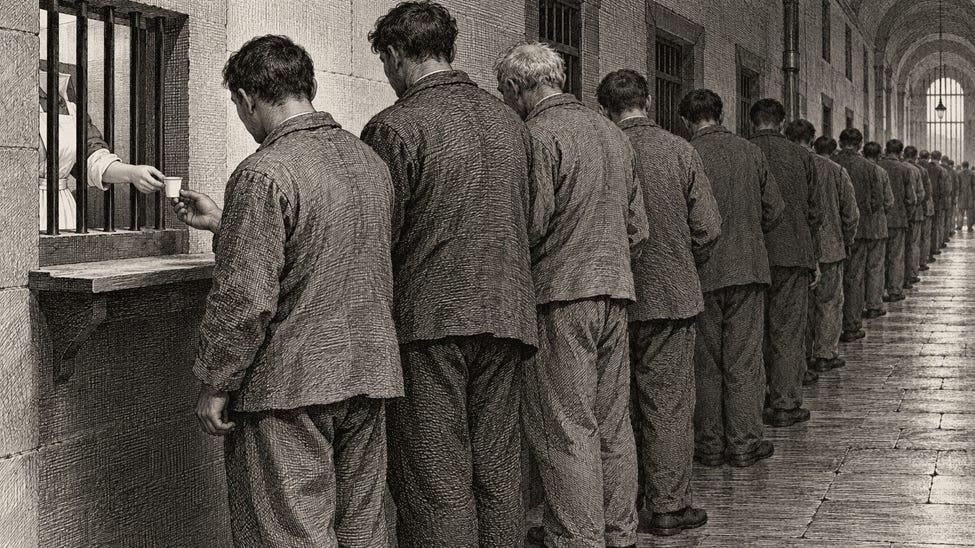
A guild protected its status. An industry sought profit. Doctors wanted authority. Patients wanted answers. The result was a shadow religion: the ritual of the pill. Patients believed in it. Doctors believed in it. But the science said otherwise. “Patients were told to take drugs forever because they had a chronic chemical abnormality. That was false.”
He pointed to Northern Finland as proof of another way. There, psychiatrists used a selective model. First-episode psychosis patients were treated with dialogical therapy, family meetings, and sometimes sleep aids. Antipsychotics were reserved for those who truly needed them, and most who went on drugs eventually came off. After five years, 80 percent were working or back in school, most drug-free. “The best outcomes in the Western world have come from Northern Finland’s selective-use model,” Whitaker said.
The larger problem, he argued, is that psychiatry has narrowed the definition of what is normal. The DSM widened the circle of pathology. Today, one in four Americans is labeled mentally ill in a given year. Distress became disease. Unhappiness became disorder. “We have narrowed what is considered normal and expanded what is considered pathological,” Whitaker said.
Whitaker’s books angered the profession. He was accused of undermining treatment. But he gave voice to survivors of mental hospitals who said the drugs harmed them. Over time, the mainstream began to shift. In 2024, JAMA Psychiatry’s editor admitted outcomes for major mental illness had deteriorated. “More and more, the narrative is changing,” Whitaker said. “Even JAMA Psychiatry now admits outcomes have deteriorated.”
He knows he has made enemies. “Good medicine listens to patients. Psychiatry dismisses them as lacking insight.” Robert Whitaker insists psychiatry must be honest about what the science shows: no proven lesions, modest short-term drug benefit, poor long-term outcomes, and the need for alternatives. Narratives change slowly. But they do change.
The heart of the matter is not whether drugs can sometimes quiet storms of the mind. Of course they can. As I argued, there is some “there, there” — syphilitic dementia, encephalitis, delirium, even the blunt edge of whiskey and street drugs all prove the brain can be altered by chemistry. The failure is not in recognizing that, but in pretending every sorrow, every breakdown, every restless child has a single molecular cure. The guild chose a pill-shaped story over the messy truth. And in doing so, it violated its highest duty: informed consent. Patients were not given a choice with eyes wide open; they were fed a myth of chemical imbalance. That is misinformed consent. If psychiatry is to regain trust, it must shed the shadow-religion of the prescription pad and return to what medicine owes every patient — the whole truth, however inconvenient.
Join us at 5 pm ET weekdays on America Out Loud Talk Radio. Listen on iHeart Radio, our world-class media player, or our free apps on Apple, Android, or Alexa. Discover all the episodes on podcast networks, i.e., Apple Podcasts, Spotify, Pandora, TuneIn, Stitcher, and iHeart. You’ll find them the day after they air on talk radio, available on podcast. Extraordinary voices for extraordinary times.
Discover more from Randy Bock MD PC
Subscribe to get the latest posts sent to your email.