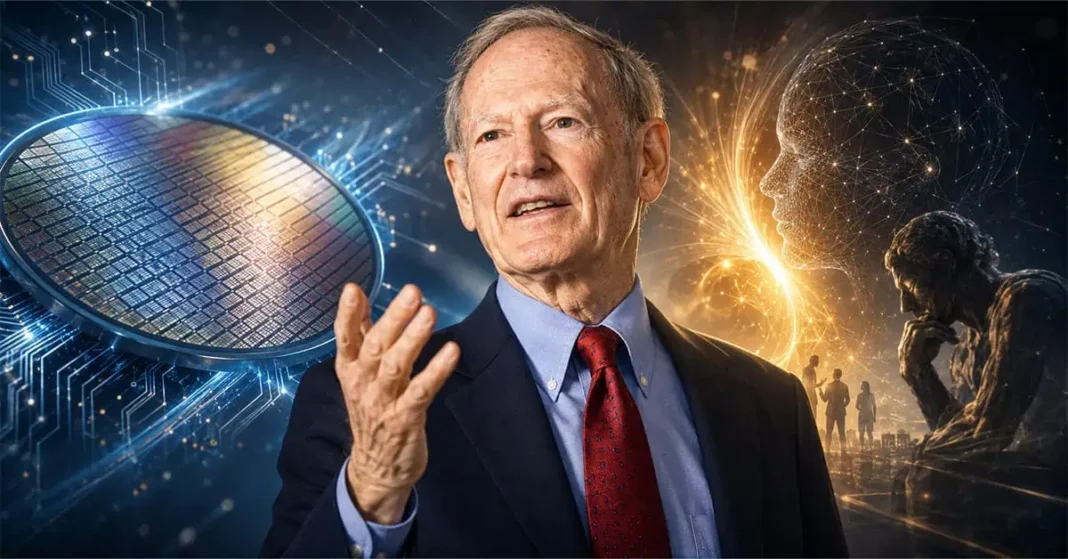


Imet Breaux Castleman at the Metropolitan Club in Manhattan before a Buckley Institute event featuring Dr. Jay Bhattacharya. The building reflected another era: marble, carved wood, sweeping staircases, and the confidence that important institutions could be built to endure. Castleman carried much the same impression. He had spent decades studying industries in transition, although medicine had not been his original destination. Banking, aviation, energy, and finance had already taught him how large systems reorganize themselves. Health care, he argued, followed the same trajectory, only more slowly. As he put it, “The whole transition typically takes about twenty years,” although in medicine, he believes the process has stretched to about forty.
His path into medicine began almost accidentally. A severe episode of amoebic dysentery landed him in a hospital, and shortly afterward, he was recruited from Booz Allen Hamilton to lead the struggling Kelsey-Seybold Clinic in Houston. There, he encountered a profession that still regarded itself as independent while economic forces were already reshaping it beneath the surface. Physicians believed they practiced medicine; insurers, legislators, and corporate managers increasingly believed they were managing a production system. Castleman watched that collision unfold from inside one of the nation’s pioneering multispecialty groups, and his conclusion remained remarkably consistent. “The whole concept of industrializing medicine arose,” he said, describing a process that would steadily consolidate physicians into larger organizations governed by increasingly standardized rules.
Listening to him, I realized that we had watched the same transformation from opposite sides of the camera. He observed it from the executive suite. I lived it from the examining room. My office remained a traditional storefront primary care practice north of Boston for decades. Patients arrived with diabetes, hypertension, infections, depression, aching joints, and the ordinary illnesses that physicians have treated for generations. Human biology changed very little. The liver still behaved like a liver. The kidneys still failed in familiar ways. What changed was everything surrounding the patient. Payment systems have changed. Ownership changed. Incentives changed. The physician gradually became another employee inside an expanding hierarchy.
Years before managed care became the dominant model, I encountered those incentives firsthand while working in one of the country’s early corporate walk-in clinic chains. The experience became the basis for my 1988 New England Journal of Medicine Sounding Board article, “The Pressure to Keep Prices High at a Walk-In Clinic.” I described how physicians were encouraged to order more laboratory studies and radiographs because those services generated revenue, and how my refusal to practice according to those expectations ultimately cost me my position. My criticism was never directed at one employer. It addressed the growing substitution of business incentives for professional judgment. Reading that article today, I am struck by how closely it anticipated the structural changes Castleman describes. Nearly four decades later, we reached many of the same conclusions by entirely different routes.
Castleman explained that evolution is almost like an engineer would. First came pressure to reduce physician compensation. Next came restrictions on what physicians could order, implemented through utilization review, prior authorization, and standardized treatment pathways. Finally, it came to shifting more financial responsibility onto patients through deductibles and copayments. Every reform promised greater efficiency; every reform also transferred authority away from the physician. “The doctors are the point of the spear,” he observed, yet increasingly someone else determined where that spear could be directed.
My own experience reinforced that conclusion. Administrators expected chest X-rays on patients whose histories rarely justified imaging because imaging generated income. That was never the medicine I learned or practiced. Diagnosis begins by listening. The physician’s greatest instrument remains judgment. Most clinical decisions are made cognitively during the first few minutes of the encounter; testing should confirm, refine, or occasionally overturn an impression. Good medicine and profitable medicine often coincide. When they diverge, however, the physician must choose which master to serve.
Castleman repeatedly returned to one observation that deserves far more attention than it receives. “Every single encounter with a patient and a doctor is unique.” That sentence appears obvious until one considers how difficult it becomes to maintain uniqueness within a standardized delivery system. The patient is unique. The physician is unique. Their relationship cannot be mass-produced without losing something essential. Medicine has always balanced science against judgment. Data informs judgment; it cannot replace it.
The analogy that occurred to me involved lawyers rather than physicians. Even someone widely believed to be guilty receives personal representation. O.J. Simpson’s attorneys represented one client rather than society. Patients deserve the same advocacy. A physician should primarily represent the individual sitting across the desk rather than the insurer, the hospital system, or the guideline committee. During COVID, that distinction often blurred. Physicians increasingly represented institutions rather than patients. Public health priorities became individualized mandates, even when individual circumstances differed substantially.
Castleman does not oppose technology. Quite the contrary. He believes information will become medicine’s defining resource. Artificial intelligence, predictive analytics, integrated medical records, and sophisticated imaging will continue improving diagnosis and coordination. “We are in the information age,” he reminded me. “The data is increasingly available, and with AI, it is going to accelerate.” He sees organizations such as Kaiser Permanente as prototypes of what much of American medicine will eventually resemble: integrated systems in which scheduling, diagnosis, referral, and payment become increasingly seamless.
I agree with much of that forecast. Better information should produce better decisions. Faster communication should reduce duplication. Artificial intelligence will almost certainly become an extraordinarily capable diagnostic assistant. Yet the central question remains unchanged. Who ultimately serves whom? If physicians become servants of algorithms, administrative protocols, and corporate metrics, patients will eventually recognize what has been lost. Many already have. They often tell me they spend more time looking at the back of a computer monitor than into their physician’s eyes.
When I wrote “The Pressure to Keep Prices High at a Walk-In Clinic” in 1988, I believed I was documenting an isolated corporate pathology. Looking back after my conversation with Breaux Castleman, I now see something larger. The incentives that appeared exceptional then gradually became structural. Castleman believes that industrialization will continue because economics and technology both favor consolidation. He is probably correct. History rarely reverses itself. The challenge, therefore, is not preserving yesterday’s practice model out of nostalgia. The challenge is preserving the physician’s independent judgment within tomorrow’s health care system. Machines will become better at computation. They may become better at diagnosis. They should never become the object of a physician’s loyalty. The Hippocratic tradition began with a physician accepting responsibility for a single patient. Every worthwhile reform should strengthen that bond rather than weaken it.
Discover more from Randy Bock MD PC
Subscribe to get the latest posts sent to your email.