
Mark Changizi thinks like an engineer but speaks like a poet of motion. His new book, Motorcycle Mind, begins with the idea that at speed, the machine stops being a machine. The rider stops commanding it; he becomes it.
“You’re still,” he said. “You just press. The whole thing leans. That’s the moment it becomes your body.” A slight push on the right grip and six hundred pounds of metal bends into a curve. Physics does the rest. “You’re not steering,” he said. “You’re signaling. The bike already knows.”
The transformation is ancient, not modern. Riding unlocks the mammal inside—the quadruped that humans forgot. “A horse runs on two sets of wheels, front and back,” he said. “When you ride, you feel that. The grace, the flow. It’s how other mammals move every day.” The hum of the engine is emotion made sound. “Every throttle change is a gesture. You hear the rider’s mood.”
Changizi’s mind shifts easily from wheels to eyes. In The Vision Revolution, he argued that color vision did not evolve for fruit but for flesh. “It’s an empathic sense,” he said. “We read oxygen in skin, see health and emotion. That’s why primates with color vision have bare faces and chests. To see feeling, you must see skin.” The placement of our color receptors—two side by side in the middle spectrum—matches the wavelength where hemoglobin changes from blue to red. “It’s tuned to blood,” he said. “To life itself.”
Sight, sound, motion—each becomes language. “When the bike revs, it’s like a face smiling or frowning,” he said. “Machines that we love mirror us. We build what fits our nervous system.”
From biology, he turns to behavior. Humans, he said, never stop signaling. Every tribe, ancient or modern, marks its members through cost or pain. “You see it in scarification, neck rings, lip plates, tattoos,” he said. “The mark proves loyalty.” In the new age, the marks come by scalpel. “The trans phenomenon works the same way,” he said. “Irreversible body change as proof of belief.” The ritual once meant to bind the clan now binds ideology. “The tragedy,” he said, “is that doctors bless it. Medicine became a priesthood, writing scripture after the fact.”
Changizi sees continuity in these instincts—the urge to belong, to express, to merge with what we make. The motorcycle is a clean version of it: union without harm, risk without deceit. “It’s honest,” he said. “You fall if you fake it.”
Color vision reveals a parallel truth. We evolved to detect sincerity—the blush, the pallor, the rush of blood that words can’t hide. “Our eyes are lie detectors built on empathy,” he said. “We were made to see one another clearly.” That clarity, he fears, is fading in an age that rewards posturing over perception.
He laughs at libertarians who forgot liberty when fear came. “Even the people who claimed to love freedom begged for mandates,” he said. The contagion, he argues, was not viral but moral. “Bottom-up authoritarianism—that’s what we lived through. The neighbor is screaming at you for breathing.”
The same reflex—tribal policing—fuels every mass hysteria. “The mob thinks it’s virtue,” he said. “They don’t see they’ve become the state.” The cure, in his view, lies where the disease began: in perception. “See people as they are,” he said. “Not as categories. Not as threats.”
The conversation turned to civility itself—the thin membrane that keeps society from tearing. “The essence of civilization,” he said, “is knowing when to shut up. To choose words over blows.” Yet even that restraint, he admits, now looks fragile. Violence comes wrapped in slogans of care.
He returns again to the image of the rider in motion. “Freedom is balance through movement,” he said. “You press, it moves. If you overcorrect, you crash. If you freeze, you fall.” The metaphor fits more than machines; it fits the species that built them.
For Changizi, the motorcycle is the mind externalized—a proof that physics and feeling share one grammar. It hums, it leans, it breathes. “It’s alive because we are,” he said. “And for a few seconds on the road, we remember what that means.”

Motorcycle Mind
Motorcycle Mind takes you beyond the handlebars and into the fascinating cognitive and perceptual world of motorcycling-a ride that’s more than just transportation; it’s a transformative way of being. Unlike…Read more →
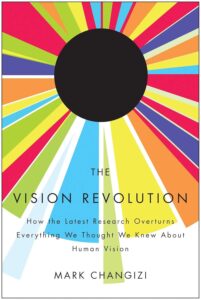
The Vision Revolution: How the Latest Research Overturns Everything We Thought We Knew About Human Vision
In The Vision Revolution: How the Latest Research Overturns Everything We Thought We Knew About Human Vision, Mark Changizi, prominent neuroscientist and vision expert, addresses four areas of human vision…Read more →
Join us at 5 pm ET weekdays on America Out Loud Talk Radio. Listen on iHeart Radio, our world-class media player, or our free apps on Apple, Android, or Alexa. Discover all the episodes on podcast networks, i.e., Apple Podcasts, Spotify, Pandora, TuneIn, Stitcher, and iHeart. You’ll find them the day after they air on talk radio, available on podcast. Extraordinary voices for extraordinary times.
Discover more from Randy Bock MD PC
Subscribe to get the latest posts sent to your email.