
Mental health in the United States has expanded into a vast, self-sustaining system, rich in diagnoses, protocols, and management plans, yet poor in cures. Eric Greene, a clinical psychologist trained in community mental health and later psychoanalysis, describes a system that increasingly treats social failure as individual pathology in The Mental Health Industrial Complex: A Study in Three Cases.
Greene began his career in a community clinic in West Philadelphia, serving a poor, largely Black population. What disturbed him most was not patient suffering but professional culture. Therapists, exhausted and underpaid, developed an adversarial stance toward those they served. “For some reason, the enemy became the patient,” he observed. The clinic functioned less as a place of healing than as a sorting mechanism, translating poverty, instability, and family fracture into medical labels.
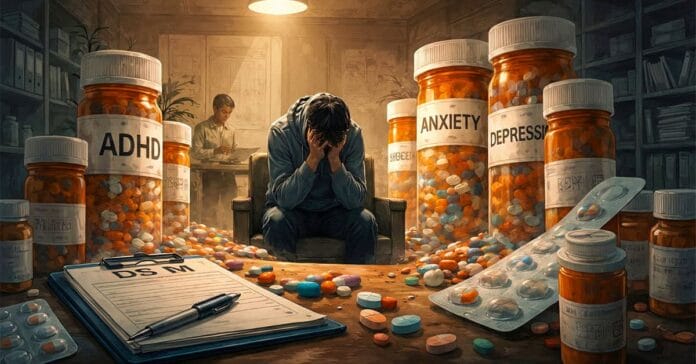
The dominant model, Greene argues, fails at the level of explanation. Psychological distress is framed as an internal malfunction rather than a response to lived conditions. “These social problems get transmuted into personal ones,” he said. Once translated, they become billable. Anxiety, ADHD, autism, and mood disorders multiply as categories not because human nature has changed, but because classification has.
The growth of diagnostic manuals tells the story. The DSM expanded from a slim volume into an encyclopedic catalog. With operationalized criteria came pharmaceutical alignment. “The model excludes cure,” Greene said. “What we have now is endless management.” Medication becomes permanent. Exit ramps disappear.
Greene does not deny that drugs help some patients. He rejects, however, their default use as a form of behavioral control. “Psychiatry turns people into docile bodies,” he noted, echoing thinkers like Foucault and Fanon. The goal becomes compliance, not insight. Patients learn to narrate themselves as diagnoses. Identity hardens around pathology.
His response was not reform from within but a departure. Greene left mainstream mental health and returned to psychoanalysis, drawing from Freud, Jung, and Lacan. The focus shifted from symptom suppression to language itself. “There is something inherent in the way people talk about themselves that produces suffering,” he said. Psychoanalysis does not strengthen the ego. It destabilizes it.
Children now occupy the front lines. Parents seek diagnoses to explain deviation from an imagined norm. Greene sees this as desperation masquerading as care. “People are clamoring to explain why their kids are not normal,” he said. The label offers relief but locks families into lifelong treatment pathways. Development becomes pathology by default.
Behind all this lies a deeper absence. Community has thinned. Families fracture. Authority disperses. What once would have been moral, spiritual, or social crises are routed into clinics. “Mental health is not an objective science,” Greene said. “People need to question the model itself.”
The mental health system did not merely respond to suffering. It reorganized it. In doing so, it built an industry that thrives on permanence. The result is a population fluent in diagnoses, medicated early, managed indefinitely, and rarely cured.
Discover more from Randy Bock MD PC
Subscribe to get the latest posts sent to your email.