
Garrett Wallace Brown entered health economics by studying low-resource systems, with much of his early work centered on Africa, where he examined how performance-based financing reshaped fragile health structures. When COVID hit, he warned that the world was drifting toward a single idea, to vaccinate our way out, while ignoring the broader calculus of public health. That critique unexpectedly pulled him into the centers of authority: the WHO, the World Bank, and the UK Cabinet Office. What he saw inside those institutions changed the course of his career.
Brown had been asked to help estimate the cost of proper pandemic preparedness. He gathered data, analyzed it, and turned it over to the WHO and the World Bank. Within weeks, they released a report. The inputs and outputs didn’t match. “They spat out this thing,” he said, “and it just looked incredibly weak.” When he pressed for the analysis pipeline, no one could (or would) explain how the numbers had been produced. The experience convinced him that the “evidence base” (sic) behind the new pandemic industry was far shakier than the headlines suggested.
Inside the UK’s COVID task force, the picture was no clearer. Brown sat alongside modelers, civil servants, and epidemiologists. Five models appeared each cycle; Neil Ferguson’s were always the most catastrophic, and always the ones the politicians adopted. “There was never (consideration of) a better scenario,” Brown said. Ministers chose the worst projections under what they called the “no regrets” doctrine: overreaction was preferable to the risk of being blamed for underreaction. The first two months, Brown recalled, were pure confusion. “These people have no idea what they’re doing,” he told his wife after the first meeting.
From the cruise ship outbreaks to China’s sealed-off data, he saw the same story: fragmentary evidence interpreted under fear. China’s numbers were viewed with suspicion, but the spectacle of Wuhan’s lockdowns carried weight. “There was this global groupthink,” Brown said. “Politicians wanted to look like they knew what they were doing.” Reasonable alternatives were pushed aside. He favored protecting the vulnerable, keeping schools open, and avoiding long lockdowns. His approach resembled Sweden’s, later vindicated, but at the time derided as reckless.
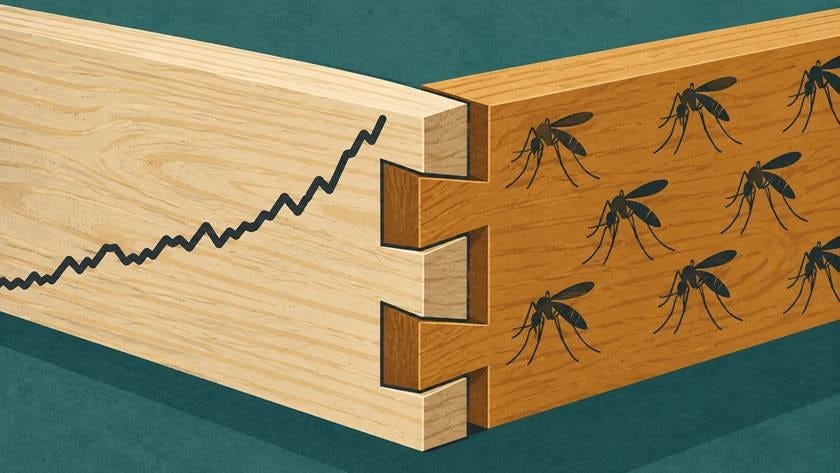
These experiences set the stage for REPPARE, the project he launched at Leeds to examine the post-COVID architecture. The team reviewed pandemic-risk claims, financial projections, and the new institutions created in the wake of COVID. They found the core assumptions deeply flawed. WHO-backed reports claimed a pandemic was “highly likely” in 20–40 years, citing a study that actually estimated 209 years for a COVID-scale event. Severity models leaned on the Spanish flu, ignoring that it occurred before antibiotics and amid a world war. None of the analyses accounted for the explosion of diagnostic capacity since 1983, when PCR made outbreak detection dramatically easier. Adjusted for detection, the trend of natural spillovers is downward, with COVID an outlier.
The economics were no better. Global cost estimates were extrapolated from a handful of wealthy countries with abundant data. Modelers assumed every expense during COVID —good, bad, or pointless —was necessary and therefore definitional. They also assumed the impossible: that proper preparedness would prevent “100 percent” of future pandemic economic losses. “No one in their right mind would say that,” Brown said.
The governance structures were even more lopsided. Every new institution —the pandemic fund, the hundred-day vaccine mission, the biohub in Germany —was built around the same sequence: detect a pathogen, sequence it, trigger an emergency declaration, and rush a vaccine to market. “It’s a one-trick pony,” Brown said. The approach ignores the real killers: malaria, tuberculosis, and malnutrition. In the Congo, 47,000 children die of malaria yearly, yet money is poured into smallpox vaccines for Mpox, at $1.2 million per life saved. “Ridiculous cost-effectiveness,” he said.
Brown sees a pattern: strong paradigms, entrenched interests, and a machinery that rewards fear. “It’s a bad cocktail,” he said. Still, he believes repair is possible. REPPARE’s work is meant to force honesty about evidence, cost, and priority– before the next panic takes hold.
Transcript Summary of this podcast episode ⤵Full Transcript (Auto-Transcribed)
We were told pandemic policy would be driven by science. What we got was a politics of fear dressed up as expertise. Models that drove lockdowns and mass purchases of PPE and vaccines were treated as prophecy. When those models were questioned, the impulse was to double down on the most extreme scenario and call it prudence. That choice cost lives and wrecked livelihoods.
Good public health begins with honesty about uncertainty. It also begins with prioritizing real harm. Twenty thousand children dying of malaria in a year matters more than a public relations panic over a few dozen Mpox deaths in one country. Tuberculosis kills over a million people every year. We ignored that reality while governments chased emergency funds for the next hundred-day miracle vaccines.
The global architecture being built now is fixated on a single playbook. Find a pathogen, sequence it, spin up countermeasures, distribute them fast. That narrow focus looks like progress on paper. In practice, it bets the farm on technologies that rarely stop transmission and that often take longer to perfect than policymakers imagine. The cost estimates that justify this betting are inflated. They treat indirect harms from lockdowns and rushed policy as if those harms were unavoidable costs of fighting a disease. They are not.
Institutions that should speak truth to power too often mirror the panic around them. Recommendations, once cautious, were rewritten to normalize social immobilization. Travel bans, school closures, and permanent mask mandates moved from outlier measures to default policy. That is not public health. That is securitization.
We must repair preparedness. Start with an honest risk assessment. Focus resources where they save the most lives per dollar. Protect the vulnerable. Respect medical freedom and truthful public debate. Stop treating every new pathogen as an existential enemy that justifies sweeping social control. Medicine serves patients, not panic.
Join us at 5 pm ET weekdays on America Out Loud Talk Radio. Listen on iHeart Radio, our world-class media player, or our free apps on Apple, Android, or Alexa. Discover all the episodes on podcast networks, i.e., Apple Podcasts, Spotify, Pandora, TuneIn, Stitcher, and iHeart. You’ll find them the day after they air on talk radio, available on podcast. Extraordinary voices for extraordinary times.
Discover more from Randy Bock MD PC
Subscribe to get the latest posts sent to your email.