
What happens when a physician decides that professional responsibility requires questioning the system rather than following it?
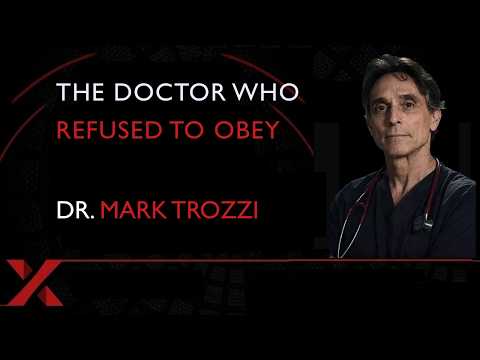
That is the central question behind the story of Dr. Mark Trozzi, a Canadian emergency physician whose career changed dramatically during the COVID-19 pandemic.
Trozzi entered the pandemic with nearly three decades of experience in emergency medicine. He describes himself as a physician trained to handle trauma, emergencies, and uncertainty—and as someone who wanted to become the kind of doctor a patient could depend on when there was no one else available.
Then, in 2020, he says, his assumptions about medicine and public health began to change.
His experience eventually led him away from clinical medicine, into public advocacy, and into a disciplinary battle with Ontario’s medical regulator.
The interview is not simply a discussion about COVID-19 vaccines or lockdowns. At its heart, it is an argument about medical judgment, informed consent, professional independence, and the responsibility of physicians during a crisis.
Editor’s note: This article summarizes and contextualizes claims and arguments made by Dr. Mark Trozzi during the interview. Several medical and scientific claims discussed below are contested and should not be interpreted as established medical fact or as personal medical advice.
Table of Contents
Who Is Dr. Mark Trozzi?
According to Trozzi’s account in the interview, he graduated from medical school in 1990 and had reached his 27th year working as an emergency physician when COVID-19 emerged in 2020. He also describes himself as an advanced trauma life-support instructor and says he held teaching positions at Sunnybrook, the University of Ottawa, and Queen’s University.
His professional identity was built around emergency medicine.
He describes working in rural emergency departments where he could be the only physician in the building, facing everything from automobile accidents and trauma to complicated deliveries and other emergencies. His goal, he says, was to become the doctor you would want if you could have only one doctor available.
That background is important to understanding why the COVID-19 experience affected him so profoundly.
He was not approaching the pandemic as someone unfamiliar with hospitals.
He was approaching it as an emergency physician.
The Empty Hospital That Changed His Thinking
One of the most striking moments in the interview concerns an experience Trozzi describes from the beginning of the pandemic.
He says he arrived at a hospital expecting the emergency department to resemble the crisis being described in the media.
Instead, he says he encountered an almost completely empty hospital.
There were no patients in the waiting room, no patients in registration, and no patients in the treatment rooms. At the same time, television coverage in the waiting area was describing emergency departments filled with people dying from COVID-19.
For Trozzi, the apparent contradiction became the beginning of a much deeper investigation.
Rather than simply accepting the official narrative, he says he began reading scientific literature, examining available information, and questioning the assumptions behind the policies being implemented.
That decision would eventually transform his career.
From Following Protocol to Questioning Protocol
One of the strongest themes throughout the interview is the difference between following medical protocols and actually exercising medical judgment.
Trozzi argues that physicians increasingly became technicians who followed changing instructions rather than independent professionals who understood the reasoning behind those instructions.
He recalls discussing the situation with a senior colleague and expressing his concern that what was happening did not make sense.
The response, according to Trozzi, was revealing:
“It is not our job to question public health.”
For Trozzi, that statement represented a turning point.
If physicians could not question public-health policy, he wondered, what happened to the traditional role of the physician as an independent decision-maker?
The question becomes even more important during an emergency, when evidence is incomplete and policies can change rapidly.
Medicine and the Principle of First Principles
Trozzi’s approach is rooted in what he describes as reasoning from first principles.
Instead of beginning with:
“What does the authority tell us to do?”
he prefers to begin with:
“How does this work, and what happens when it fails?”
That distinction matters.
Medicine has always involved uncertainty. Physicians frequently have to make decisions before every fact is known.
The professional challenge is therefore not simply memorizing the latest guideline. It is understanding physiology, pathology, risk, evidence, uncertainty, and the individual patient.
Trozzi argues that this responsibility cannot simply be transferred to a government agency, medical college, pharmaceutical company, or institutional protocol.
His broader argument is that a physician’s professional oath requires personal responsibility for medical decisions.
The COVID-19 Vaccine Debate
The most controversial portion of the interview concerns COVID-19 vaccines, particularly the mRNA technology used by Pfizer-BioNTech and Moderna.
Trozzi says he obtained and reviewed emergency-use authorization documents during 2020 and became increasingly concerned about the technology, its development timeline, and the way it was being presented to the public.
He focuses particularly on the use of messenger RNA delivered through lipid nanoparticles.
In the interview, Trozzi makes strong claims about the biological distribution and potential consequences of the technology. Those claims are his interpretation and should be distinguished from established scientific consensus.
For example, regulatory authorities continue to monitor COVID-19 vaccine safety and recognize adverse events such as myocarditis and pericarditis, while also concluding that the overall benefit-risk balance remains favorable for authorized uses.
That distinction is important.
A serious discussion of vaccine policy requires separating three different questions:
- What did regulators conclude?
- What did critics such as Trozzi argue?
- What does subsequent evidence show?
The interview primarily explores the second question.
Trozzi’s Objection to the Speed of the Rollout
Trozzi argues that the COVID-19 vaccine rollout placed a new vaccine platform into widespread use remarkably quickly.
His concern was not merely whether vaccines could work.
His deeper question was whether the evidence available at the time justified applying the technology broadly across populations with dramatically different levels of COVID-19 risk.
The transcript contains particular criticism of vaccination policies involving children and younger people. Trozzi argues that children faced a very different risk profile from elderly or medically vulnerable populations and therefore should not automatically have been treated as though their circumstances were identical.
This leads to a larger question about public-health policy:
Should a single intervention be applied uniformly to populations with radically different risks?
That is a legitimate policy question even when people disagree about the answers.
Informed Consent and Medical Freedom
For Trozzi, the vaccine debate ultimately becomes a question of informed consent.
He describes helping people who did not want COVID-19 vaccination and argues that individuals should not have needed special permission to make decisions concerning their own bodies.
This is where the discussion moves beyond vaccines.
It becomes a philosophical argument about the relationship between the patient, physician, government, and medical institution.
Who owns the final decision?
Who is responsible when the decision is wrong?
And can consent still be considered voluntary when employment, travel, education, or access to services depends upon compliance?
These questions remain central to debates about medical freedom.
The Cost of Medical Dissent
Trozzi’s decision to challenge COVID-19 policies came at a significant personal cost.
In the interview, he says he resigned from his job, described the decision as a sabbatical for human-rights work, sold his house, paid down debts, and moved his family into much simpler accommodations.
He says he made the decision because he believed he could no longer continue practicing medicine while remaining silent about what he considered serious ethical and scientific problems.
That decision turned his career into activism.
He began publishing videos and speaking publicly about COVID-19 policies, testing, vaccines, medical ethics, and the treatment of physicians who challenged prevailing policies.
The Fight With Ontario’s Medical Regulator
The dispute eventually reached the College of Physicians and Surgeons of Ontario.
Here it is important to distinguish the timeline in the interview from the official record.
The Ontario physician registry states that an Ontario Physicians and Surgeons Discipline Tribunal decision dated October 6, 2023 found Trozzi guilty of several forms of professional misconduct and found him incompetent. The tribunal subsequently ordered the revocation of his certificate of registration effective January 25, 2024. The registry also records that Trozzi appealed and that the Divisional Court dismissed the appeal in November 2024.
The World Council for Health, which supported Trozzi, describes the disciplinary action very differently, arguing that the regulator punished him for challenging COVID-19 policy and defending informed consent.
Those competing descriptions are essential to understanding the controversy.
One side sees professional misconduct and failure to meet medical standards.
The other sees institutional punishment of a physician who challenged the dominant narrative.
The facts of the disciplinary record can be established independently. The interpretation of those facts remains deeply contested.
What Happened to the Doctor Who Wouldn’t Comply?
The title of this interview—“The Doctor Who Refused to Obey”—captures Trozzi’s own interpretation of his story.
He does not portray his decision as a rejection of medicine.
Quite the opposite.
He portrays it as an attempt to return medicine to what he believes it should be: independent reasoning, scientific inquiry, informed consent, and responsibility to the patient.
His critics would describe the situation differently.
They would argue that professional independence does not exempt physicians from evidence-based standards, regulatory oversight, or professional accountability.
That disagreement is precisely what makes the story worth examining.
The World Council for Health
Trozzi became closely involved with the World Council for Health, an organization formed during the COVID-19 era that promoted alternative approaches to pandemic policy and public-health guidance.
The organization lists Trozzi among its leadership and coalition participants.
The World Council for Health has publicly supported Trozzi in his dispute with Ontario’s medical regulator and has promoted his work on COVID-19 policy, medical ethics, vaccines, and human rights.
For Trozzi, the organization became part of a broader effort to create an alternative institutional framework for physicians and scientists who believed that conventional health institutions had failed during the pandemic.
The Bigger Question: Who Decides Medical Truth?
The most important issue raised by this interview may not be whether every claim made by Trozzi is correct.
It is the question underneath those claims:
Who gets to decide what constitutes medical truth during a crisis?
Is it the government?
The medical regulator?
The hospital?
The pharmaceutical company?
The scientific consensus?
The individual physician?
Or some combination of all of them?
Science is not supposed to be an exercise in obedience.
But neither is medicine supposed to be an exercise in personal conviction detached from evidence.
The difficult territory lies between those extremes.
A healthy medical system needs scientists who can challenge prevailing assumptions without being automatically dismissed.
It also needs mechanisms capable of distinguishing legitimate scientific dissent from unsupported medical claims.
That balance becomes especially important during emergencies.
What Dr. Mark Trozzi’s Story Says About Physician Autonomy
Trozzi’s story presents physician autonomy as more than a professional privilege.
He sees it as an ethical responsibility.
If physicians are expected to exercise judgment, they must also be able to question policies, examine evidence, acknowledge uncertainty, and disagree with institutions when they believe patient interests are at stake.
At the same time, professional autonomy comes with accountability.
A physician cannot simply invoke independence as protection from scrutiny. Medical claims must remain open to examination, replication, criticism, and evidence.
That tension is not a weakness of medicine.
It is part of what makes medicine scientific.
The Price of Dissent
By his own account, Trozzi had spent decades building the life many physicians work toward: professional expertise, academic teaching, emergency medicine, a home, and financial stability.
He walked away from much of it.
The transcript describes him selling his assets, reducing his family’s expenses, and devoting himself to advocacy.
The official disciplinary record confirms that his Ontario medical registration was ultimately revoked.
Whether one agrees with Trozzi’s medical conclusions or not, the personal dimension of the story is difficult to ignore.
He believed that remaining silent would violate his understanding of the physician’s role.
So he chose professional consequences over compliance.
A Doctor’s Oath Versus Institutional Authority
The central conflict can therefore be reduced to a deceptively simple question:
When institutional authority and personal medical judgment collide, which one should a physician follow?
Trozzi’s answer is clear.
He believes the physician must reason independently and remain accountable to the patient rather than simply defer upward.
His critics would answer that medicine requires standards precisely because individual judgment can be wrong.
Both positions contain an important warning.
Blind obedience can become dangerous.
But so can certainty without evidence.
The challenge for medicine is to build institutions where neither problem dominates.
Why the Story Still Matters
The COVID-19 emergency has passed, but the institutional questions raised during the pandemic have not disappeared.
Future emergencies will again involve:
- incomplete scientific information;
- rapidly changing evidence;
- government intervention;
- public fear;
- emergency regulations;
- new medical technologies;
- competing interpretations of risk;
- professional disagreement;
- and pressure on doctors to act quickly.
The next crisis will therefore test the same principle.
Can medical institutions tolerate disagreement while maintaining standards?
Can physicians challenge policy without abandoning evidence?
Can governments communicate uncertainty honestly?
Can patients give genuinely informed consent?
And can regulators distinguish professional misconduct from legitimate scientific dissent?
These are not questions that belong to one political camp.
They belong to medicine itself.
The Doctor Who Walked Away
Dr. Mark Trozzi’s career illustrates the personal stakes of refusing to accept an institutional consensus.
He entered the COVID-19 era as an experienced emergency physician and teacher.
He emerged as a controversial public advocate whose medical registration was revoked after disciplinary proceedings.
His story can be interpreted as a cautionary tale about institutional authority.
It can also be interpreted as a cautionary tale about the responsibilities that come with professional dissent.
But perhaps the most valuable lesson is simpler.
Medicine needs doctors willing to ask difficult questions.
It also needs evidence strong enough to withstand those questions.
The future of medical trust depends on both.
Frequently Asked Questions
Who is Dr. Mark Trozzi?
Dr. Mark Trozzi is a Canadian emergency physician who became a prominent critic of COVID-19 public-health policies and vaccination strategies. In the interview, he describes a 27-year career in emergency medicine before shifting toward public advocacy during the pandemic.
What happened to Dr. Mark Trozzi’s medical license?
According to the College of Physicians and Surgeons of Ontario’s official registry, an Ontario Physicians and Surgeons Discipline Tribunal found Trozzi guilty of professional misconduct in October 2023 and ordered revocation of his medical registration effective January 25, 2024. His appeal was dismissed by the Ontario Divisional Court in November 2024.
Why did Dr. Mark Trozzi leave medicine?
Trozzi says he resigned from his job because he believed he could not continue practicing while remaining silent about what he considered serious problems with COVID-19 policy, vaccines, informed consent, and medical ethics. He says he subsequently devoted himself to human-rights advocacy and public education.
What does Dr. Mark Trozzi say about mRNA vaccines?
Trozzi argues that the rapid deployment of mRNA COVID-19 vaccines raised important questions about technology, safety, risk assessment, and informed consent. His views are controversial, and several of his specific medical claims differ from conclusions reached by major regulatory and scientific institutions.
What is Dr. Mark Trozzi’s position on informed consent?
Trozzi argues that individuals should have the right to make informed decisions about medical interventions affecting their own bodies. In the interview, he places informed consent at the center of his opposition to COVID-19 vaccination requirements.
Is Dr. Mark Trozzi still involved in medical advocacy?
Yes. Trozzi remains involved in public health and medical-policy advocacy and has been associated with the World Council for Health. The organization identifies him as a coalition partner and has published statements supporting his work.
What is the World Council for Health?
The World Council for Health is an organization that emerged during the COVID-19 era and promotes what it describes as independent public-health guidance. Trozzi has been involved with the organization since its early period and has served in leadership/steering roles.
Why is Dr. Mark Trozzi controversial?
Trozzi is controversial because he publicly challenged COVID-19 policies, vaccine strategies, and prevailing medical narratives. His disciplinary case resulted in the revocation of his Ontario medical registration, while organizations supporting him argue that he was punished for dissenting from official policy.
What is the main lesson from Dr. Mark Trozzi’s story?
The broader lesson is about the tension between physician autonomy and institutional authority. Trozzi argues that doctors must retain the freedom to question policy and exercise independent judgment. His disciplinary case raises broader questions about how medical institutions should handle scientific disagreement during public-health emergencies.
Final Takeaway
Dr. Mark Trozzi’s story is ultimately a story about the price of dissent.
Whether readers agree with his conclusions about COVID-19, vaccines, public-health policy, or medical regulation, his experience forces a difficult question into the open:
What should happen when a physician believes that following the system means violating his professional conscience?
Trozzi chose to walk away from the career he had spent decades building.
His medical license is gone.
His advocacy continues.
And the debate over physician autonomy, informed consent, scientific disagreement, and institutional authority is far from finished.
Sometimes the most important question in medicine is not “What are we being told to believe?”
It is:
“What evidence would make us change our minds?”
Research & Further Reading
- Dr. Mark Trozzi’s official website
- Dr. Mark Trozzi News
- Dr. Mark Trozzi biography
- https://rumble.com/DrTrozzi
- Ontario physician registry — Mark Raymond Trozzi
- https://hpdt.ca/trozzi-22-006
World Council for Health statement on Dr. Trozzi’s license
Discover more from Randy Bock MD PC
Subscribe to get the latest posts sent to your email.