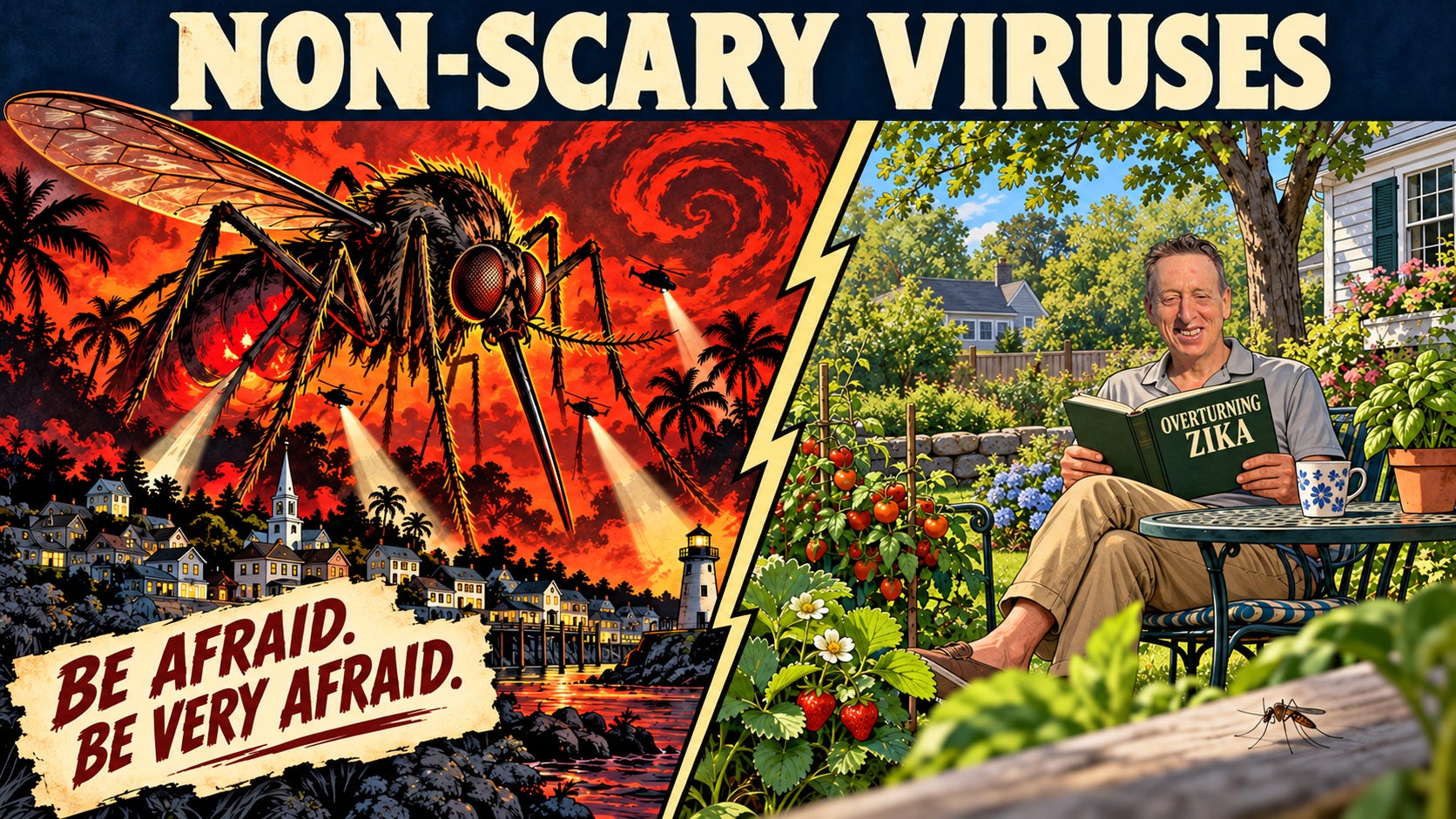


In 2015, the world watched in horror as news emerged from Northeast Brazil about a devastating new threat: the Zika virus, supposedly causing severe birth defects called microcephaly in babies. The World Health Organization declared it a Public Health Emergency of International Concern (PHEIC). Travel advisories were issued. Pregnant women across Latin America were terrified. The U.S. Congress allocated $1 billion for vaccine development and emergency response.
Then something remarkable happened: the Zika microcephaly crisis simply disappeared. No explanations. No corrections. No accountability. Just silence.
A Virus That Never Caused Human Illness
Dr. Randall Bock, a primary care physician and author of “Overturning Zika: The Pandemic That Never Was,” has spent years investigating what really happened during those chaotic months. His findings reveal a troubling story of scientific misconduct, flawed diagnostic standards, media sensationalism, and questionable vaccine development priorities that should serve as a cautionary tale for future public health emergency response.
Zika virus, discovered in Uganda’s Zika Forest in 1947, had warranted only a dozen scholarly articles in 60 years — because it had never caused documented human illness. As Dr. Bock explains, “Not a single case of human medical illness had previously been attributed to Zika.”
The virus is essentially identical to dengue, which causes a million cases of “bone-break fever” annually in Brazil without any associated microcephaly. Both are flaviviruses transmitted by the same Aedes aegypti mosquito. Dr. Steven Harrison, a PhD professor at Boston University, believes Zika should simply be classified as “dengue 5” due to their remarkable similarity.
The Foundation of a Flawed Zika Microcephaly Narrative
In 2014, a WhatsApp group of Brazilian physicians formed “ChickV the Mission” — named after the 1986 Robert De Niro film “The Mission.” Their stated goal was to find a viral outbreak in Northeast Brazil’s impoverished regions to draw attention, funding, and resources to address health inequities.
They were hoping for Chikungunya virus. Instead, they found — or rather, created — a story that would become the Zika microcephaly panic that gripped the world.
Three Critical Failures That Created a Phantom Zika Microcephaly Pandemic
Failure #1: Unverified Testing Without Peer Review
In April 2015, a married couple of PhD researchers in Bahia, Brazil — Silvia Sardi and Gubio Suarez Campos — tested blood samples from undiagnosed fever cases using a Zika PCR primer of questionable provenance. Without submitting their findings for peer review or verification by Brazil’s regulatory agency (Anvisa), they leaked their “discovery” to the press.
The husband admitted there was no treatment for Zika beyond Tylenol and that it would resolve on its own in days. Yet he justified bypassing scientific protocols by calling it a public health emergency. As Dr. Bock pointedly asks: “If there’s no treatment for it, it goes away, it’s mild, never had any illnesses, how can it be a public health emergency?”
Failure #2: Wrong Diagnostic Standards for Microcephaly
Brazil was using a diagnostic standard of two standard deviations below the mean for head circumference — meaning 2.4% of all newborns would automatically be classified as microcephalic regardless of actual health issues. The World Health Organization standard called for three standard deviations (0.15% of births).
When Brazil corrected its standards in December 2015, reported microcephaly cases dropped from 600 nationwide to essentially zero. The Zika microcephaly “epidemic” disappeared overnight — not because the virus went away, but because Brazil fixed its measuring stick.
Failure #3: Correlation Without Causation
In August 2015, Dr. Vanessa Vander Linden, a neuropediatrician in Recife, saw what appeared to be a temporary spike in microcephaly cases — from the usual 7-8 babies in the wards to about 15. Rather than recognizing this as normal statistical variation, it was declared an epidemic.
Dr. Carlos Brito, part of the ChickV group, conducted a retrospective study with massive selection and recall bias: he called mothers whose babies already had microcephaly and asked if they’d experienced fever, rash, or chills during pregnancy. In a tropical region among poor populations, nearly all said yes. He immediately leaked to the press that “Zika causes microcephaly” — a claim that has never been corrected in the mainstream literature on congenital Zika syndrome.
Geographic Anomalies That Don’t Add Up
The mosquito-borne nature of Zika virus should have created consistent patterns across regions. Instead:
- Colombia had similar Zika exposure but only 46 microcephaly cases compared to Brazil’s 2,000
- Cases clustered in urban Northeast Brazil’s poverty areas, not following mosquito distribution
- Southern Brazil claimed cases despite having no Aedes aegypti mosquitoes
- The Amazon basin, with extensive mosquito populations, had minimal cases
As Dr. Bock notes, scientists were bewildered by Zika’s path. The pattern suggested word-of-mouth panic rather than genuine viral transmission driving the Zika microcephaly numbers.
The Zika Virus Vaccine Development Agenda
Perhaps the most troubling aspect of the Zika microcephaly story involves continued vaccine development despite the crisis having vanished.
Dr. Fauci’s Persistent Pursuit
The U.S. allocated $1 billion for Zika response in September 2016 — after the crisis had already shown signs of being a mirage. About $400 million was earmarked for Zika virus vaccine development.
Dr. Anthony Fauci, then director of NIAID, faced a catch-22: to prove a vaccine’s efficacy, the virus needs to be circulating. When Brazil’s own ethics panels forbade human challenge trials, Fauci offered Brazil $100 million to host such trials anyway. Brazil refused.
Undeterred, NIAID proceeded with human challenge trials in Baltimore through Johns Hopkins, injecting and infecting women with Zika — despite no ongoing transmission, no microcephaly cases since 2016, and opposition from his own wife, Christine Grady, chief bioethicist at HHS, whose entire career had been built on preventing exactly such unethical research.
Bill Gates and mRNA Vaccine Development
In 2017, Bill Gates promised Moderna $100 million to develop a Zika virus vaccine using mRNA vaccine development technology. This was years before COVID-19, establishing precedent for expedited mRNA vaccine development for “emergencies.”
The Human Cost: 100,000+ “Ghost Babies”
Dr. Bock estimates at least 100,000-200,000 children were never conceived due to Zika fear-mongering. The WHO recommended complete birth moratoriums throughout tropical regions until a vaccine existed. Several countries and regions followed this guidance.
Nearly a decade later, there’s still no approved Zika vaccine. If people had followed WHO advice indefinitely, there would be no children under age 10 in entire regions of Latin America.
Still No Zika Vaccine in 2026
As of April 2026, the U.S. Food and Drug Administration, Brazil’s regulators, the European Medicines Agency, and the UK have still not approved a single Zika vaccine or monoclonal antibody, and no Phase 3 trial has been completed — largely because there are too few real-world cases left to power a meaningful study. More than a dozen candidates remain stuck in Phase 1 or Phase 2 a decade after the emergency was declared. That is not the profile of a virus that justified a global public health emergency response in the first place.
Lessons for Future Public Health Emergency Response
The Zika microcephaly case reveals systemic problems in how public health emergencies are declared, communicated, and resolved:
1. Transparency Over Speed. Scientific findings should never be leaked to media before peer review, regardless of perceived urgency.
2. Correct the Record. When an emergency declaration proves unfounded, there must be public acknowledgment and correction. The silence around Zika microcephaly’s disappearance has allowed the false narrative to persist.
3. Question “Conspiracy of Interests.” This wasn’t a coordinated conspiracy but rather multiple actors benefiting from maintaining panic: researchers getting funding, pharmaceutical companies developing vaccines, politicians addressing inequity, media getting stories.
4. Market-Based Accountability. Government agencies need the same accountability mechanisms as private companies. When wrong repeatedly, there should be consequences — not continued funding and authority.
5. Ethical Boundaries Matter. Human challenge trials for a non-circulating virus with no ongoing threat cross ethical lines, regardless of how much funding is available.
Parallels to COVID-19 Response
Many readers will recognize familiar patterns: emergency declarations with insufficient scientific rigor, diagnostic criteria problems, vaccine development continuing past the emergency phase, a lack of acknowledgment when predictions don’t materialize, and censorship of scientists questioning official narratives.
Dr. Bock’s investigation began before COVID-19, but the parallels are striking. His inability to publish his findings in any mainstream medical journal despite clear evidence mirrors experiences of many scientists during the pandemic.
What Happened to Scientific Integrity?
The Zika microcephaly story represents a fundamental failure of the scientific method. When Brazil corrected its diagnostic standards and microcephaly vanished, not a single major scientific journal retracted or revised its claims. The New England Journal of Medicine, JAMA, The Lancet — all published extensively on Zika microcephaly. None have corrected the record.
Dr. Bock attempted to publish his findings in dozens of outlets, keeping a detailed spreadsheet of rejections. The editor of JAMA expressed interest but refused publication because “we don’t want to sow doubt in the public health establishment” during the early COVID-19 pandemic.
Moving Forward: Demanding Accountability
As we face potential future health emergencies, the Zika microcephaly case offers critical lessons:
For Scientists: Resist pressure to bypass peer review. Short-term attention isn’t worth long-term credibility loss.
For Journalists: Verify claims independently. Don’t amplify panic without examining underlying data.
For Public Health Officials: Build trust through honesty, including admitting mistakes. Trust destroyed is nearly impossible to rebuild.
For Citizens: Maintain healthy skepticism. Ask for data. Question claims that rely on fear rather than evidence.
For Policymakers: Create accountability mechanisms for emergency declarations. Require regular review and sunset provisions for any public health emergency response.
Conclusion: The Pandemic That Should Teach Us Everything
The Zika microcephaly saga isn’t just history — it’s prophecy. The same institutional failures, perverse incentives, and resistance to accountability that created this phantom pandemic remain embedded in our public health infrastructure.
Dr. Bock’s warning is clear: “If we don’t overturn the concept that this was never a real thing to begin with, soon enough for an unwitting public, we will have a Zika vaccine and it will get mandated.”
The question isn’t whether another manufactured crisis will emerge — it’s whether we’ll have learned enough from Zika microcephaly to recognize and resist it.
The ghost babies of Brazil deserve better. So do we.
FAQs
What is the connection between Zika microcephaly and the 2015-16 Brazil outbreak?
Zika microcephaly refers to the claimed link between Zika virus infection during pregnancy and microcephaly, a birth defect involving an abnormally small head. The connection was first proposed in Brazil in 2015 based on unpeer-reviewed testing and flawed diagnostic standards, and the World Health Organization declared it a Public Health Emergency of International Concern in February 2016.
Is there currently an approved Zika virus vaccine?
No. As of 2026, no regulatory agency, including the FDA, Brazil’s health authority, the European Medicines Agency, or the UK, has approved a Zika virus vaccine or monoclonal antibody. More than a dozen candidates remain in early-phase trials, and no Phase 3 trial has been completed due to insufficient ongoing cases to measure effectiveness.
Why did microcephaly cases in Brazil drop so suddenly in late 2015?
Brazil had been using a diagnostic threshold of two standard deviations below average head circumference, which misclassified roughly 2.4% of all healthy newborns as microcephalic. When Brazil adopted the World Health Organization’s three-standard-deviation standard in December 2015, reported cases fell from around 600 to nearly zero almost overnight.
What is congenital Zika syndrome?
Congenital Zika syndrome is the clinical term used to describe a pattern of birth defects, including microcephaly, brain calcifications, and eye abnormalities, that researchers attributed to Zika virus infection during pregnancy. Critics, including Dr. Randall Bock, argue the syndrome was defined using biased retrospective studies rather than rigorous, peer-reviewed causal evidence.
What lessons does the Zika microcephaly case offer for future public health emergency response?
The Zika microcephaly episode highlights the need for peer review before media disclosure, consistent diagnostic standards across regions, public correction of the record when emergency declarations prove unfounded, and built-in accountability and sunset provisions for future public health emergency response decisions.
Randall Bock’s articles at Brownstone

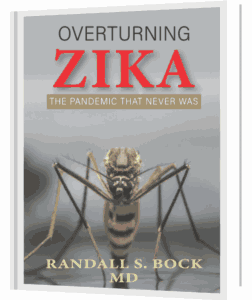
Get Dr. Randall Bock’s Book “Overturning Zika: The Pandemic That Never Was”
Discover more from Randy Bock MD PC
Subscribe to get the latest posts sent to your email.