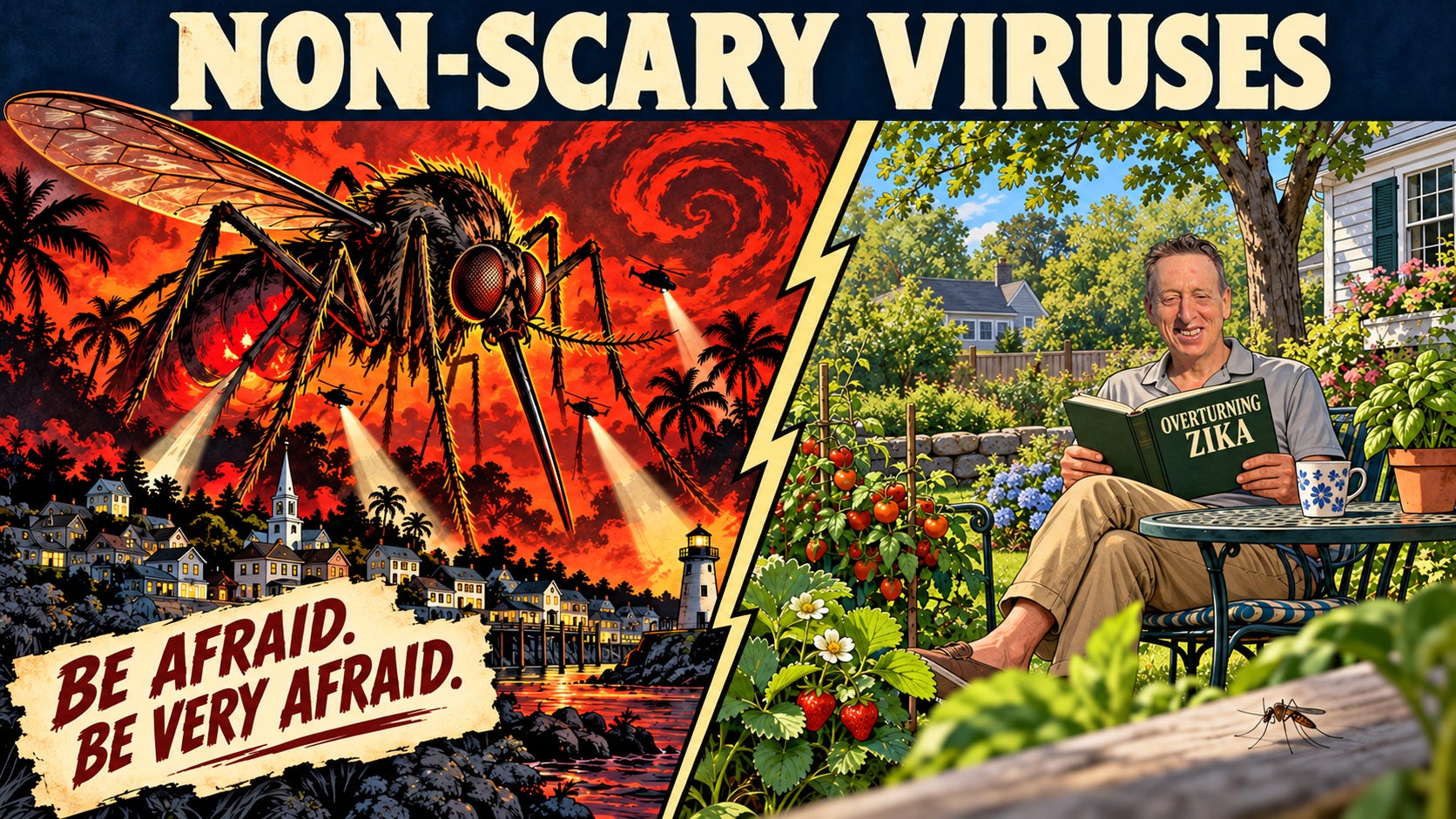


What if one of the biggest problems in modern public life is not that there are too few warnings, but that there are too many?
That is one of the central questions raised by journalist and author John Tierney in this wide-ranging conversation about willpower, public health, journalism, media bias, COVID lockdowns, human progress, and what he calls the “crisis crisis.”
Tierney’s intellectual journey did not begin with a political doctrine. He describes arriving at skepticism through journalism itself: reporting, investigating, and repeatedly discovering that the real world did not always behave according to the assumptions he had been given.
That distinction matters.
Instead of beginning with a theory and searching for evidence to confirm it, Tierney learned to begin with the evidence and then reconsider the theory.
His career—from newspapers and science magazines to The New York Times, books, and City Journal—gave him an unusual vantage point. He became interested not merely in science, but in the broader question of rationality under pressure.
Why do people believe alarming predictions?
Why does bad news attract so much attention?
Why do institutions sometimes respond to uncertainty by demanding more control?
And why does a supposed crisis so often become an argument for policies that create new problems?
These questions sit at the heart of Tierney’s idea of the “crisis crisis.”
Table of Contents
From Journalism to Skepticism
Tierney describes himself as partly a science writer and partly a generalist. His career included newspaper reporting in the 1970s, work at science magazines, a long career at The New York Times, books, and later writing for City Journal.
That broad experience shaped his worldview.
He did not say that he began with a fully formed philosophy of liberalism, conservatism, or libertarianism. Instead, journalism repeatedly forced him to confront a basic problem:
The world often refuses to conform to the narrative.
That can be an uncomfortable lesson.
A journalist may arrive somewhere expecting to find a particular problem and discover something much more complicated. A prediction may sound convincing until the deadline arrives. A trend that looks catastrophic in one news cycle may look entirely different when examined over decades.
Tierney’s skepticism therefore emerged less from ideology than from observation.
He learned to ask:
- What actually happened?
- What was predicted?
- How large was the problem?
- What happened over the longer term?
- What assumptions were wrong?
- What unintended consequences followed the proposed solution?
That habit became increasingly important as his work moved toward science, psychology, and public policy.
Julian Simon and the Lesson of Looking at Trends
One of the most important intellectual influences on Tierney was economist Julian Simon.
The connection began when Tierney was sent to Kenya to report on population growth. The assignment was framed around the idea of a population crisis and the problems supposedly created by rapid demographic growth.
Before leaving, however, Tierney contacted Simon.
Simon challenged the conventional framing.
Instead of automatically interpreting population growth as catastrophe, he encouraged Tierney to look at what was actually happening.
The experience became transformative.
Tierney later returned to a Kenyan village that had previously been portrayed as an example of demographic disaster. What he found was strikingly different.
The village had adapted.
People were moving to cities. Money was being sent back home. Infrastructure had improved. Piped water had arrived. And the woman whose growing family had previously been presented as a symbol of impending disaster had changed her own plans.
The reality was not the static catastrophe that the original narrative suggested.
It was a story about adaptation.
Tierney says this became one of the pieces of reporting he was most proud of because it demonstrated Simon’s larger point: human beings respond to changing circumstances.
The lesson was simple but profound:
Do not confuse a snapshot with a trend.
A problem can be real without being an existential crisis.
A negative event can happen without meaning that the future is inevitably negative.
And a frightening projection is not the same thing as an observed outcome.
The “Crisis Crisis”
This is where Tierney’s concept of the crisis crisis becomes important.
The phrase emerged from his work with social psychologist Roy Baumeister, particularly their book The Power of Bad.
Tierney had spent much of his career examining exaggerated or misleading crisis narratives, including claims surrounding energy, species extinction, and other supposed emergencies. He began to notice a recurring pattern.
The media environment rewards alarming stories.
As the old journalistic saying goes, bad news gets attention.
But psychology provides another piece of the puzzle.
Baumeister’s research on the negativity bias suggested that people tend to react more strongly to negative events than positive ones. Tierney describes the basic finding bluntly: bad is stronger than good.
That creates a powerful feedback loop.
A frightening story attracts attention.
Attention creates incentives for more frightening stories.
Politicians can respond to public fear.
Activists can use fear to mobilize support.
Media organizations can use fear to retain audiences.
And institutions can use emergencies to justify extraordinary interventions.
The result is what Tierney calls the “crisis crisis.”
He summarizes its rules roughly this way:
- The world will always be presented as being in crisis.
- The crisis will rarely be as bad as advertised.
- The proposed solution may make things worse.
This does not mean that every crisis is imaginary.
It means that the existence of a genuine problem does not automatically validate the most alarming interpretation of it—or the proposed solution.
Why Bad News Is So Powerful
The psychology behind the crisis crisis is especially important.
Humans naturally pay attention to threats.
A newspaper headline saying that nothing terrible happened today is unlikely to attract millions of clicks.
A headline warning that disaster is approaching is different.
This creates what Tierney and Baumeister describe as an environment where the power of bad can overwhelm the quieter evidence of improvement.
Tierney’s advice is therefore not to ignore bad news.
It is to put bad news in context.
A school shooting is real.
A terrorist attack is real.
A disease outbreak can be real.
A failing institution can be real.
But none of those facts automatically tells us what the larger trend looks like.
Tierney argues that readers should therefore curate their information sources carefully. Instead of allowing the day’s most frightening anecdotes to define their worldview, people should examine long-term trends.
This is perhaps one of the most useful ideas in the entire conversation.
Anecdotes tell us what happened. Trends tell us how often it happens.
Those are not the same thing.
The Denominator Matters
One of the simplest ways to understand the problem is to ask:
Compared with what?
Suppose ten terrible events receive enormous media attention.
That sounds frightening.
But what if the population is 300 million people?
What if the number of incidents has actually declined over twenty years?
What if the relevant denominator has increased?
What if the probability of the event is far lower than the emotional presentation suggests?
This is why statistical context matters.
A dramatic individual story can be completely genuine while still giving us a distorted picture of the larger reality.
Tierney’s approach is essentially an argument for statistical humility.
Before concluding that society is collapsing, ask what the historical baseline was.
Before concluding that something is getting worse, look at the trend.
Before demanding extraordinary government action, examine the costs of the intervention.
And before accepting a frightening prediction, ask whether the person making it is willing to make a precise, testable forecast.
Make Predictions Testable
One of Tierney’s suggested antidotes to crisis forecasting is simple:
Make people bet on their predictions.
The logic comes from Julian Simon.
It is easy to announce catastrophe.
It is much harder to put a specific prediction on the record and accept consequences if it fails.
Tierney discusses the idea of prediction markets and Simon’s famous willingness to make bets. The purpose is not that every prediction must be correct. Rather, specific predictions create accountability.
A vague prediction cannot easily be falsified.
“Things are going to get much worse” can survive almost indefinitely.
A measurable prediction cannot.
This provides a useful rule for evaluating public warnings:
Ask what exactly is being predicted, by when, and compared with what baseline.
The more precise the prediction, the easier it becomes to determine whether it was actually successful.
Willpower and the Power of Self-Control
The conversation also turns from society to the individual.
Tierney’s collaboration with Roy Baumeister produced Willpower, a book focused on self-control and human behavior.
Baumeister’s work became a major influence on Tierney because it connected psychology with practical everyday life.
The central subject was something deceptively ordinary:
Can people control themselves?
Tierney explains that Baumeister’s research focused heavily on self-control and that this work became the basis for their collaboration.
The official description of Willpower likewise presents the book as an exploration of self-control, temptation, goal-setting, and the practical ways people can improve their ability to regulate behavior. (Penguin Random House)
This is more than a self-help question.
Self-control influences work, health, relationships, finances, education, and countless everyday decisions.
It also connects to a broader principle in Tierney’s thinking:
Human beings have more agency than many modern narratives assume.
That does not mean circumstances are irrelevant.
It means that the capacity for deliberate action should not be dismissed.
The Unfinished Task and the Power of Making a Plan
One particularly interesting example from the conversation concerns unfinished tasks.
Tierney discusses research associated with the Zeigarnik effect, the idea that unfinished tasks can remain mentally active and distract us.
His practical lesson is useful even outside the scientific debate surrounding the underlying research.
If something cannot be completed immediately, make a plan for it.
The act of creating a concrete plan can reduce the mental burden of the unfinished task and allow attention to return to other priorities.
This gives willpower a practical dimension.
Self-control is not necessarily about constantly fighting temptation through heroic effort.
Sometimes it is about designing an environment in which less effort is required.
Create routines.
Set clear goals.
Finish what can be finished.
Make plans for what cannot.
Reduce unnecessary decisions.
Build habits.
In other words, good systems can conserve willpower.
Public Health and the COVID Lockdowns
The most controversial section of the interview concerns COVID lockdowns and public health.
Tierney describes the pandemic as a major test of his broader theory about crisis narratives.
Importantly, his argument is not that COVID was imaginary.
He explicitly distinguishes COVID from many of the crises he had previously investigated. The issue, in his view, was how institutions responded to the problem and whether the response was proportionate to the evidence.
He describes the lockdowns as an extraordinary public-policy decision with costs extending beyond the virus itself.
According to the interview, he believes lockdown policies imposed significant costs on children, education, the economy, social life, and public trust. He was also struck by what he viewed as the degree of media conformity surrounding the policies.
This is central to the public health argument in the interview.
Public health decisions cannot be evaluated solely by asking whether they reduce one particular risk.
They must also account for:
- educational disruption
- economic damage
- mental and social consequences
- delayed medical care
- effects on children
- loss of institutional trust
- unintended behavioral consequences
- the opportunity costs of government intervention
The fundamental question becomes:
Did the intervention reduce more harm than it created?
That is a much harder question than simply asking whether the intervention had a benefit.
When Public Health Becomes Too Broad
The interview also raises a larger question about the changing mission of public health.
Tierney describes public health as having expanded beyond traditional disease prevention into a much broader attempt to address social problems.
This expansion creates a difficult philosophical problem.
If public health becomes responsible for solving virtually every social problem, then almost any government intervention can potentially be justified as a public-health measure.
At that point, the boundaries of public health become difficult to define.
What should remain an individual’s responsibility?
What belongs to families?
What belongs to communities?
What belongs to doctors?
What belongs to government?
And when government acts, who evaluates the unintended consequences?
These are not merely political questions.
They are questions about institutional competence and accountability.
The Media Problem
Tierney’s criticism of media incentives runs throughout the interview.
He argues that the internet transformed the economic structure of journalism. Subscription-based media can become increasingly dependent on giving audiences the content they already want, potentially reinforcing ideological niches.
That creates a difficult environment for independent thinking.
If readers want fear, give them fear.
If readers want outrage, give them outrage.
If readers want confirmation, give them confirmation.
The problem is not confined to one political side.
Any media organization can fall into the trap.
The result is an information environment in which people increasingly live inside separate narratives.
Each side sees evidence confirming its worldview.
Each side sees the other side’s stories as propaganda.
And the possibility of shared reality becomes harder to maintain.
Tierney’s answer is not to stop reading.
It is to curate sources.
Read people who challenge your assumptions.
Look for evidence rather than emotional intensity.
Read outside your preferred ideological niche.
And, above all, compare claims against outcomes.
The World May Be Better Than It Feels
Perhaps the most optimistic part of the interview comes near the end.
Tierney argues that, over the long term, many measures of human well-being have improved dramatically.
He points to improvements in areas such as electricity, running water, longevity, education, literacy, and living standards.
The paradox is striking.
As life improves, people in wealthy societies can become more convinced that the world is deteriorating.
Meanwhile, people in poorer or developing countries may be more optimistic because they can see improvements happening around them.
They see electricity arriving.
They see running water.
They see children going to school.
They see longer lives.
They see expanding opportunities.
This leads to an important distinction:
Feeling worse does not necessarily mean that things are worse.
Human beings experience the present emotionally.
History is measured comparatively.
Those are different perspectives.
Hope Without Gullibility
The lesson is not blind optimism.
Tierney is not arguing that every institution works, every trend is positive, or every warning is false.
Quite the opposite.
His argument is that skepticism should work in both directions.
Do not automatically believe the doomsayer.
But do not automatically believe the optimist either.
Look at the evidence.
Examine the trend.
Check the denominator.
Test the prediction.
Compare the costs and benefits.
Ask what happened after the policy was implemented.
And remember that human beings adapt in ways that simplistic forecasts often fail to anticipate.
The Kenyan experience that changed Tierney’s thinking is a perfect example.
The predicted catastrophe was not the whole story.
People adapted.
They moved.
They changed family plans.
They invested.
Infrastructure improved.
The future turned out to be more complicated than the original narrative.
What John Tierney’s “Crisis Crisis” Teaches Us
The most important lesson from this conversation is not simply that some crises are exaggerated.
It is that fear can distort our perception of reality.
Once fear becomes the dominant frame, several things can happen.
We notice negative anecdotes while ignoring positive trends.
We overestimate rare dangers.
We underestimate adaptation.
We demand immediate action.
We accept extraordinary restrictions.
And we may fail to calculate the damage created by our own response.
That is the crisis crisis.
The danger is not that problems do not exist.
The danger is that our reaction to problems can become disconnected from proportion.
A real problem can become an exaggerated crisis.
An exaggerated crisis can produce political pressure.
Political pressure can produce sweeping intervention.
And sweeping intervention can create new problems that then require another intervention.
The cycle continues.
A Better Way to Think About Public Problems
Tierney’s approach suggests a simple checklist for evaluating the next alleged crisis.
1. Look at the long-term trend
Don’t let one frightening news cycle define the entire picture.
2. Check the denominator
Ask how common the event actually is.
3. Separate anecdotes from evidence
One compelling story does not necessarily establish a national trend.
4. Demand specific predictions
Ask what exactly is expected to happen and when.
5. Examine incentives
Who benefits from public fear?
Who receives money, attention, power, or influence?
6. Calculate the cost of the solution
A policy can solve one problem while creating another.
7. Look for adaptation
Human beings respond to changing conditions.
8. Curate your information sources
Do not allow an algorithm or news cycle to determine your entire worldview.
9. Compare today with history
The present can look frightening when compared only with an imagined perfect world.
10. Stay hopeful—but skeptical
Optimism does not require gullibility.
Skepticism does not require pessimism.
Why Willpower and Crisis Thinking Belong Together
At first glance, willpower and the crisis crisis might seem like unrelated subjects.
They are not.
Both concern the ability to resist immediate pressures.
For an individual, willpower means resisting temptation and staying focused on long-term goals.
For a society, rationality requires resisting the temptation to respond emotionally to every alarming headline.
In both cases, the short-term impulse can overwhelm the long-term objective.
An individual sees an immediate temptation.
A society sees an immediate threat.
The individual acts impulsively.
The government acts urgently.
The individual later regrets the decision.
The society later discovers unintended consequences.
The solution in both cases is similar:
Pause. Think. Look at the evidence. Consider the long-term consequences.
The Case for Rational Optimism
There is something refreshing about Tierney’s conclusion.
After decades of reporting on crises, studying psychology, covering COVID, and challenging conventional assumptions, his answer is not despair.
It is cautious optimism.
The world is imperfect.
Institutions make mistakes.
Media incentives can distort information.
Governments can overreach.
Humans are vulnerable to fear and negativity.
But none of those facts requires us to conclude that civilization is collapsing.
The historical record can support a more hopeful interpretation.
The challenge is to see that progress without becoming complacent—and to recognize danger without becoming hysterical.
As Tierney puts it in the spirit of the conversation: be hopeful, and be careful who you follow.
That may be the best antidote to the crisis crisis.
Final Thoughts
John Tierney’s career offers an unusual lesson for anyone trying to understand public health, media bias, willpower, and modern crises.
His skepticism was not born in a political classroom.
It was developed through reporting.
He went into the world expecting to find one story and repeatedly found something more complicated.
Kenya taught him that demographic growth could coexist with adaptation and improvement.
Julian Simon taught him to look at long-term trends.
Roy Baumeister introduced him to the psychology of self-control and negativity bias.
The Power of Bad helped explain why negative information can dominate public attention.
And COVID provided perhaps the most dramatic modern example of how fear, institutions, media incentives, and public policy can interact.
The conclusion is neither “believe everything” nor “believe nothing.”
It is more demanding:
Count. Compare. Question. Test. Think.
A crisis may be real.
The fear surrounding it may still be disproportionate.
The proposed solution may still cause greater damage.
And the long-term trajectory may still be better than the headlines suggest.
That is why rational skepticism is not pessimism.
Sometimes skepticism is the path to hope.
Frequently Asked Questions
Who is John Tierney?
John Tierney is a journalist and author known for his work on science, psychology, public policy, and social trends. His career has included The New York Times, science magazines, books, and City Journal.
What is the “crisis crisis”?
The “crisis crisis” is John Tierney’s term for the recurring tendency to portray society as being in perpetual crisis. In The Power of Bad, Tierney and Roy Baumeister connect this phenomenon to the psychological power of negative information.
What is John Tierney’s view of willpower?
Tierney’s work with Roy Baumeister examines willpower and self-control, including ways people can improve self-control, manage temptation, and establish habits that make good behavior easier. (Penguin Random House)
How does Julian Simon influence John Tierney?
Julian Simon influenced Tierney by encouraging him to examine evidence and long-term trends rather than automatically accepting crisis narratives. Tierney’s reporting trip to Kenya became a particularly important example of this lesson.
What does John Tierney say about COVID lockdowns?
In the interview, Tierney argues that COVID lockdowns produced substantial costs for children, education, the economy, health, and society, and he criticizes the media and public-health response for failing to sufficiently question those costs.
What is negativity bias?
Negativity bias is the tendency for negative events or information to have a stronger psychological impact than positive events. Tierney discusses this concept through Roy Baumeister’s research in The Power of Bad.
Why does Tierney emphasize long-term trends?
Because individual anecdotes can be misleading. Tierney argues that readers should examine long-term trends rather than allowing a small number of dramatic events to define their understanding of society.
What is the main lesson of the interview?
The central lesson is to remain skeptical without becoming cynical: examine evidence, question crisis narratives, consider unintended consequences, and recognize that long-term human progress can coexist with serious short-term problems.
Discover more from Randy Bock MD PC
Subscribe to get the latest posts sent to your email.