
The pediatric vaccine schedule 2025 has been fundamentally rewritten. The Department of Health and Human Services officially reduced the number of routine childhood vaccine recommendations from 17 antigens down to 11 — a structural policy shift that reintroduces clinical discretion, aligns the United States more closely with peer nations like Denmark and Japan, and removes COVID-19, flu, and RSV shots from the automatic universal list. If you are a parent, a pediatrician, or anyone with a stake in childhood health policy, this change directly affects you.
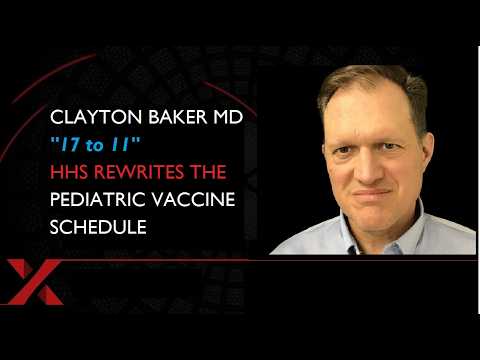
In a detailed clinical interview on America Out Loud Pulse Radio, physician Clayton Baker, MD, offered one of the first on-the-record professional assessments of what the pediatric vaccine schedule 2025 update actually means, why the press reaction has been disproportionate, and what parents should be asking their doctors right now.
“HHS has announced that they have reduced the number of recommended vaccines on the pediatric vaccine schedule from 17 specific vaccines down to 11.”
— Clayton Baker, MD — America Out Loud Pulse Radio
Table of Contents
Pediatric Vaccine Schedule 2025: What Exactly Changed and Why It Matters
The updated pediatric vaccine schedule 2025 does not eliminate any vaccine from availability. Every shot that previously appeared on the universal list remains fully covered under the Affordable Care Act, Medicaid, CHIP, and the federal Vaccines for Children program. No parent is being told they cannot vaccinate their child. What changed is the classification of six vaccines — moving them from automatic universal recommendation to either high-risk group targeting or shared clinical decision-making between parent and pediatrician.
Here is a precise breakdown of the childhood immunization schedule update:
| Vaccine | Previous Status | New Status (2025) |
| DTP, Hib, Pneumococcal, Polio, MMR, Varicella | Universal Routine | REMAINS: Universal Routine |
| HPV | Universal: 2 doses | UPDATED: Universal, 1 dose only |
| COVID-19 | Universal Routine | Shared Decision-Making |
| Influenza (Flu) | Universal Annual | Shared Decision-Making |
| RSV | Universal (Infants) | Shared Decision-Making |
| Rotavirus | Universal Routine | Shared Decision-Making |
| Hepatitis A & B | Universal Routine | High-Risk Groups Only |
| Meningococcal | Universal Routine | High-Risk Groups Only |
| Dengue | High-Risk Areas Only | Remains High-Risk Only |
The most significant removals from the routine pediatric vaccine schedule 2025 list are the three mRNA-platform or mRNA-trending shots: COVID-19, flu, and RSV. Together, these represent the vaccines that required annual or recurring administration and that Baker identifies as carrying the highest unresolved evidentiary questions.
7 Powerful Reasons the Pediatric Vaccine Schedule 2025 Had to Change
1. The United States Was a Global Outlier on Childhood Immunization
A December 2025 Presidential Memorandum directed HHS to benchmark the U.S. childhood immunization schedule update against peer developed nations. The findings were striking: the United States recommended more childhood vaccine doses than any comparable country, and in many cases more than twice the number recommended by nations with equivalent or superior pediatric health outcomes.
2. Denmark and Japan Offer Proven, Narrower Models
Two nations were prominently featured in the policy review: Denmark and Japan. Critics immediately argued that Denmark is too small and too demographically uniform to serve as a comparison point. Baker dismissed this reasoning directly, noting that Japan — with a population of 120 million people — made a deliberate decision to move the majority of its pediatric vaccine recommendations to after a child’s second birthday, and subsequently documented significant population health benefits. Japan is not a small, homogeneous country.
3. The COVID-19 Vaccine Was Never Appropriate for Universal Pediatric Mandate
Baker was direct on this point: children face a statistically minimal risk from COVID-19 itself. A healthy eight-year-old, he noted, faces roughly 100,000 times less mortality risk from COVID-19 than an 80-year-old in a nursing home. Yet the COVID-19 vaccine was placed on the universal pediatric vaccine schedule 2025 predecessor list without the same evidentiary standard applied to the vaccines that remain on it. The mRNA platform used had never completed standard Phase 2 and Phase 3 clinical trials before mass rollout began.
4. The mRNA Platform Carries Unresolved Safety Questions
Baker referenced two large-scale observational studies: one from South Korea covering approximately 8 million individuals and a parallel study from Italy covering around 700,000. Both found elevated cancer incidence rates among mRNA COVID vaccine recipients versus unvaccinated cohorts over a one-year follow-up period, with five of six specific cancer types matching between the two independently conducted studies.
EDITORIAL NOTE — Medical Accuracy Disclosure:
The cancer incidence findings cited above are observational and represent contested minority positions in the medical literature. They are not endorsed by the CDC, WHO, or mainstream oncology bodies. These findings have been disputed by mainstream researchers who cite confounding factors including age distribution and detection bias. Readers should consult their pediatrician and review primary peer-reviewed research before making vaccination decisions.
5. Reducing Antigenic Burden on Infants Is Clinically Rational
One of the least-discussed but most significant arguments in favor of updating the pediatric vaccine schedule 2025 is the cumulative antigenic burden placed on infants. Under the previous schedule, a child could receive six or more simultaneous injections in a single visit at six months of age. Baker cited documented reports, particularly among infant girls, of adverse outcomes following multiple simultaneous vaccinations. Regardless of which specific vaccines are involved, reducing concurrent antigenic exposure in neonates and young infants has a rational clinical basis.
6. The HPV Two-Dose Reduction Is Supported by Evidence
The reduction of the HPV vaccine recommendation from two doses to one is not simply a cost-cutting measure. Scientific evidence has emerged indicating that a single dose provides comparable immunological protection to a two-dose series for most recipients, and adverse events have been disproportionately associated with the second dose. Baker, who has been involved in HPV vaccine injury litigation, noted that several peer nations had already adopted the single-dose protocol before the U.S. change. This update brings the U.S. into alignment with existing international evidence-based practice rather than departing from it.
7. Shared Decision-Making Is Simply Good Medicine
The new shared decision making vaccines framework that governs the six removed vaccines does not represent a radical departure. It represents the return of informed consent as a foundational principle of clinical practice. Baker described shared decision-making as what the doctor-patient relationship in pediatrics always should have been: a conversation between a clinician and a parent, grounded in the individual child’s health profile, family history, risk factors, and values.
“Shared decision-making is basically informed consent. I don’t say to anyone: ‘Time for your flu shot, roll up your sleeve.’ I say: ‘We have the flu shot. If you’re interested, I can give it to you. If you have any questions, I can answer them.’”
— Clayton Baker, MD
Childhood Immunization Schedule Update 2025: How the Press Got It Wrong
The mainstream press response to the childhood immunization schedule update was rapid and largely hostile. Baker described major outlets as functioning as pharmaceutical industry mouthpieces, noting that within minutes of the announcement, headlines were warning of epidemic-level consequences without engaging in any comparative data analysis.
The two central press arguments were that the U.S. cannot be compared to Denmark because of demographic differences, and that removing vaccines from universal recommendation will inevitably increase disease burden. Baker addressed both. The Denmark comparison, he argued, collapses entirely once Japan is included in the analysis. And the claim that removing a vaccine from the universal recommendation schedule is equivalent to banning it fundamentally misrepresents what the policy change actually does.
Baker also noted that the press failed to acknowledge even a single concession: not one outlet he reviewed included the sentence “maybe we don’t need all of them.” The framing was absolute denial rather than proportionate analysis.
HHS Vaccine Schedule Changes 2025: What the AAP Split Means for Parents
The American Academy of Pediatrics has declined to adopt the updated CDC schedule that reflects HHS vaccine schedule changes, publishing its own 2026 immunization guidance independently. This is an unusual and significant institutional divergence: the nation’s leading pediatric organization and the federal government are now operating on different recommendation frameworks.
For parents, this creates real-world complexity. The pediatrician in the room may be following AAP guidance. The CDC’s published schedule reflects the HHS directive. And state-level school entry requirements — which are set independently of federal recommendations — have not yet been updated in most states. Parents navigating the pediatric vaccine schedule 2025 landscape need to understand all three layers of authority.
Pediatric Vaccine Schedule 2025: What Parents Should Do Right Now
Here is a practical action checklist for parents navigating the updated pediatric vaccine schedule 2025:
- All previously recommended vaccines remain fully covered by insurance, Medicaid, CHIP, and the Vaccines for Children program — nothing has been taken away from you.
- Six vaccines now require a shared clinical decision-making conversation rather than automatic administration. Ask your pediatrician to explain the current evidence for each.
- COVID-19, flu, and RSV vaccines are no longer on the universal routine list. You may still choose to get these for your child; coverage remains in place.
- The HPV vaccine remains on the universal recommended list, but now as a single dose rather than two. Ask your child’s doctor whether the single-dose protocol applies.
- State school entry requirements are separate from the federal schedule and have not automatically changed. Check your state health department for current requirements.
- The AAP maintains a different 2026 schedule from the updated HHS/CDC version. Your pediatrician may be following AAP guidelines; ask which framework they use.
- Bring a list of questions to your next well-child visit. The new policy explicitly supports you in having this conversation — shared decision-making is now official federal policy.
Key External Resources on the Pediatric Vaccine Schedule 2025 Update
The following authoritative sources provide official and analytical context on the childhood immunization schedule update:
• CDC Immunization Schedule Portal: CDC Recommended Immunization Schedule
• AAP 2026 Immunization Schedule: American Academy of Pediatrics Immunization Schedule
• WHO Global Vaccine Schedule Reference: WHO Immunization Schedules by Country
• Brownstone Institute — Dr. Baker’s Research: Clayton Baker, MD at Brownstone.org
Conclusion: The Pediatric Vaccine Schedule 2025 Shift Is a Recalibration, Not a Repudiation
The pediatric vaccine schedule 2025 change is not the end of childhood vaccination. It is the beginning of a more honest conversation about which vaccines every child needs, which require individual clinical judgment, and who has the authority to make that call. The HHS decision removes COVID-19, flu, and RSV from the automatic universal list. It keeps DTP, MMR, polio, and the other long-established vaccines firmly in place. It reduces HPV from two doses to one based on emerging evidence. And it introduces a shared decision-making framework that makes federal policy consistent with basic medical ethics.
Dr. Baker’s core argument is that the pediatric vaccine schedule 2025 predecessor was not built on comparative international evidence, did not apply consistent evidentiary standards across all included vaccines, and placed an unnecessary antigenic burden on the youngest and most immunologically vulnerable patients. Whether the HHS response goes far enough is a legitimate debate. That the old schedule needed review is, increasingly, not.
The question the pediatric vaccine schedule 2025 update forces every parent and every clinician to answer is the same one that should always have been asked: not ‘What is on the list?’ but ‘What does this child need?’
About Dr. Clayton Baker, MD
Clayton Baker, MD, is a practicing physician, author, and host on America Out Loud Pulse Radio (Thursdays, 5 PM ET). He has contributed extensively to Brownstone.org on vaccine policy, public health ethics, and the COVID-19 era. His book The Medical Masquerade is available on Amazon and Barnes & Noble. Follow him on X at @CJBakerMD.
Discover more from Randy Bock MD PC
Subscribe to get the latest posts sent to your email.