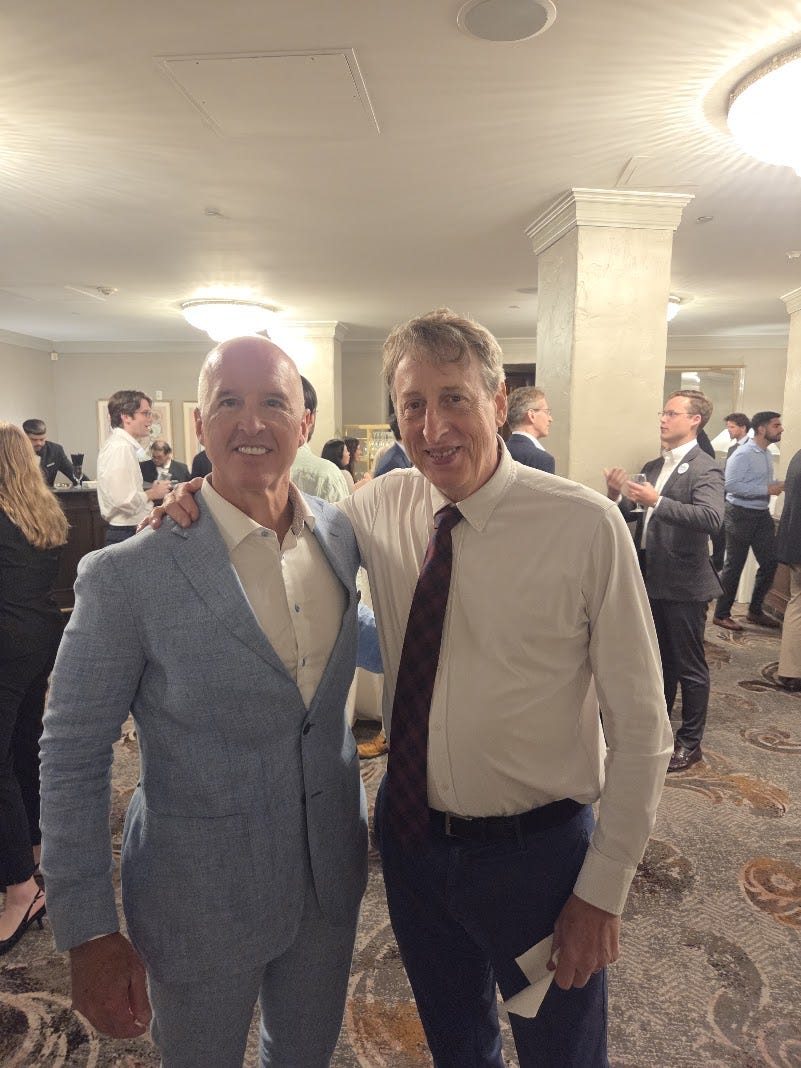


Gabrielle Bauer spent most of her professional life writing about medicine rather than politics. A medical writer for more than three decades and the author of several books, she entered public controversy through a side door. COVID pushed her there. What she witnessed during those years convinced her that free expression, long assumed secure in Western democracies, rested on shakier foundations than many people imagined.
“During COVID is when I realized that free speech wasn’t guaranteed,” she said. Online insults did not particularly concern her. Those are part of modern life. What concerned her was watching people lose jobs, standing, and reputations for questioning prevailing narratives. The experience eventually drew her into the Free Speech Union of Canada, a sister organization to Toby Young’s Free Speech Union in Britain. “I just realized late in life that I have a passion for free speech.”
That commitment to free inquiry formed the backbone of a conversation that ranged from assisted dying to autism, from diagnostic inflation to gender ideology, and from public morality to private decision-making. The connecting thread was not politics. It was the question of how societies assign value to human life.
Bauer describes herself as “politically homeless for sure.” She sees free speech increasingly defended by conservatives while many contemporary liberals have shifted toward protection from offense, emotional harm, and social disruption. Yet she does not identify comfortably with the political right. Her views on Canada’s “Medical Assistance in Dying” program, known as MAID, illustrate why.
“People are too attached to the idea that we should and need to live as long as possible,” she argued. In her view, modern medicine often treats death as a technical failure rather than an inevitable human event. She pointed to therapies that cost hundreds of thousands of dollars while extending life only briefly. “We don’t really have much respect for the natural arc of life anymore.” Society, she suggested, has become preoccupied with preserving what philosopher Giorgio Agamben called “bare life,” biological existence detached from many of the qualities that once gave it meaning.
I approached the issue from a different direction. Physicians have always guided patients through illness and death. They have not traditionally served as agents of death itself. Hospitals already possess mechanisms that allow patients and families to refuse aggressive treatment, withdraw interventions, and permit life to end naturally. The distinction matters because allowing death and causing death have never occupied precisely the same moral ground. Once medicine crosses that boundary, questions arise that extend far beyond individual autonomy.
Those questions emerged again when the conversation turned toward prenatal diagnoses and disability. Bauer cited the recent public controversy surrounding a couple who terminated a pregnancy after learning the fetus had Down syndrome. Public condemnation was widespread. Yet she noted a striking discrepancy between public rhetoric and private behavior. “The statistics which don’t lie say that about sixty percent, maybe sixty to sixty-six percent in the US, make the same decision if they get that diagnosis.” In some European countries, she observed, the percentage climbs much higher.
“What people actually think privately is a little bit different than what they’re saying publicly.” That observation struck at a broader reality. Human beings routinely make utilitarian calculations while simultaneously insisting they do not. Public morality and private decision-making do not always coincide.
The subject led naturally into autism. Here, Bauer’s views overlapped considerably with my own. “I believe there is no autism epidemic,” she said. “The diagnosis has just expanded to an absurd degree.” Conditions once associated with profound impairment now encompass people who function independently, maintain careers, raise families, and often describe themselves as merely socially awkward.
The search for causes has become almost obsessive. Vaccines, environmental toxins, dietary factors, and countless other explanations compete for attention. Yet diagnostic expansion alone explains a substantial portion of the apparent increase. As categories broaden, prevalence inevitably rises. A condition that once described Rain Man now often describes someone who struggles to make eye contact at a party.
The pattern extends beyond autism. Definitions expand. Diagnostic boundaries drift. Ordinary human variation becomes pathology. Language loses precision while institutions gain authority.
Bauer applied similar reasoning to gender ideology. She does not dismiss gender dysphoria as imaginary. She questions the framework through which modern society interprets it. “You can have something that is real and amplified a thousand-fold by social contagion.” Human beings have always experienced discomfort, alienation, and uncertainty. The language used to explain those experiences changes across generations.
That concern about social contagion intersects directly with free speech. Institutions increasingly discourage scrutiny of fashionable ideas. The result is not stronger science but weaker science. As I argued during our exchange, science functions much like competition. Ideas face one another. Evidence accumulates. Better explanations survive. The answer to a challenging argument should never be silence. “The answer is always shut up,” I observed, describing what institutions do when they can no longer defend a position on its merits.
Bauer agreed. Her concern was not that dissenters are always correct. They are not. Her concern was that society loses the ability to correct mistakes when dissent becomes unacceptable. Whether discussing pandemic policy, Indigenous grave claims in Canada, autism, gender ideology, or assisted dying, the underlying principle remained the same.
“I’d like to see a world in which we can all be more honest and speak freely and listen to what the other person is saying,” she said. We arrived at different conclusions on some subjects, particularly MAID. Yet the broader question remained unresolved and perhaps unresolvable. Human beings possess value that cannot always be measured by utility, productivity, cost, or convenience. Whether the subject is euthanasia, disability, autism, aging, or public policy, every society eventually confronts the same challenge. It must decide which lives deserve protection, which ideas deserve hearing, and which assumptions deserve scrutiny. The health of a free society depends less on the answers than on its willingness to keep asking the questions.
Discover more from Randy Bock MD PC
Subscribe to get the latest posts sent to your email.