
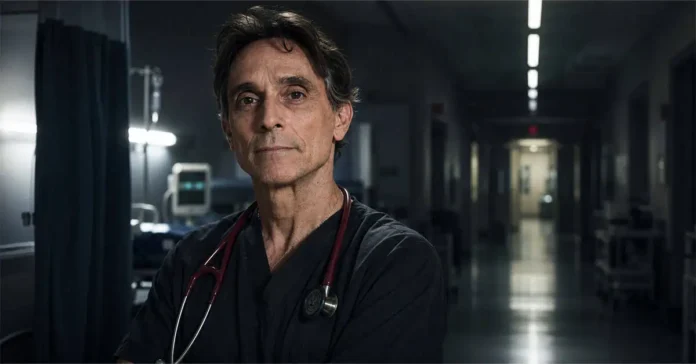
Mark Trozzi spent twenty-seven years in emergency rooms before he walked away from the work that made him. He trained in trauma, taught at three universities, and built his practice in rural Ontario, where a single physician on a night shift might face a car wreck, a breech delivery, and a chainsaw injury before dawn. He liked that the work left no room to hide behind a specialist, and he wanted to be the doctor you would want if you could have only one.
When the pandemic reached Canada, Trozzi expected the floods the screens described, and he found something else instead. He walked into hospitals that stood empty while the televisions in their waiting rooms ran footage of the collapse. “Then came the day that I would come into an absolutely empty hospital. No one in the waiting room, not a single patient in any room, zero patients,“ he says. The gap between the room and the broadcast set him reading, and the reading hardened fast into a verdict. “It was very obvious very early that the public was being lied to on a scale that I don’t think we’ve ever seen in the world,“ he says, and from there the rest of his thinking unspools.
What he believes broke is not the virus but the profession’s habit of mind. He holds that physicians traded judgment for protocol somewhere in the last century, and that the doctor who once reasoned from the body outward became a technician reading a chart. “There’s been a gradual shift towards diagnostic criteria and treatment protocol, and this is like thinking like a computer,“ he says. The cost of that drift, in his telling, is a physician who can no longer defend a recommendation except by pointing upward. “This is how doctors have become non-thinking high priests in a cult,“ he says, and he offers it as a description rather than a taunt.
Against that, he sets an older standard he learned from a teacher and has never let go of. “If you understand how a thing works, you can understand how it breaks, so you should think from first principles,“ he says. He frames the oath as a personal duty rather than an institutional one, owed to the patient in the room ahead of the bureaucracy, the ministry, and the manufacturer. “The oath says, to the best of your judgment, not the best of somebody else’s judgment,“ he says, and the line organizes everything that follows. The duty, for him, stays plain at the bedside. “When I sit down with a patient, I’m not there to decide whether they should live or die. You’re sick, you’ve got a problem, you need help, and I’m going to help you to the best of my ability,“ he says.
His sharpest objection is technical, and it is the one I raised myself. The messenger RNA shots were a new platform moved onto the whole population at speed, with the long follow-up compressed and the foundational work never properly shown. “Absent any phase two or phase three studies of the mRNA platform at all,“ I noted of the push to inject young women and children, the order was reversed, the population used to prove a technology rather than the technology proven before it reached the population. Regulators counted large accelerated trials and an emergency review; both of us counted the follow-up too short and the mechanism too novel to earn that trust.
Trozzi points to the road not taken. More conventional designs were in production elsewhere, the inactivated whole-virus shots made in China and India, and the protein-subunit vaccines built from pieces of the virus rather than instructions to manufacture them. Those platforms carried decades of precedent behind them. The decision to lead the West with the newest method instead of the more familiar ones is, for him, the whole case in miniature, a choice that treated novelty as a virtue when caution was the safer reading.
His license is gone now. The College of Physicians and Surgeons of Ontario ruled against him in 2023 over what he said in public about the pandemic and the shots, and he disputes that ruling still. The details of that proceeding are their own long argument, and they are not the measure of the man. What the case establishes plainly is the cost. He resigned, sold his house, cut his family’s spending, and gave his hours to the World Council for Health and to the defense of other physicians caught in the same machinery, and he presents none of it as tragedy.
The draconian texture of those years belongs in the record too, and hindsight should not sand it away. Borders closed, and families were kept from deathbeds, and dissent inside hospitals was unwelcome, whether or not the dissenter turned out to be right. Trozzi worked the floor through all of it, and he reached his conclusions in the room before he ever argued them in public.
The question he leaves is older than the pandemic. Someone decides medical truth in an emergency, and something happens to the physician who decides differently. He answers that trust should rest on a willingness to reason in the open rather than on a credential or a directive, and he means to keep at it on those terms. “I’m going to maintain the Hippocratic Oath and the basic Christian oath to treat others the way I want to be treated for as long as I can keep moving my arms and legs,“ he says. “Sometimes to keep your vocation, you have to leave your job.“ The career is gone, but the calling, by his telling, remains.
Discover more from Randy Bock MD PC
Subscribe to get the latest posts sent to your email.