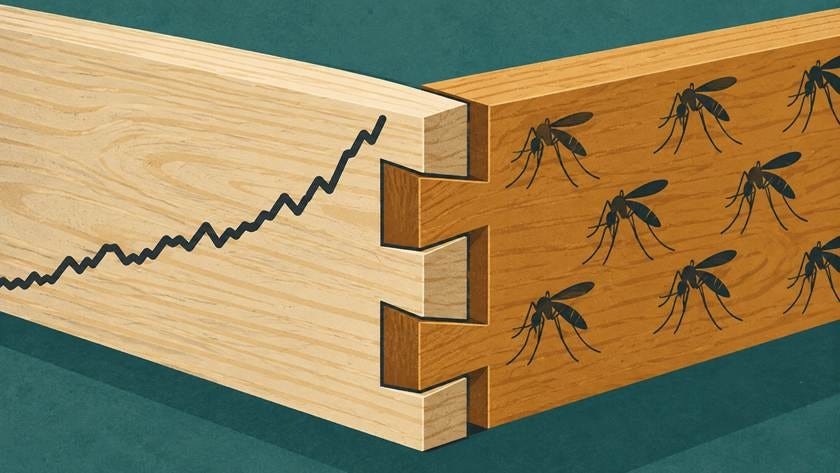

Three people die aboard a cruise ship off Patagonia from the Andes hantavirus. Roughly 150 passengers and crew remain together aboard the vessel for weeks while authorities monitor symptoms and track infections. Eleven cases emerge. The event explodes across international media with a familiar rhythm: frightening graphics, urgent headlines, expert commentary, and the insinuation that another global biological emergency may already be underway.
Then the story disappears almost overnight. Ebola replaces it. Before Ebola was Mpox; before Mpox, avian flu. Before avian was the return of Mpox in Africa; before that, COVID; before COVID, Zika. The names change; the cadence does not. A steady drip of outbreak anxiety now forms part of the background noise of modern life. David Bell, physician, former WHO adviser, and specialist in tropical medicine and public health, notes that “the main unexpected thing about it is that it became a huge news story,” because hantavirus itself is neither new nor especially efficient at human transmission.
That point matters because the real story no longer concerns the pathogen alone. The deeper issue concerns the use of perpetual biological anxiety as a mechanism of institutional expansion. Bell observes that “someone really wanted it to be a big news story,” and his statement captures the broader architecture surrounding modern outbreak politics. Fear keeps populations attentive, compliant, and psychologically prepared for emergency rule. Fear also creates markets. Pharmaceutical companies require customers; public health bureaucracies require missions; global organizations require justification for their continued growth and authority.
The WHO pandemic treaty sits directly inside that framework. Publicly, the treaty presents itself as a cooperative instrument designed to improve global coordination during future outbreaks. In practice, critics increasingly view it as an attempt to formalize the emergency powers, censorship structures, surveillance systems, and pharmaceutical pipelines that emerged during COVID.
Bell points toward the transformation of WHO funding itself, explaining that “WHO’s funding has shifted from predominantly states’ giving money (just for WHO to decide what is best), to eighty percent of its being: ‘You have to do what we say (with the money).’” That change alters the organization’s center of gravity. Independent public health judgment gives way to donor-directed priorities that are increasingly tied to pandemic preparedness and vaccine infrastructure.
The treaty’s language regarding “misinformation” (sic):
generates particular concern because the phrase now functions as a euphemism for institutionalized suppression of dissent. During COVID, epidemiologists, physicians, and scientists who questioned lockdowns, school closures, vaccine mandates, masking policies, or the lab-leak hypothesis often faced coordinated censorship campaigns. The proposed framework threatens to internationalize that model. Scientific inquiry depends upon criticism, argument, uncertainty, and revision. Bureaucracies, by contrast, seek message discipline and centralized authority. Those instincts increasingly collide.
The treaty’s surveillance components raise similar concerns. Under the expanding “One Health” framework, governments and international agencies intensify monitoring of humans, animals, food systems, and environmental samples to detect potential threats. On paper, the proposal sounds prudent. In practice, it risks creating a permanent biosecurity state in which emergency declarations become normalized and microscopic theoretical dangers justify continuous intervention into ordinary life. A civilization taught to view itself perpetually through the lens of invisible pathogens becomes easier to regulate because fear lowers resistance and habituates populations to oversight.
The pharmaceutical implications remain impossible to ignore. Moderna and South Korean collaborators are already pursuing hantavirus vaccine development despite the disease’s continued obscurity and rarity. Bell summarizes the economic logic directly when he states that “the job of Pfizer is to maximize return on investment for shareholders.” He does not portray this as villainy; corporations exist to make money. The problem arises when public institutions begin to function primarily as market-conditioning mechanisms for pharmaceutical products. Vaccines occupy a uniquely profitable niche because they target entire populations rather than only sick individuals. Bell remarks plainly that “with a vaccine, you just give them to everyone,” and that simple observation explains much of the economic momentum behind the pandemic industry.
Meanwhile, the diseases that actually devastate poor populations continue almost unnoticed. Tuberculosis kills thousands daily. Malaria kills children relentlessly. Malnutrition weakens immune systems across large sections of the developing world. Bell repeatedly returns to the foundational reality that “poverty is the biggest driver of disease.” Yet resources increasingly flow toward surveillance systems, genomic sequencing programs, emergency preparedness exercises, and fast-tracked vaccine platforms while sanitation, nutrition, and durable healthcare infrastructure receive comparatively less attention. The spectacle of emergency displaces the arithmetic of actual mortality.
The modern outbreak cycle, therefore, serves multiple functions simultaneously.
- It frightens populations.
- It conditions citizens to accept centralized authority;
- It expands pharmaceutical markets.
- It justifies surveillance systems, and
- it normalizes the idea that basic liberties become negotiable whenever experts invoke biological risk.
The pathogens themselves may be real, but the political uses attached to them increasingly follow a recognizable pattern. Bell’s warning ultimately reaches beyond hantavirus itself when he states that
“The pandemic agreement furthers what we saw in COVID, which is not public health.”
The deeper fear no longer concerns merely the next virus. The deeper fear concerns the possibility that permanent emergency governance becomes the defining political condition of the twenty-first century. Just imagine how these seemingly anodyne statements will be used to manipulate and control — under potential false flags of exaggerated panics. Remember bureaucrats will be deciding the meaning of each of these underlying terms (screen captures from the document itself)
Regarding the WHO, keep in mind these sage words from The Who, “ Won’t Get Fooled Again”!!!!
Discover more from Randy Bock MD PC
Subscribe to get the latest posts sent to your email.