
Scott Johnston never planned to become a novelist. He had worked on Wall Street, managed a hedge fund, and written investment letters. Fiction seemed like another profession, complete with rules he had never learned. Then Yale supplied the material.
At a reunion, Johnston held a door for a female undergraduate. She refused to pass through it and accused him of patriarchy. The exchange contained the seed of Campusland, his satire of elite higher education. The novel grew through what he calls “lurching and iterating.” One observed absurdity led to another; characters acquired voices, and the plot took shape behind them.
The Sandersons Fail Manhattan extended the indictment from college campuses to New York’s private schools. Johnston began writing the book after the death of George Floyd, when elite institutions rapidly reorganized themselves around race, identity, and social justice. Parents attending Zoom classes could suddenly hear what their children were being taught. Students were divided into oppressors and oppressed; privilege exercises, land acknowledgments, and racial struggle sessions entered the curriculum.
Johnston focused much of his reporting on the Dalton School. An insider sent him an eight-page list of faculty demands. His articles at The Naked Dollar received about one million views within weeks. The Wall Street Journal commissioned an op-ed, and Dalton’s headmaster later departed. Parents from other private schools then began sending Johnston documents from their own institutions. They wanted someone to expose what was happening, but they did not want their names attached to the complaint.
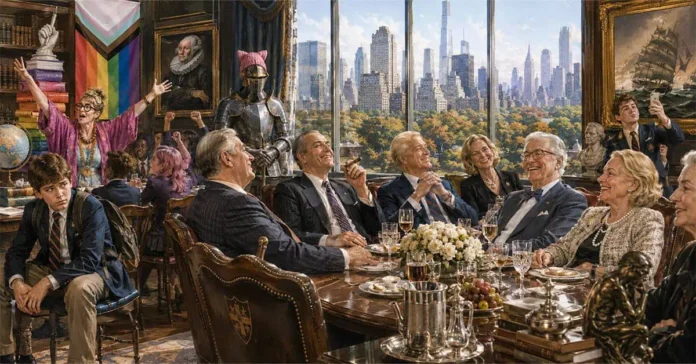
That fear became the novel’s center. The principal targets are not the loudest activists. They are the wealthy, educated trustees who recognize institutional madness and permit it. They fear that resistance could damage their children’s chances of entering Harvard or Yale. They possess money, standing, and influence, yet they decline to use them.
Johnston originally wanted to call the novel All the Lovely People. The title referred to polished dinner companions who serve on prominent boards, speak with assurance, and accomplish little while the institutions under their supervision abandon their purposes. His publisher preferred The Sandersons Fail Manhattan because it presented a family, a crisis, and a question.
The book draws its force from details that reality has already made comic. At the Spence School, rectangular dining tables reportedly gave way to round ones because seating someone at the head created a power imbalance. The school also changed its curriculum and recruitment after Yale reportedly dismissed it as a neighborhood school for wealthy white girls. Spence began enrolling students from less prosperous neighborhoods, but those students often became the ones Yale wanted. The old families financed a system that increasingly excluded their own children.
The novel also examines the expanding categories of sexual and personal identity. Johnston created Clover, a girl attracted to “goblincore,” an actual aesthetic that rejects conventional beauty in favor of moss, dirt, twigs, and decay. Another central character is a boy transitioning into a girl, surrounded by adults who encourage the process and turn it into social capital. Johnston treats the child with sympathy; his contempt falls upon the adults who use a vulnerable person to advertise their virtue.
Tom Wolfe stands behind Johnston’s work as both model and witness. Wolfe spent two days observing Johnston’s trading desk at Salomon Brothers while researching The Bonfire of the Vanities. Johnston later drew upon Wolfe’s method: watch closely, remember the detail, and wait until it belongs somewhere. Social satire rarely requires invention because institutions routinely produce scenes that a novelist would hesitate to fabricate.
Johnston recalls a Yale wrestler who visited the university art gallery for an assignment. The student chose what appeared to be its best-represented artist and wrote about the long career and stylistic development of “Circa.” His teaching assistant returned the paper with a single question written across it: “Are you a moron?” The student later finished first in his Navy SEAL class and founded a prominent private school. Human ability remains uneven, comic, and resistant to tidy judgment.
The deeper subject is meritocracy. Johnston argues that a free society gives status to people who build companies, make useful things, and solve practical problems. An intellectual political class resents that arrangement because credentials do not guarantee command. Centralized government offers another route to power; control can replace creation.
The same contest now reaches artificial intelligence. Johnston doubts that AI has written a great novel, but he no longer treats that limit as permanent. He has used it experimentally while writing a road novel about two brothers crossing America. The machine produced a description of a Nebraska wheat field that startled him with its beauty. The novelist still chooses the road, the characters, and the destination, but the tools are changing under his hands.
Johnston’s novels preserve the comedy of people who surrender their institutions while congratulating themselves on their virtue. Manhattan does not fail because its ruling class lacks intelligence. It fails because intelligence without courage becomes ornamental. The lovely people remain lovely at dinner; outside, the schools, language, and culture pass into other hands.
Discover more from Randy Bock MD PC
Subscribe to get the latest posts sent to your email.