

Quantum Computing Is Finally Becoming Real
For decades, quantum computing lived somewhere between mathematical theory, physics speculation and technological ambition.
Today, that is changing.
Small quantum devices exist. They can be programmed. They can manipulate qubits and perform operations that behave in ways predicted by quantum theory. The central challenge is no longer simply whether quantum computation is physically possible. The harder question is much more practical:
Table of Contents
What can a quantum computer actually do better than a classical computer?
That is the question at the heart of a wide-ranging conversation with computer scientist Prof. Scott Aaronson.
Aaronson has spent roughly 27 years working on quantum computing. He has watched the field move from theoretical proposals toward functioning machines, while also observing the enormous amount of hype surrounding the technology.
His answer is neither the utopian promise that quantum computers will revolutionize everything nor the cynical claim that quantum computing is a technological fraud.
The reality is more interesting.
Quantum computers represent a fundamentally different way of computing. But that difference does not automatically make them better at every task.
The future of quantum computing may depend less on spectacular claims about replacing ordinary computers and more on identifying the specific problems for which quantum mechanics gives us an advantage.
From Quantum Mechanics to Quantum Computing
To understand why quantum computers are different, it helps to understand what quantum mechanics actually changes.
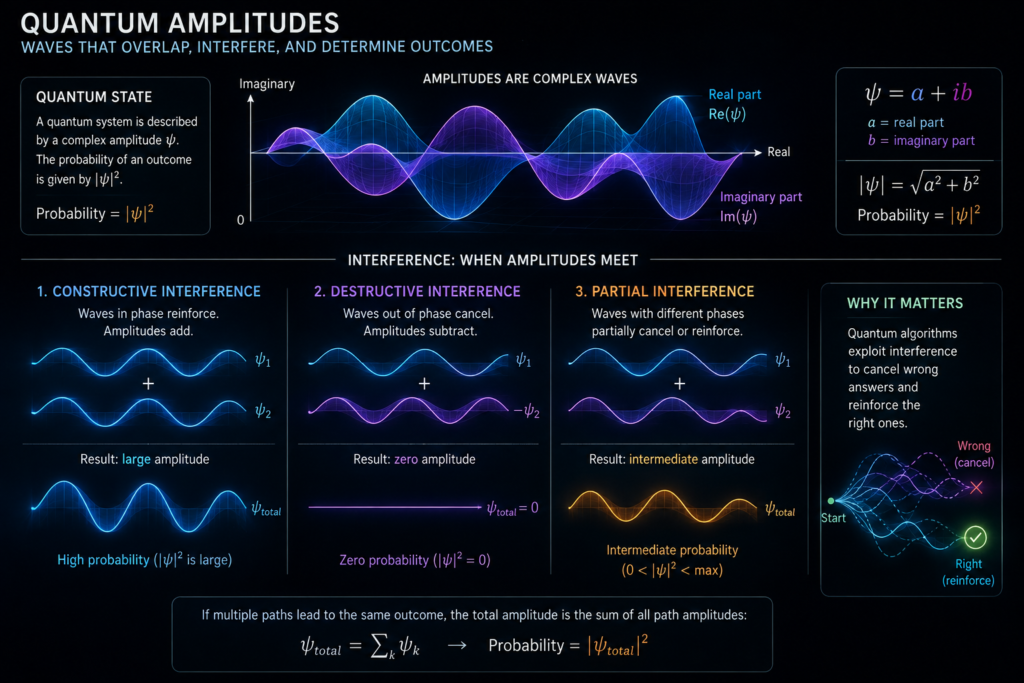
Aaronson describes quantum mechanics not simply as a theory about tiny particles or discrete packets of energy, but as a change in the rules of probability that nature follows at the subatomic scale.
Classical probabilities are familiar. An event might have a 10%, 50% or 90% probability. Probabilities range from zero to one.
Quantum mechanics introduces something stranger: amplitudes.
Amplitudes can be positive, negative or complex numbers. They are related to probabilities, but they are not themselves probabilities. When a quantum system is measured, the probabilities of different outcomes are obtained from the amplitudes.
That distinction is crucial.
It is also the foundation of quantum computation.
Instead of simply manipulating conventional bits that are either 0 or 1, a quantum computer manipulates quantum states whose amplitudes can evolve and interfere.
That gives programmers a new computational resource:
interference.
What Is a Qubit?
The basic unit of quantum information is the qubit, or quantum bit.
A classical bit has two possible values:
- 0
- 1
A qubit can exist in a quantum superposition involving both possibilities.
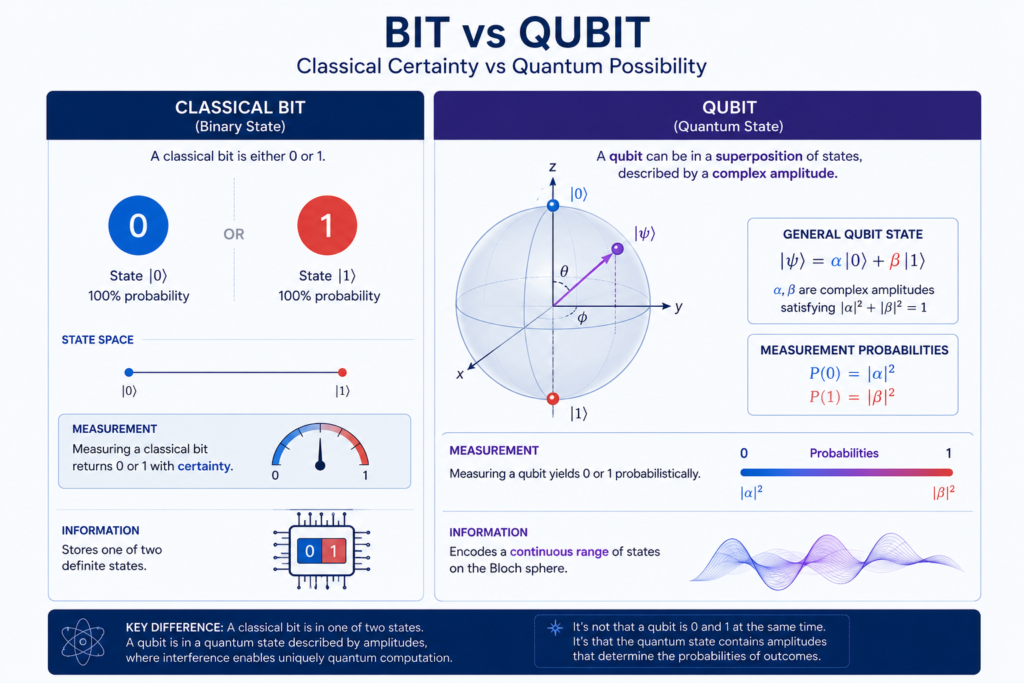
But this does not mean that a quantum computer simply has a magical bit that is simultaneously two ordinary bits.
The deeper point is that the quantum state contains amplitudes associated with possible outcomes, and those amplitudes can evolve according to quantum rules.
Aaronson uses this distinction to explain why quantum mechanics cannot simply be reduced to ordinary uncertainty. A quantum system is not merely a classical object whose state we happen not to know.
Its amplitudes can interact.
And that interaction produces interference.
The Secret Power of Quantum Computing: Interference
This is perhaps the most important idea in understanding quantum computing.
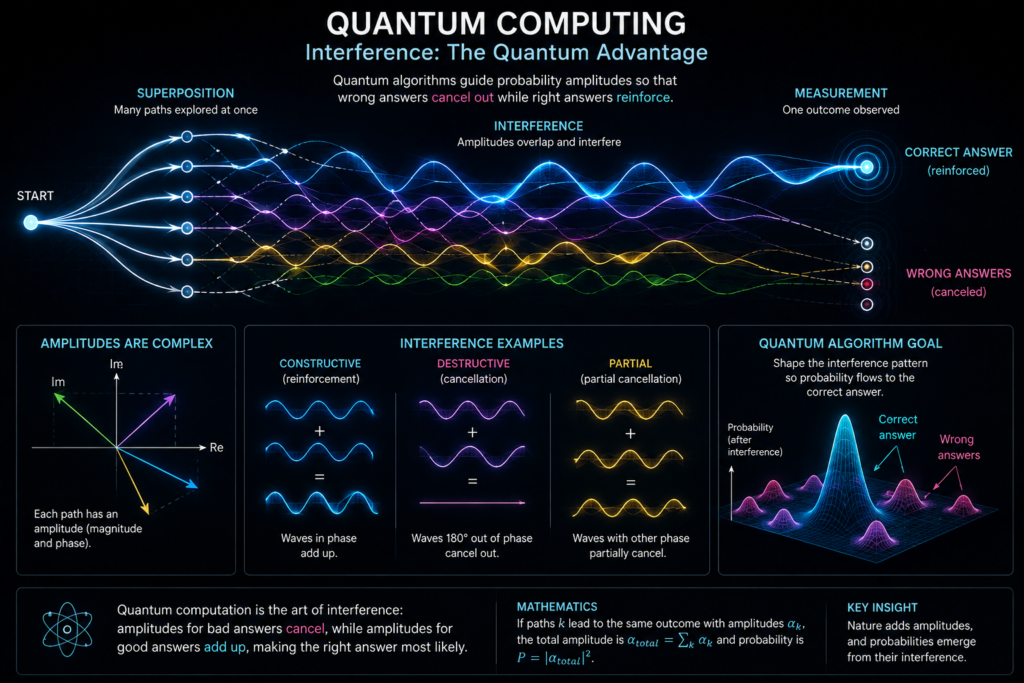
Imagine two possible paths leading to the same outcome.
If their amplitudes have opposite signs, they can cancel each other.
If they reinforce each other, the probability of the corresponding outcome can increase.
This is known as quantum interference.
Aaronson describes quantum computation as essentially the deliberate choreography of such interference patterns.
The goal is not to make every possible answer equally likely.
The goal is to design a quantum process so that unwanted answers interfere destructively while useful answers become more prominent.
In other words, the algorithm is designed so that:
wrong answers cancel, while useful answers survive.
The interview explains this as a fundamental difference between quantum and classical computation rather than a minor modification to conventional computing.
This is why quantum computing is so difficult to explain with ordinary computer metaphors.
The computer is exploiting physical behavior that has no straightforward classical equivalent.
Quantum Mechanics Is Not “Anything Goes”
One of Aaronson’s most important warnings concerns the way quantum mechanics is used in popular culture.
Because quantum physics is strange, the word quantum is often treated as a synonym for mystery.
Quantum becomes shorthand for:
- unexplained phenomena
- consciousness
- alternate realities
- aliens
- psychic effects
- time travel
- anything mysterious
But actual quantum mechanics is not a theory in which anything is possible.
It is extraordinarily precise.
Quantum mechanics allows certain physical processes and rules out others.
That matters when discussing quantum computing, because technological claims should be judged against what quantum theory actually permits.
Aaronson makes a similar point about science fiction. Rather than inventing a story first and then asking quantum physics to justify it, he would prefer writers to start with the actual rules of quantum mechanics and ask what kinds of stories those rules might inspire.
The same intellectual discipline should apply to technology.
Quantum Computing Versus Classical Computing
The distinction between classical and quantum computing is not simply that one is “old” and the other is “new.”
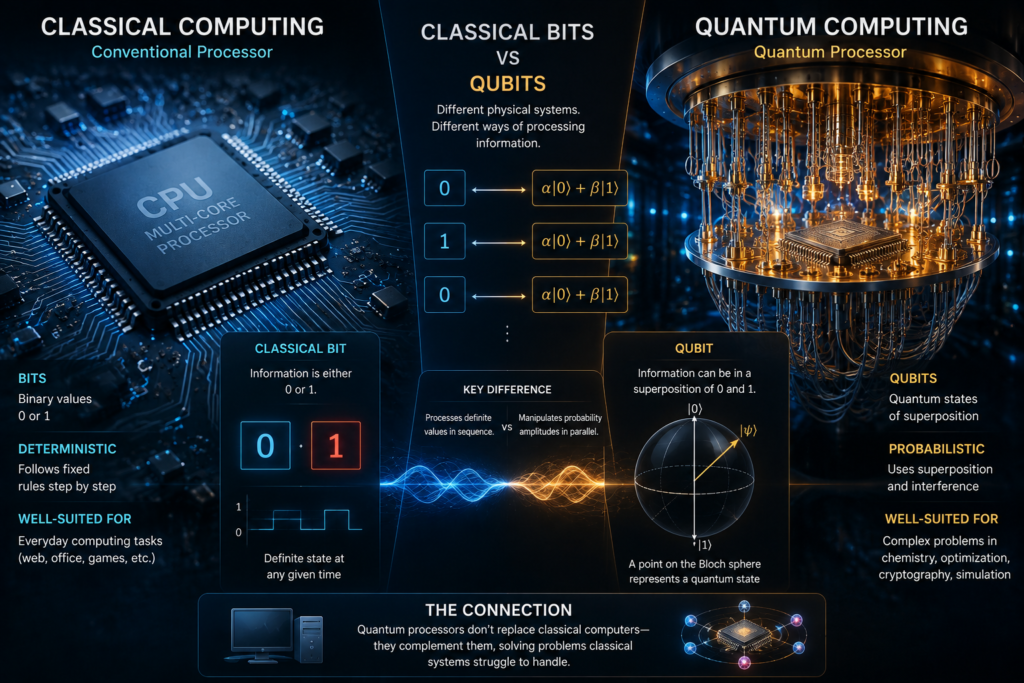
Classical computers operate according to classical information-processing principles. Quantum computers manipulate quantum states.
For many everyday applications, classical computers are extraordinarily effective.
That is one reason quantum computing should not be viewed as a universal replacement for conventional computing.
We use classical machines to:
- browse the internet
- edit documents
- run databases
- stream video
- operate businesses
- perform ordinary calculations
- train many forms of AI
Quantum computers are not expected to replace all of these systems.
Instead, they are potentially useful for a narrower class of problems where quantum mechanics provides a computational advantage.
That distinction is frequently lost in marketing.
Why Quantum Computers Will Not Speed Up Everything
Aaronson is particularly skeptical of the claim that quantum computers will simply make every computational task dramatically faster.
He points out that some known quantum advantages are relatively modest, while others remain speculative.
There is another problem: classical computing keeps improving.
A new quantum algorithm may initially appear to outperform the best-known classical algorithm. Then classical-computing researchers study the problem more closely and develop a better classical algorithm.
The supposed quantum advantage can shrink or disappear.
That means demonstrating that a quantum computer can perform a task is not enough.
Researchers have to demonstrate that it performs that task better than the best realistic classical alternative.
As Aaronson explains, this comparison is one of the hardest parts of the field.
This is a useful antidote to technological hype.
The relevant question is not:
“Can a quantum computer do it?”
The relevant question is:
“Can a quantum computer do it substantially better than the best classical computer?”
Where Quantum Computing Could Actually Matter
There are, however, areas where the potential advantage is much more compelling.
One of the most important is quantum simulation.
This idea goes back to physicist Richard Feynman’s vision of using quantum systems to simulate other quantum systems.
The logic is intuitive once the problem is understood.
Nature itself operates according to quantum mechanics.
Trying to simulate an enormously complicated quantum system using a classical computer can require tracking an enormous number of possible states.
A quantum computer, by contrast, is itself a quantum system.
That creates the possibility of using quantum hardware to study problems involving:
- quantum physics
- chemistry
- materials science
- superconductivity
- batteries
- solar cells
- pharmaceuticals
Aaronson identifies quantum simulation as one of the most economically important potential applications of the technology.
This is a much more concrete vision than the claim that quantum computers will simply accelerate everything.
Quantum Computing and Drug Discovery
The pharmaceutical possibility is especially intriguing.
Many problems in chemistry involve complicated interactions among electrons and molecules.
Those interactions can become computationally difficult because the underlying quantum state becomes enormous.
If sufficiently capable quantum computers can simulate molecular systems more effectively, they could eventually contribute to the development of better drugs and materials.
That does not mean quantum computers will suddenly invent miracle medicines.
It means they could become a new scientific instrument for exploring molecular behavior that is difficult to calculate using classical methods.
The same principle could potentially apply to:
- molecular treatments
- pharmaceuticals
- new materials
- batteries
- solar technology
- biochemical systems
These are possibilities rather than guaranteed outcomes, and the distinction is important.
Shor’s Algorithm and the Cryptography Problem
Another famous application is very different.
It concerns cryptography.
Peter Shor demonstrated that a sufficiently powerful, fault-tolerant quantum computer could factor large numbers dramatically faster than known classical methods.
That matters because modern public-key cryptography relies on mathematical problems that are extremely difficult for conventional computers to solve at sufficiently large scales.
A sufficiently capable quantum computer could therefore threaten some of the cryptographic infrastructure underlying modern digital communications.
Aaronson describes this as one of the major real-world consequences of quantum computing.
It is not necessarily a positive development.
It is a technological problem that governments, companies and security professionals need to prepare for.
The interview emphasizes that breaking public-key cryptography and simulating quantum systems are among the areas where large quantum speedups are much more firmly expected than in fields such as general optimization or machine learning.
Quantum Error Correction Is the Engineering Challenge
The mathematics of quantum computing is one thing.
Building a reliable quantum computer is another.
Quantum systems are extremely sensitive.
Noise, environmental interactions and imperfections can introduce errors into computations.
That makes quantum error correction one of the central engineering challenges of the field.
Aaronson’s assessment is strikingly optimistic in one respect: he does not see a fundamental law of physics that prevents large-scale quantum computing.
Instead, he characterizes the challenge as extraordinarily difficult engineering.
The theory of quantum error correction provides a pathway toward making quantum computation reliable enough for large-scale applications.
That does not mean the problem is solved.
It means the remaining obstacles appear to be engineering and scaling problems rather than evidence that quantum computing is fundamentally impossible.
The Quantum Hardware Race
Quantum computing is no longer confined to theoretical physics departments.
Multiple hardware architectures are being pursued.
The interview discusses several approaches, including:
- trapped-ion systems
- neutral atoms
- superconducting qubits
- photonic qubits
Each architecture has different engineering characteristics and tradeoffs.
This diversity is important because there is no guarantee that one approach will dominate.
The field is still experimenting with different ways of creating, controlling and connecting qubits.
The machines are real.
But real machines are not necessarily commercially transformative machines.
That distinction is central to understanding where the field stands.
Quantum Advantage Is the Real Test
The phrase quantum advantage is becoming increasingly important.
It describes a situation in which a quantum computer can perform a meaningful computational task beyond the practical reach of classical systems.
But even here, careful benchmarking matters.
Aaronson notes that existing quantum systems have begun to outperform classical computers on some specially constructed tasks, including certain physics simulations and benchmark problems.
The difficulty is determining whether those demonstrations represent useful applications or merely impressive laboratory exercises.
The transcript describes current systems as capable of beating classical machines on some contrived or specialized tasks, while noting that genuinely useful applications require much larger scales and quantum error correction.
That is a much more sober assessment than either “quantum computing has arrived” or “quantum computing doesn’t work.”
The Hype Problem
Perhaps the most valuable lesson from Aaronson is not a technical one.
It is methodological.
He argues that quantum computing has suffered from enormous hype.
One part of the truth can be surrounded by many parts of exaggerated marketing.
The result is a strange situation in which people can be pushed toward two equally mistaken conclusions.
First:
Quantum computers are magical machines that will revolutionize everything.
Or:
Quantum computing is all hype and doesn’t actually work.
Aaronson rejects both extremes.
There is something genuinely extraordinary happening.
Quantum computers are demonstrating physical effects predicted by quantum theory. The theoretical framework has survived experimental testing, and engineers are building increasingly capable machines.
But that does not imply that every proposed application will work.
As Aaronson puts it in the interview, the truth is complicated, and neither extreme narrative captures it.
That may be the most useful way to think about the field.
What About Quantum Computing and AI?
Aaronson’s career also intersects with the other major technological revolution of the moment: artificial intelligence.
He spent two years at OpenAI from 2022 to 2024 before returning to academia.
He describes AI as an enormous issue and says his work now includes both quantum information and questions surrounding AI alignment.
At UT Austin, he works on theoretical computer science and AI alignment while continuing his quantum-computing research.
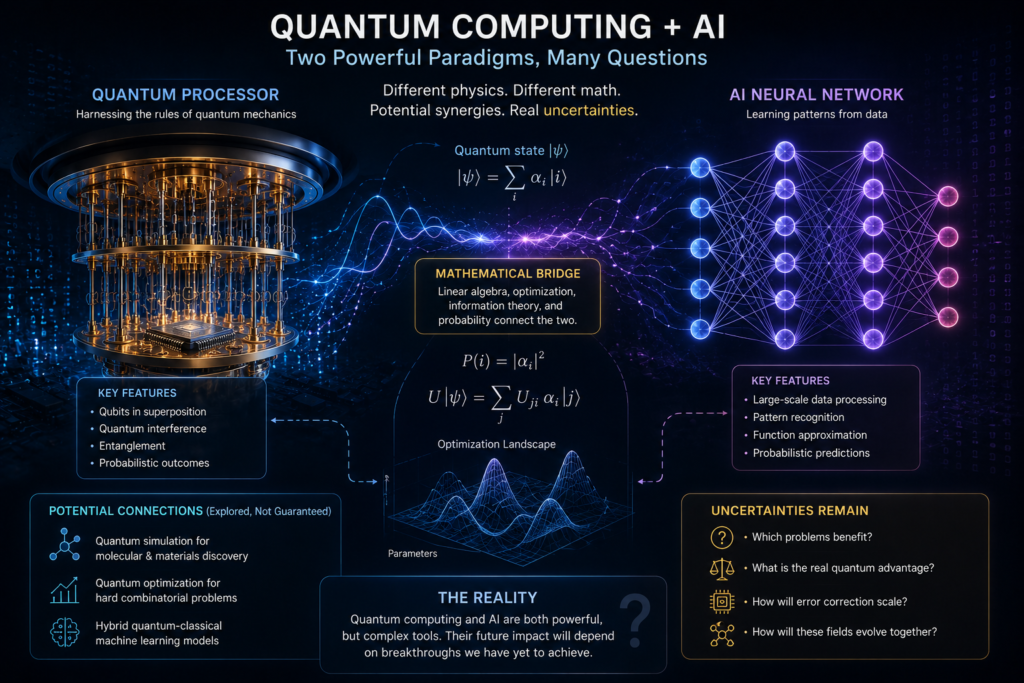
The relationship between quantum computing and AI is often exaggerated.
Aaronson is cautious here too.
Quantum computers may eventually have applications in machine learning and optimization, but the strongest known advantages in those areas are less certain than the advantages associated with quantum simulation and cryptographic applications.
The lesson is simple:
Possibility is not proof.
What Quantum Computing Could Mean for Medicine
The most exciting long-term possibility may ultimately be scientific rather than computational.
If quantum computers become powerful enough to model molecular systems that classical computers cannot efficiently simulate, the consequences could extend into medicine.
Researchers could potentially explore molecular interactions with greater precision.
That could contribute to:
- drug discovery
- molecular design
- pharmaceutical research
- materials science
- biochemical modeling
But this is a long-term possibility, not a promise of immediate medical breakthroughs.
The interview’s emphasis is on what sufficiently powerful quantum systems could eventually enable, rather than claiming that today’s machines can already perform these tasks at scale.
That distinction should remain front and center.
How Close Are We?
This may be the hardest question.
Quantum computers exist.
Quantum algorithms exist.
Quantum error-correction theory exists.
Quantum hardware is improving.
But the large-scale, fault-tolerant machines required for many transformative applications remain a major engineering challenge.
Current industry roadmaps show how quickly the field is moving. IBM, for example, says its 2026 roadmap is targeting examples of quantum advantage and is continuing work toward fault-tolerant systems, while recent IBM research has reported demonstrations involving logical qubits and error correction. (IBM)
These are industry claims and demonstrations, not proof that every promised application is imminent.
That is precisely why Aaronson’s more cautious framework remains valuable.
The correct question is not whether quantum computing is “real.”
It clearly is.
The question is when sufficiently reliable and scalable quantum machines will become economically useful for important problems.
The answer remains uncertain.
It could be years.
It could take longer.
The Quantum Leap Is Real—But It Is Not Magic
Quantum computing represents a genuine change in the way computation can be performed.
It takes advantage of physical phenomena—superposition, amplitudes and interference—that have no direct classical equivalent.
The theory is not science fiction.
The hardware is not imaginary.
And the potential applications are not limited to laboratory demonstrations.
Quantum computers could eventually become powerful tools for simulating quantum systems, studying chemistry and materials, and tackling problems that are fundamentally difficult for classical machines.
They could also create serious challenges for existing cryptographic systems.
But none of that means quantum computers will replace classical computers.
They will not necessarily make every algorithm faster.
They will not automatically transform artificial intelligence.
And they will not turn every problem into a trivial calculation.
The real quantum leap may therefore be more subtle.
It is the possibility of harnessing nature itself as a computational resource.
That is already extraordinary.
The next challenge is discovering where that extraordinary capability becomes genuinely useful.
And according to Scott Aaronson, that is where the real story of quantum computing is only beginning.
Frequently Asked Questions About Quantum Computing
What is quantum computing?
Quantum computing is a form of computation that uses quantum-mechanical phenomena to process information. Instead of relying only on classical bits, quantum computers use qubits whose quantum states can exhibit superposition and whose amplitudes can interfere.
What is a qubit?
A qubit is the basic unit of quantum information. Unlike a classical bit, which has a definite 0 or 1 state, a qubit can exist in a quantum superposition involving different possible states.
How does quantum computing work?
Quantum computing works by manipulating quantum states and deliberately controlling interference among their amplitudes. Quantum algorithms are designed so that useful outcomes become more likely while unwanted outcomes can cancel through destructive interference.
Are quantum computers faster than classical computers?
Not for everything. Quantum computers are expected to provide major advantages for certain specialized problems, while other applications may offer only modest or uncertain improvements. Classical algorithms can also improve and reduce apparent quantum advantages.
What is quantum advantage?
Quantum advantage refers to a situation where a quantum computer performs a computational task beyond the practical capabilities of the best available classical approaches.
What is Shor’s algorithm?
Shor’s algorithm is a quantum algorithm for factoring integers efficiently. A sufficiently large, fault-tolerant quantum computer running Shor’s algorithm could threaten some widely used public-key cryptographic systems.
Why is quantum error correction important?
Quantum systems are highly sensitive to errors and environmental noise. Quantum error correction is intended to protect quantum information and make reliable, large-scale quantum computation possible.
Will quantum computers replace ordinary computers?
Probably not. Quantum computers are expected to be specialized machines that work alongside classical computers. Their value will come from solving particular problems where quantum algorithms provide an advantage.
Can quantum computing improve medicine?
Potentially. One major proposed application is simulating molecules and chemical systems, which could eventually contribute to pharmaceutical research, drug discovery and molecular design.
Is quantum computing mostly hype?
No, but the field has been heavily hyped. The underlying physics and functioning quantum hardware are real. The uncertainty concerns the scale of practical advantages, the applications that will ultimately prove valuable and how long large-scale fault-tolerant machines will take to build.
Final Takeaway
Quantum computing is neither magic nor a hoax.
It is a fundamentally different computational model built upon the strange but experimentally established rules of quantum mechanics.
Scott Aaronson’s central message is a useful one for anyone trying to understand this rapidly developing technology: separate what quantum computers can theoretically do, what today’s machines can actually demonstrate, and what companies claim they will eventually do.
That distinction may be the difference between understanding the quantum revolution and simply buying into its hype.
📚 Related Resources, Videos, and Links
- https://www.scottaaronson.com
- https://scottaaronson.blog/
- https://www.cs.utexas.edu/people/faculty-researchers/scott-aaronson
- https://www.cs.utexas.edu/~qic/
- https://www.scottaaronson.com/papers/
Discover more from Randy Bock MD PC
Subscribe to get the latest posts sent to your email.