
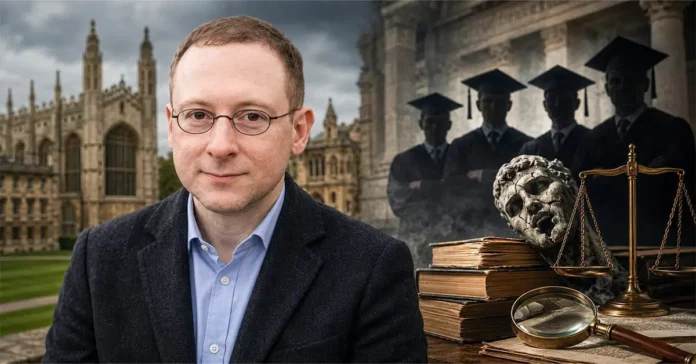
Two years before the Jason Arday affair, a Cambridge philosopher explained how institutions protect accepted beliefs from inconvenient evidence.
Nathan Cofnas studies the origins of belief, but his career has become a study in what institutions do when belief collides with evidence. In May 2024, he was a Leverhulme Early Career Fellow at Cambridge University, working on the evolution of morality. He now holds a postdoctoral position in the Department of Philosophy and Moral Sciences at Ghent University in Belgium.
Cofnas begins with a medical sort of question: does a belief arise through a process capable of detecting the thing believed? A diagnosis based on examination and laboratory evidence differs from one drawn from a numbered ball in a bucket. The lucky ball may carry the correct number, but the method does not track the patient, the restaurant, or the world.
Morality presents the harder case. Human beings experience certain acts as wrong, and the experience seems immediate. Cofnas argues that natural selection produced moral intuitions because they served survival and reproduction, not because they detected an independent moral order. “When we do give a scientifically accurate account of where our moral beliefs come from, those explanations are debunking for our moral beliefs.”
The same caution applies when humans find morality in animals. A capuchin monkey becomes enraged when offered a cucumber while grapes remain visible. Researchers described this as a protest against unfairness, but the monkey reacts similarly when no favored companion exists, and the grapes merely sit within view. “All of these alleged demonstrations of moral intuitions in non-human animals end up being deflated in this way.” We place our psychology inside the animal, then announce that we have found it there.
Cofnas applies the instrument to liberalism. Classical liberalism protected people’s being left alone unless they harmed others; its modern descendant increasingly pursues equality through censorship, administrative power, and economic intervention. If no objective moral truth exists, liberal democracy did not prevail because mankind finally solved the moral equation. “There is no truth, and as conditions change, people’s values can change to adapt to the new reality for them.”
His argument becomes more abrasive when applied to intelligence. He maintains that intelligence has several dimensions, that men and women differ in the distribution of some cognitive abilities, and that test designers removed tasks producing large sex differences. He also attributes part of the average differences among some ancestral populations to genetics, while denying that pigmentation itself carries intelligence. “Hereditarianism doesn’t mean that there’s a special connection between skin color and intelligence.”
I pressed the apparent counterexample. Nigerian, Jamaican, and Haitian immigrants often outperform American Blacks, although they retain more African ancestry. Cofnas answered that immigrant groups are selected samples; accepting Nigerian physicians and Haitian degree holders does not reproduce the Nigerian or Haitian population. The argument does not settle the question, but it meets the objection rather than avoiding it.
The deeper subject was academic behavior. Philosophy developed through people’s questioning conventions, finding contradictions, and testing inherited claims. Universities proclaim this method while constructing careers that reward its opposite. “Academia also is a system which specifically selects for conformity and timidity.” The safe scholar completes the assignment, adopts the approved vocabulary, and learns which evidence creates professional danger.
That judgment acquired new force in 2026. Cofnas publicized evidence challenging the scholarship, credentials, and extraordinary personal narrative of Cambridge professor Jason Arday. The narrative was extraordinary in both senses of the word: radically uncommon, yet also so improbable that parts approached the supernatural. It grew through apparent fabulism and confabulation, with one astonishing claim supporting another.
Cambridge opened investigations into Arday’s qualifications, honorary appointments, and alleged academic misconduct. Arday resigned and later died. Attention then shifted from the institutions that had promoted him to the man who had exposed the evidence. The whistleblower was recast as the culprit; scrutiny of the claim became scrutiny of the claimant.
Cofnas had described a similar pattern in 2024 through Harvard’s selection of Claudine Gay. “There are serious black scholars who they could have selected who would have been credible. But they chose Claudine Gay for some reason. And then it turned out that she’s a plagiarist, and it kind of blew up in their face.” Two years later, Cambridge confronted its own version of the problem.
A whistleblower receives praise when his evidence damages an approved enemy. Alexander Vindman became a national figure when his reporting aided the case against Donald Trump. John Paul Mac Isaac received a different treatment after producing Hunter Biden’s abandoned laptop. Institutions called one man courageous and treated the other as a suspected conduit for disinformation.
The evidence should remain the evidence regardless of its political destination. Cofnas pulled a thread that others preferred to leave untouched. Cambridge had woven the garment, displayed it, and praised its colors; it then blamed the man who showed where the seams had failed.
Discover more from Randy Bock MD PC
Subscribe to get the latest posts sent to your email.