
Prof. Scott Aaronson (author of the semi-humorously titled but authoritative “Quantum Computing Since Democritus,” and whose Shtetl-Optimized blog is a must-read) has spent 27 years in quantum computing, long enough to watch theory become hardware and hardware become sales copy. “We now finally have devices that, while on a small scale, are working just like the theory said they would thirty years ago.” The harder question is what they can do that ordinary computers cannot.
Aaronson’s dual foci are quantum computing, where the work is mathematical, physical, and exact, and generative AI. He spent two years at OpenAI, then returned to UT Austin, where he works on quantum information and AI alignment.
Quantum mechanics does not mean weirdness for its own sake, as many popular science writers hope or wish it to be. Aaronson put the matter cleanly: “It’s really (an algorithmic) change to the whole rules of probability that nature obeys at the subatomic scale.” Classical physics lets us speak as if a system has a state we can know without disturbing it. Quantum mechanics is different because its basic object is the wave function, a list of amplitudes for possible configurations.
That distinction matters. Probability in daily life ranges from 0 to 1. Rain tomorrow, an election result, a baseball being fair or foul: these become records, and records become classical information. Amplitudes can be positive, negative, or complex. They can cancel. They can reinforce. “By decreasing the number of paths that a particle could take to get somewhere, I can increase the chance that it gets there.”
Yet the world we live in looks classical. Baseballs fly. Rockets reach the moon. Cells do biochemistry. “If we are throwing a baseball, even if we’re building rockets to go to the moon, classical physics is good enough.” The quantum world is hidden because large systems keep, in effect, measuring one another. They force each other back down toward ordinary-looking states.
The screenwriters get this wrong because they want quantum mechanics to bless aliens, dreams, projections, and time tricks; then they ask physics to make it plausible. His answer is usually no. “Once you’re talking about quantum mechanics, it’s not just a synonym for everything is confusing and anything goes.” It has content. It allows certain things and forbids others. A better fiction would start with the real rules and let the plot grow from there.
Quantum computing follows the same discipline. A uselessly unreliable quantum computer would be a bad machine. Quantum error correction and fault tolerance showed that small errors could, if held below a threshold, be driven lower. Computation becomes a planned interference pattern. Wrong answers cancel. Right answers build..
Shor’s algorithm showed how a reliable quantum computer could factor large numbers far faster than known classical methods. That matters because much of internet security rests on cryptography vulnerable to such machines. Feynman’s older dream remains more constructive: use quantum computers to simulate quantum physics and chemistry, where the world being modeled is quantum too.
Aaronson objects to the easy hype. Quantum computers will not speed up everything. Classical computers fight back; once a problem becomes interesting, classical algorithm designers often improve their side and erase the supposed advantage. “For every one part of truth, there’s like ten parts of hype.” Still, he is not a debunker. “There is something exciting here. There is a potential to harness nature to do computation in a fundamentally new way.”
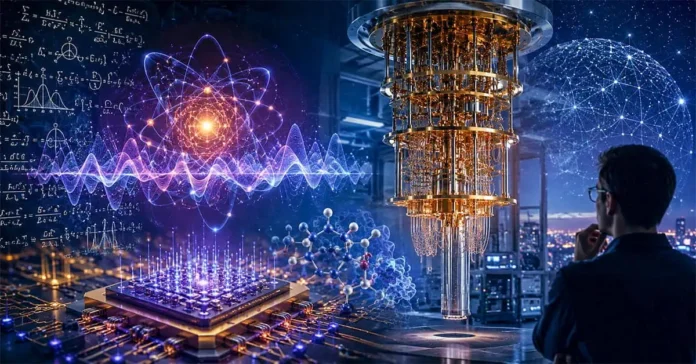
At the end, the abstraction became hardware. A quantum lab may hold a dilution refrigerator the size of a closet. The chip sits near absolute zero. A trapped-ion system holds atoms in a magnetic trap and steers them with lasers. The machines exist. They are early. They are specialized. They are hard engineering, not new physics. Aaronson thinks one or more efforts will succeed; he cannot say whether that means five years, ten years, or longer. But if/when it does, it may hold new hope for science and medicine, in particular, molecular treatments, gene therapies, and pharmaceuticals.

Quantum Computing Since Democritus
Written by noted quantum computing theorist Scott Aaronson, this book takes readers on a tour through some of the deepest ideas of maths, computer science and physics. Full of insights,…Read more →
Discover more from Randy Bock MD PC
Subscribe to get the latest posts sent to your email.