

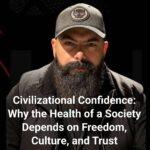
Western Civilization Has a Confidence Problem
What happens to a society when it becomes embarrassed by the civilization that produced its freedom, prosperity, institutions, and extraordinary technological achievements?
That is the central question explored in this conversation with Dan Burmawi, whose life has taken him across cultures, religions, and political systems. Born in Jordan and raised in the Middle East, Burmawi converted from Islam to Christianity, a decision that ultimately forced him to leave. His experiences in Lebanon and later in the West gave him an unusual vantage point from which to examine the foundations of freedom—and what happens when those foundations begin to weaken.
His argument is ultimately about more than politics.
It is about civilizational confidence.
Burmawi suggests that innovation, institutional trust, creativity, prosperity, and even our ability to care for one another depend upon a cultural foundation that cannot simply be taken for granted.
And when that foundation begins to disappear, the consequences eventually become visible everywhere.
Table of Contents
The West’s Greatest Weakness May Be Its Lack of Confidence
Western civilization has achieved something historically extraordinary.
Modern Western societies provide levels of material prosperity, technological capability, personal freedom, and life expectancy that would have been unimaginable to most people throughout human history.
Yet prosperity has not necessarily produced contentment.
Instead, Burmawi sees a growing phenomenon in which Western societies become increasingly critical of their own inheritance.
The paradox is striking.
A civilization produces extraordinary prosperity and freedom, then increasingly interprets its own history primarily through the lens of oppression, exploitation, inequality, and failure.
Criticism itself is not the problem. Every healthy civilization needs the ability to examine its own mistakes.
The question is whether self-criticism eventually becomes self-rejection.
There is an enormous difference between saying:
“Our civilization has serious flaws.”
and saying:
“Our civilization is fundamentally illegitimate.”
The first can produce reform.
The second can produce a vacuum.
And vacuums rarely remain empty.
What the Iron Curtain Revealed About Freedom
One of the most important themes in Burmawi’s perspective comes from his experience behind the Iron Curtain.
The difference between freedom and authoritarianism, he suggests, cannot be understood simply by comparing constitutions or political slogans.
It is experienced in ordinary life.
It appears in whether people feel comfortable speaking openly.
It appears in whether people can criticize authorities without fear.
It appears in whether citizens feel watched.
It appears in whether spontaneity survives.
Burmawi describes the atmosphere of authoritarian societies as one in which people constantly monitor themselves because they know that someone else may be monitoring them.
That observation matters because freedom is not merely the right to vote.
Freedom includes the ability to live without constantly calculating whether an authority, institution, ideology, or social group will punish you for saying what you actually believe.
A society can have elections and still become culturally authoritarian.
It can have democratic institutions while people become afraid to use their freedom.
Individualism vs. Collectivism
Burmawi frames today’s culture war partly as a conflict between individualism and collectivism.
At its simplest, individualism begins with the idea that the individual possesses dignity and responsibility that cannot simply be absorbed into the collective.
Collectivism begins from the opposite direction: the group becomes the primary unit through which identity, responsibility, and political legitimacy are understood.
The difference affects much more than elections.
It influences:
- Economics
- Education
- Creativity
- Scientific research
- Entrepreneurship
- Family life
- Religious freedom
- Freedom of speech
- Political institutions
- Social trust
Innovation requires people to challenge existing assumptions.
Creativity requires experimentation.
Entrepreneurship requires risk.
Science requires the ability to question established conclusions.
A culture that increasingly punishes dissent eventually begins to discourage the very behaviors that generate innovation.
This is why the health of a society cannot be measured exclusively by GDP or technological sophistication.
A society also needs the cultural permission to think.
Why Social Trust Matters
A free society cannot function entirely through coercion.
People have to trust one another enough to cooperate.
They need some confidence that strangers will follow rules, institutions will function, contracts will be honored, and disagreements will not automatically turn into existential conflicts.
Research has found meaningful relationships between generalized social trust, confidence in political institutions, and satisfaction with democracy.
That makes social trust more than a vague cultural virtue.
It is part of the infrastructure of a functioning society.
When trust collapses, every institution becomes more expensive to operate.
People demand more rules.
Governments demand more enforcement.
Organizations become more bureaucratic.
Citizens become more suspicious.
Political opponents become enemies.
And eventually people begin looking for increasingly powerful institutions to impose order.
That can create a dangerous feedback loop:
Less trust → more control → less freedom → less trust.
The Religious Foundations of Western Freedom
One of Burmawi’s most controversial arguments concerns the relationship between Christianity and Western civilization.
He points to the biblical concept that human beings possess equal dignity because they are created in the image of God.
This idea has profound implications.
If human beings possess intrinsic dignity, then governments do not create human rights.
They are supposed to recognize them.
The state is not the ultimate source of human worth.
This theological inheritance became intertwined with Western concepts of law, individual rights, conscience, and limits on political power.
That relationship between Christianity and Western freedom is debated by historians and philosophers, but it is difficult to understand Western political development without taking religious ideas seriously.
Even contemporary Christian thinkers have explicitly connected freedom and human dignity with the Christian heritage of the West.
The broader lesson is important:
Political institutions do not exist in a cultural vacuum.
They depend upon assumptions about what human beings are, what rights they possess, what obligations they have toward one another, and what authority governments should legitimately exercise.
Can Democracy Survive Without a Culture of Freedom?
Democracy is more than elections.
A functioning democratic society requires habits of tolerance, disagreement, persuasion, compromise, institutional restraint, and respect for the rights of people who hold unpopular opinions.
UNESCO similarly emphasizes that democracy cannot be separated from freedom of political choice.
But Burmawi’s argument goes further.
The deeper question is whether democratic institutions can survive after the culture that sustains them has deteriorated.
Imagine a society where everyone technically has freedom of speech but citizens are terrified of losing their jobs for expressing unpopular opinions.
The constitutional protection may remain.
The practical freedom is already shrinking.
This is why civilizational confidence matters.
People have to believe that freedom is worth defending before they will defend it.
Wokeism as Western Self-Criticism Taken Too Far
Burmawi views woke ideology as an example of a broader Western tendency toward self-correction that can become self-destruction.
Again, criticism itself is not inherently dangerous.
Western civilization has always contained traditions of reform.
Slavery was challenged.
Political corruption was challenged.
Religious abuses were challenged.
Governments were challenged.
Social hierarchies were challenged.
The ability to criticize one’s own society is one of the strengths of an open civilization.
The danger emerges when criticism loses the distinction between reforming a civilization and delegitimizing it.
The modern culture war often revolves around precisely this question.
Are Western societies capable of correcting their failures while maintaining confidence in the principles that made correction possible?
Or does every historical achievement eventually become evidence against the civilization itself?
Contemporary scholarship describes the “culture war” as involving competing ideological interpretations of identity, justice, social order, and Western society.
Modernization Is Not the Same as Liberalization
Burmawi also brings an important perspective from the Middle East.
A country can build skyscrapers, develop advanced infrastructure, attract international investment, and modernize its cities without necessarily undergoing a comparable transformation in its underlying ideology.
Technology is not the same thing as liberalism.
A smartphone does not automatically create freedom of conscience.
A modern airport does not automatically create freedom of speech.
A technologically sophisticated economy does not necessarily produce pluralism.
Modernization can be imposed from above.
Cultural transformation is different.
For reform to become durable, the underlying population must increasingly embrace the values and institutions that sustain it.
That distinction is especially important when comparing political systems.
Modernization changes what a society can do. Culture determines what a society believes it should do.
What the Middle East Can Teach the West
Burmawi’s personal history gives this discussion unusual force.
He did not arrive at his conclusions simply through reading political theory.
He experienced societies where religious and political authority could affect the boundaries of ordinary life.
He then encountered Western societies where individual freedom was taken for granted.
That contrast produced a question that increasingly concerns many Western observers:
What happens when people who have inherited freedom stop understanding where it came from?
Freedom can feel natural to people born into it.
That is precisely why it can become fragile.
A person who has never experienced censorship may underestimate the value of free expression.
A person who has never experienced authoritarian surveillance may treat privacy as unimportant.
A person who has never lived without religious liberty may assume it will always exist.
History suggests otherwise.
Europe and the Next Ideological Conflict
Burmawi’s warning about Europe is particularly stark.
He believes Europe could become a major arena for the next stage of ideological conflict because the continent is struggling with questions surrounding immigration, identity, religion, national sovereignty, democratic legitimacy, and the meaning of Western culture.
These debates are not isolated.
They intersect.
Who belongs?
What values should citizens share?
How much cultural diversity can a political community sustain?
Can liberal democracy remain neutral toward competing ideologies?
What happens when tolerance is used by movements that do not necessarily share the assumptions underlying liberal tolerance?
These questions have become increasingly prominent across Europe and North America.
Recent scholarship and policy research likewise point to political polarization, declining institutional confidence, and challenges to democratic governance as important concerns for established democracies.
Freedom Is Not Self-Sustaining
Perhaps the most important lesson of the conversation is simple:
Freedom requires maintenance.
It requires institutions.
It requires laws.
But it also requires citizens who understand why freedom matters.
A free society depends upon people who can disagree without destroying one another.
It needs institutions strong enough to enforce laws but restrained enough not to dominate citizens.
It needs cultural traditions that teach responsibility alongside rights.
And it needs enough civilizational confidence to distinguish between legitimate reform and cultural surrender.
This does not mean pretending the West is perfect.
It means recognizing that imperfection is not proof of illegitimacy.
A civilization can acknowledge its failures without denying its achievements.
It can defend freedom while expanding justice.
It can preserve tradition while embracing innovation.
It can criticize its institutions without destroying institutional legitimacy.
That balance may be one of the defining challenges of the twenty-first century.
The Health of a Society Is More Than Material Prosperity
The West’s extraordinary prosperity can obscure a deeper problem.
A society can become richer while becoming less confident.
It can become more technologically advanced while becoming less socially cohesive.
It can become more politically participatory while becoming less trusting.
It can become more tolerant in some areas while becoming less tolerant of dissent in others.
And it can possess enormous institutional power while losing the cultural confidence necessary to use that power wisely.
This is why the health of a society cannot be measured only through economics.
We should also ask:
- Do people trust one another?
- Can citizens speak freely?
- Can institutions tolerate criticism?
- Do individuals believe their lives have meaning?
- Do families and communities remain strong?
- Does society understand its historical inheritance?
- Can people disagree without becoming enemies?
- Do citizens believe freedom is worth protecting?
These questions are harder to quantify.
They may also be more important.
Civilizational Confidence Does Not Mean Civilizational Arrogance
There is an important distinction between confidence and arrogance.
Civilizational confidence does not require believing that the West has never done anything wrong.
It requires believing that some principles are worth preserving.
Freedom of conscience is worth preserving.
Freedom of speech is worth preserving.
Equality before the law is worth preserving.
Individual dignity is worth preserving.
Democratic government is worth preserving.
Religious liberty is worth preserving.
The ability to criticize one’s own government is worth preserving.
A confident civilization can say:
We made mistakes—and we still believe our principles matter.
That is very different from saying:
Because we made mistakes, our principles are worthless.
The Candle of Freedom
The metaphor that emerges from Burmawi’s warning is powerful.
Freedom is like a candle.
It is easy to assume that because it has always been there, it will always remain there.
But candles require protection.
A gust of wind can extinguish them.
So can neglect.
So can indifference.
So can the belief that someone else will protect them.
The responsibility therefore falls not only on politicians, judges, academics, journalists, or religious leaders.
It falls on ordinary citizens.
Freedom survives when people understand it, practice it, defend it, and transmit it to the next generation.
That is the deeper meaning of civilizational confidence.
It is not blind worship of the past.
It is the conviction that the achievements of a civilization are worth understanding before they are discarded.
And in an age of intense ideological conflict, that confidence may be one of the most important forms of cultural resilience a free society possesses.
Dan Burmawi on Western Civilization and Freedom
Dan Burmawi’s perspective is shaped by his experience of leaving the Middle East, converting from Islam to Christianity, and later writing about religion, ideology, and Western civilization. His own website describes the West in terms including rule of law, individual liberty, freedom of speech, religious freedom, equality under law, and a Judeo-Christian moral inheritance.
His recent work continues to focus heavily on Western civilization, freedom, Islam, ideology, and the cultural foundations of the West.
The conversation therefore raises a question that extends well beyond one political movement or one election:
Can a civilization remain free if it loses confidence in the ideas that made freedom possible?
That is the question worth debating.
Frequently Asked Questions
What is civilizational confidence?
Civilizational confidence is the belief that a society can recognize its historical achievements and cultural inheritance while still acknowledging and correcting its failures. It is different from nationalism or cultural arrogance.
Why is Western civilization important to this discussion?
Western civilization developed political, legal, religious, and philosophical traditions that contributed to modern ideas of individual liberty, constitutional government, freedom of speech, and religious freedom. The interview examines whether those traditions are being preserved or rejected.
What does Dan Burmawi say about freedom?
Burmawi argues that freedom is fragile and cannot be taken for granted. His experiences in the Middle East and behind the Iron Curtain inform his emphasis on the practical difference between free societies and systems characterized by surveillance, conformity, and political control.
How does social trust affect democracy?
Social trust helps citizens cooperate and is associated with confidence in political institutions and satisfaction with democracy. Research has found significant relationships between generalized social trust and attitudes toward institutions and democracy.
What is the culture war?
The culture war refers to political and social conflicts over competing ideas about morality, identity, religion, education, family, government, justice, and social order. Contemporary research treats the phenomenon as more complicated than a simple left-versus-right divide.
Why does Burmawi connect Christianity with Western civilization?
Burmawi argues that Christianity helped shape Western ideas about human dignity and equality. More broadly, the historical relationship between Christianity, freedom, political institutions, and Western culture remains an important subject of historical and philosophical debate.
Can a society criticize its own civilization and still be confident?
Yes. Healthy civilizational confidence should allow serious criticism without assuming that every historical achievement is illegitimate. Reform and self-rejection are not the same thing.
Why does modernization not necessarily produce freedom?
Economic and technological modernization can occur without corresponding changes in political institutions, religious liberty, freedom of speech, or cultural attitudes toward individual autonomy. Modern infrastructure does not automatically produce liberal democratic culture.
Why does freedom require cultural support?
Political institutions alone cannot guarantee that citizens will continue defending freedom. Free societies also require social trust, civic norms, tolerance for disagreement, institutional restraint, and citizens who understand the value of liberty.
Recommended Links
- Dan Burmawi’s official website and biography Dan Burmawi’s official website
- Dan Burmawi’s article On Islam, Israel and the West On Islam, Israel and the West
- https://idicenter.org/experts/danny-burmawi
- Book “Islam, Israel and the West”
- https://www.christianpost.com/by/danny-burmawi
- https://www.meforum.org/podcasts/danny-burmawi-on-the-rebranding-of-islamic-jihad-in-the-west
Discover more from Randy Bock MD PC
Subscribe to get the latest posts sent to your email.