

AWished-For Virus, No Baseline Data, No Peer Review, a Jumped Gun, and a Standard Seventeen Times Too Loose — a Comedy and Tragedy of Errors, Now a Decade Undefended by a Single Recurrence– even at “Ground Zero” Northeast Brazil
Dr. Kleber Giovanni Luz is a professor of infectious diseases at the Federal University of Rio Grande do Norte, an arbovirus consultant to the Pan American Health Organization, and a member of the World Health Organization’s Technical Advisory Group on arboviruses. He is a serious, hardworking clinician, and in early 2015 he was among the first anywhere to suspect that Zika was circulating in Brazil — before any laboratory confirmed it, he matched a strange rash-and-joint-pain illness against the arbovirus tables in an old textbook and told his government to look. I have no wish to diminish that. I want to be fair to him, because his own account, offered generously and at length, is the clearest illustration I have found of how this catastrophe actually happened.
On July 10, 2026, Dr. Luz gave me eighty-two minutes; two-thirds of it here, and elsewhere uncut. He ended it by telling me, three times, that I am wrong. I would ask the listener to weigh that against what he told me in the hour before — because the trouble with his case is not that he is hiding anything. It is that he is not.
Here is how he described the moment the alarm was raised. A colleague telephoned him on a Monday asking whether he was seeing microcephaly. He went to the maternity hospitals, gathered the neonatologists, and — in his words — began to receive photographs: “Five babies during a Saturday, five babies during a Sunday.” Against a remembered historical baseline of about five cases a year, that felt like a deluge. And so the emergency was declared.
I hold that this is precisely where it went wrong — not through bad faith, but through proximity. Those five babies were real. Their heads were genuinely small; they crossed the line Brazil was using. But that is exactly the trap. Brazil defined microcephaly at two standard deviations below the mean head circumference, and by the arithmetic of percentile, roughly one baby in forty-four falls below that line — always, everywhere, with no virus at all. A large maternity hospital delivering two hundred infants over a weekend will produce four or five babies under that threshold every weekend, in perpetuity, whether or not anything is wrong. Dr. Luz saw precisely what Brazil’s erstwhile incorrect microcephaly standards nearly guaranteed he would see.
Obviously, there will always be some fluctuation; we see it with every type of aggregated data, from snowfalls to car accidents. He read what may have been temporary aberrancy as a heretofore unknown epidemic, from a previously human-inert, never-distributed virus; in particular, one never seen before in the Americas: Zika. Notably, Zika’s closest cousins are dengue viruses, which occur in the millions over the decades, never with any microcephaly in Brazil.
A physician standing in the ward, holding photographs of afflicted infants, is in the worst possible position to make that distinction. Five vivid cases are an anecdote; an anecdote is not a rate. And the baseline he measured them against — “five a year” — was not a measurement at all. Brazil kept no microcephaly registry before 2015. It was a recollection. A memory was being used as the denominator for a continental emergency.
We do not disagree about whether a virus can injure a fetus. We disagree about how many were injured, and about what was actually demonstrated before a continent of women was urged to stop having children. That distinction is the whole of it — and it is the distinction a doctor at the bedside, moved by what he sees, is least equipped to make.
What I do believe
Let me be plain about my own view, since it is easy to mistake this argument for denial. Zika is a real virus; I hold to germ theory without reservation. Microcephaly is real, too — a rare and multifactorial condition that has always been with us, arising from genetics and from insults that tend to cluster in the same poor places: malnutrition, alcohol and drugs in pregnancy, and the long-known congenital infections doctors group under TORCH — toxoplasmosis, rubella, cytomegalovirus, herpes, syphilis. These causes overlap, and they overlap most where people are poorest.
That is the tell. When the microcephaly clustered in Recife, it clustered in the poor peripheries — the same neighborhoods where malnutrition and the TORCH infections have always concentrated. A mosquito-borne virus loose in a wholly non-immune population, by contrast, should not respect the map of poverty at all. Before anyone had sprayed a larvicide or hung a net, Zika should have struck rich districts and poor ones alike, and struck Colombia and Venezuela and the whole Caribbean as hard as it struck Pernambuco. It did not. Even Dr. Ernesto Marques, who studies these viruses at Pittsburgh and Fiocruz and does not share my conclusions, acknowledges that the burden fell overwhelmingly on the Northeast rather than spreading as a naive-population epidemic would. A virus does not sort itself by income. A cluster of the old, poverty-linked causes of microcephaly, newly and vigorously searched for, does.
To his credit, Dr. Luz was careful to tell me he examined patients himself — “a direct interview, not a phone call.” The method that actually cemented the Zika-microcephaly link belonged to his colleague Dr. Carlos Brito, and it is worth describing, because it fails on nearly every axis a first-year epidemiology student would recognize. Brito telephoned some thirty mothers of already-diagnosed infants, months after delivery, and asked whether they recalled a rash or fever during pregnancy; a yes was counted as Zika. There was no serology, no examination, and — most damning — no comparison group of mothers whose babies were born healthy. Selection bias, because he called only the mothers of afflicted children. Authority bias, a hospital physician prompting frightened, poorer women. Recall bias, asking about a rash from half a year earlier. And plain incentive, since public support was becoming available to families of affected infants. This full exchange, and my reasons for regarding it as unscientific, are in the complete unedited interview; for time, that portion is not in the broadcast edit.
Step back and the whole thing reads as a chain of errors, each one compounding the last. It began with a wish: a group of clinicians in the Northeast, Dr. Luz among them, had been actively hunting for a new arbovirus to explain a wave of mild rash-and-fever illness — primed, in other words, to find something. When the microcephaly appeared, there was no baseline to check it against, because Brazil had never kept a registry. The alarm was raised on anecdote — photographs, recollections, a colleague’s phone calls — rather than on any counted rate. It was carried to the press before peer review, before confirmation, before the national surveillance authorities could weigh it. And all of it was measured against a definition of microcephaly seventeen times looser than the world’s. A wished-for virus, no baseline, a jumped gun, and the wrong ruler: remove any one link and the panic does not happen. Together they made a catastrophe that was, in the most literal sense, a comedy of errors with a tragic ending.
The question that never got answered
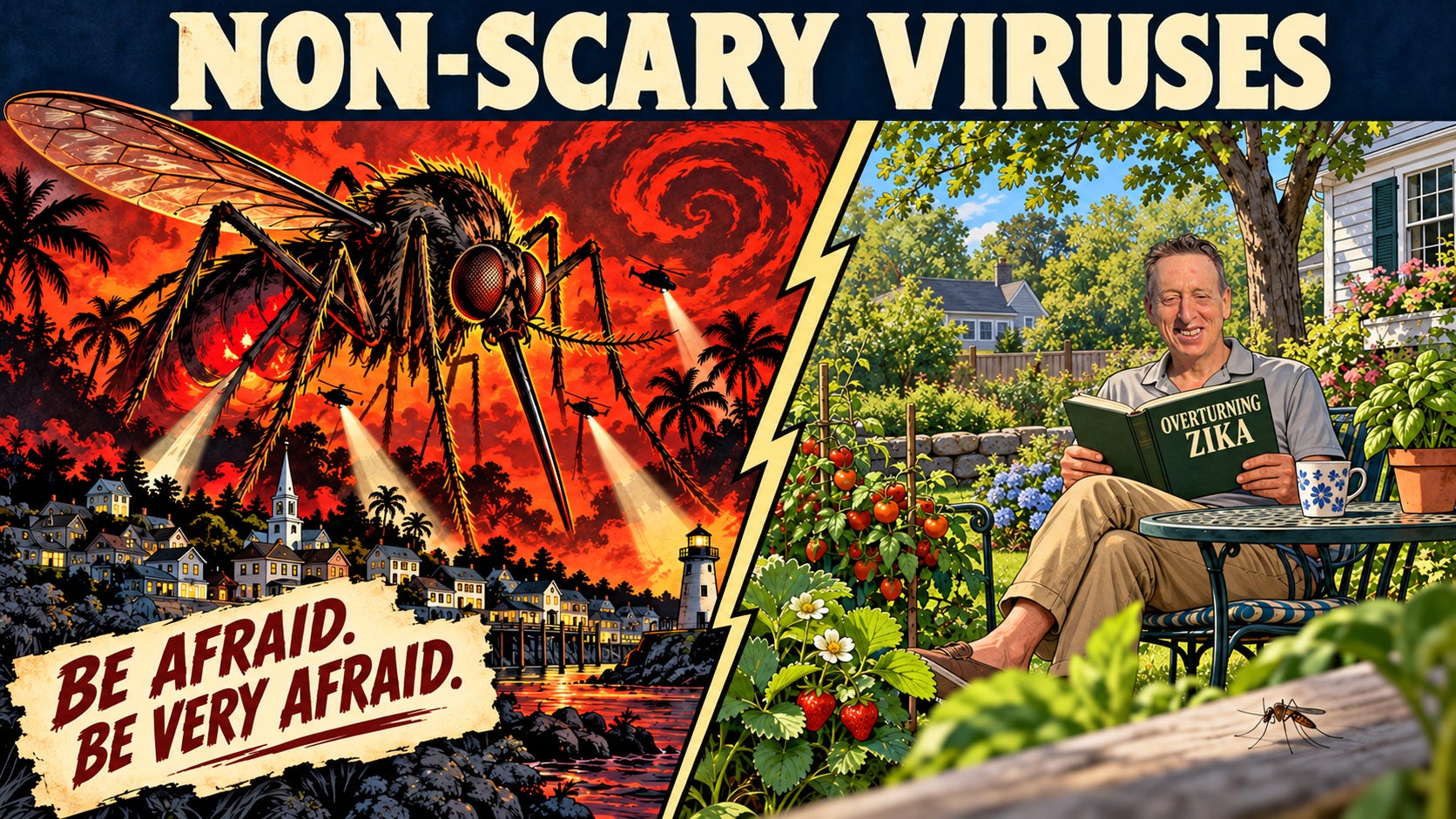
In 2016, health officials predicted more than a thousand cases of microcephaly in the Brazilian Northeast. Fewer than a hundred appeared. The man who published that discrepancy was Christopher Dye, then Director of Strategy at the World Health Organization, writing in The New England Journal of Medicine. He asked the obvious question out loud: this is a huge discrepancy, so what could possibly explain it? Ten years later, the question sits exactly where he left it. I have spent much of that decade on it — a book, Overturning Zika: The Pandemic That Never Was; a paper in the American Journal of Medicine; and an essay at Brownstone.
His case, at full strength
Dr. Luz’s explanation for the epidemic’s disappearance is herd immunity. Zika has a single serotype, unlike dengue’s four. It swept the Northeast so completely — he estimates infection approaching the whole population, with only about one in five people symptomatic — that there was no one left to infect. He expects a new outbreak as a non-immune generation grows up.
He also told me the story that changed his own mind, and it is a fair and serious one. In 2015, a pregnant Brazilian woman living in Italy came to Natal, fell ill, returned home, and learned her fetus had an abnormality; every standard congenital-infection test was negative. She asked him whether Zika could be responsible. His answer, in his words, was “it’s impossible.” Then the Italians tested for Zika, found it, and the case reached The New England Journal of Medicine. He described, too, an autopsy in which he divided an infant’s brain in two and sent the halves to the CDC in Atlanta and to a Fiocruz laboratory in Paraná; both, he says, found Zika and nothing else. That response deserves to be heard, and I gave it the floor without editing him into a foil.
Where I part company
As a physician, I keep returning to the ruler. Every one of Dr. Luz’s numbers is a comparison — we used to see five a year, now I see five in a weekend — and a comparison only means something if the ruler stays the same length. Throughout the emergency, Brazil diagnosed microcephaly at roughly two standard deviations below mean head circumference. The rest of the world, and the WHO, use three. In any normal population, about 2.3% of babies fall below the −2 line and about 0.13% below −3: a threshold nearly seventeen times looser than the international standard, one that marks roughly one baby in forty-four as abnormal no matter what virus is or is not circulating.
Set that against the size of the thing it was meant to detect. The confirmed rate of congenital Zika syndrome in the hardest-hit states was on the order of a quarter of one percent of live births — several times smaller than the instrument’s own false-positive floor. It could not have seen the disease clearly even if every confirmed case were real. And the numbers behaved exactly as a measurement artifact would: of roughly 1,500 reported Brazilian microcephaly cases with completed investigation, most were discarded on review, and only about one in eight carried laboratory evidence of Zika. Brazil’s own researchers concede that one in five confirmed or probable cases had head circumferences in the normal range. When the country finally adopted the world standard in early 2016, the epidemic began to evaporate — before any vaccine, before any intervention, before anything except a change in where the line was drawn.
Across twenty-six countries, from October 2015 to May 2017, the confirmed total of congenital Zika cases was about 3,374. The world had been told to expect a million a year.
What it cost, and the wager ahead
We never got the million microcephaly cases. We got a million of something else. WHO-aligned physicians toured Latin America urging women to postpone pregnancy until a vaccine arrived. Ten years on there is no vaccine, because after 2016 there was no epidemic left to vaccinate against. Across the Northeast, the birth rate fell and did not recover; there are classrooms in Salvador with empty seats. I call them the ghost babies — the children never conceived, because their mothers were frightened by a number that was wrong by more than two orders of magnitude.
I do not think Dr. Luz set out to do any of this, and I want to say so plainly. But intention is not the measure of harm. We have watched, in our own country, what happens when a respected physician mistakes his own certainty for settled science and lends it the force of public authority — when Dr. Anthony Fauci’s conviction became mandate, and mandate crowded out the ordinary clinical judgment that might have corrected it. The pattern in Recife and Natal was the same, only earlier: a sincere man, close to real suffering, too close to see that a handful of vivid cases is not a rate — and a public that paid for his certainty. The physician who raises an alarm of this magnitude carries the burden of proving it before he rings the bell, not after. That burden was never met. It has still not been met.
For once, the competing explanations are dated and falsifiable. Neil Ferguson’s 2016 model predicted herd immunity would hold Zika off for “over a decade.” Dr. Ernesto Marques of Pittsburgh and Fiocruz told me in 2021 he put the odds of another large outbreak “in this decade” at about 35 percent. Dr. Luz told me he expects one “in the next year.” The decade is up. If the next two years pass in Brazil with no resurgence, herd immunity fails on its own terms, and its authors owe the world a different answer to Christopher Dye’s question. If the outbreak comes, and the babies come with it, I will report that too — and I will report it first.
And here is what most troubles me. A decade on, Dr. Luz stands gallantly athwart the contrary evidence, defending his theory much as the boy in the story defended the dike — except that the flood has already passed him by, and there has been no recurrence. At this point his position becomes not merely questionable but unfalsifiable. If the babies return, it proves the virus; if they never return, it proves herd immunity. A hypothesis confirmed equally by both outcomes has quietly stopped being a hypothesis at all. As Carl Sagan warned, the hardest thing is not to detect the error but to admit we were taken by it — “it is simply too painful to acknowledge, even to ourselves, that we have been taken.”
Dr. Luz will be in Boston in September; I have invited him to dinner, and he has accepted. He told me that if there is ever another outbreak, I should come to Brazil and look at the babies myself. I would go tomorrow. He got the last word in our conversation, and he used it to tell me I am wrong. On the virus, he may well be right. On the million, he has not answered me yet.
The full unedited interview is available on YouTube. Further reading: Overturning Zika: The Pandemic That Never Was; “Investigating Zika-Microcephaly’s ‘Crash,’” American Journal of Medicine (2022); “The Mysterious Case of Zika-Microcephaly’s Disappearance,” Brownstone (2022).
Dr. Randall S. Bock is a physician and the author of Overturning Zika: The Pandemic That Never Was.
Discover more from Randy Bock MD PC
Subscribe to get the latest posts sent to your email.