
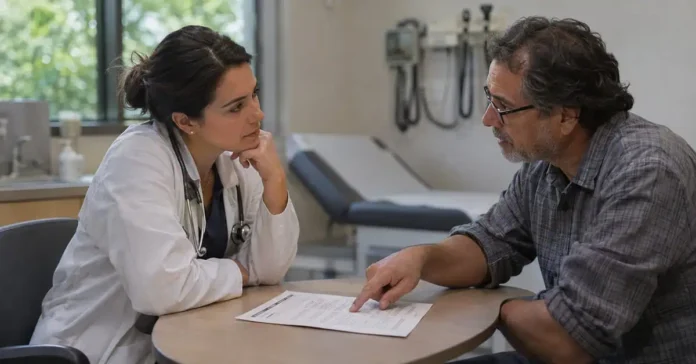
When the state brings a case against you, it has its own lawyer. Your lawyer has a separate obligation. He owes you his judgment and his loyalty, even when the authorities are convinced that their interests and yours coincide. I put that analogy to Dr. Clayton Baker, an internist in Rochester and the author of The Medical Masquerade. He answered with a line he remembered from Saving Private Ryan. “When I see a patient, the man is the mission or the woman is the mission.”
Baker says the difference is visible in his practice. Patients who once took medical advice largely on trust now ask whom to believe. A survey of more than 443,000 U.S. adults found that the share reporting a lot of trust in physicians and hospitals fell from 71.5 percent in April 2020 to 40.1 percent in January 2024. Those figures measure a loss of confidence. Baker’s explanation comes from what he has heard from patients since COVID, including patients who used to give the profession the benefit of the doubt.
His example of how a profession protects its own predates COVID by decades. His father, an orthopedic surgeon, submitted a study of a surgical procedure to a leading journal. In Baker’s account, the journal delayed publication through rounds of revisions, then printed the study alongside a paper by a group close to the journal’s leadership. The question in that story is who had the power to decide when the work would see daylight. In How to Fix Science, I argued for making scientific disputes easier to inspect. A reader ought to be able to see what an editor or reviewer objected to and judge whether the objection answers the author’s evidence.
I brought up menopausal hormone therapy because it complicates a simple account of commercial influence. I prescribed it in primary care and remember how quickly enthusiasm cooled. The Women’s Health Initiative reported in 2002 on a particular estrogen-plus-progestin regimen used in a prevention trial. Years later, the FDA revised the boxed warnings on certain menopausal hormone therapy products. Drug companies stood to sell fewer prescriptions when physicians pulled back, a point I made to Clayton. I wanted to know how a result from one trial had come to carry so much weight in decisions about women who differed from the trial population or sought treatment for a different reason.
Statins raised a related question. The West of Scotland trial used pravastatin in men with high cholesterol and no prior heart attack. Baker accepts that a patient with known coronary disease can benefit from a statin he tolerates. He wanted to know what evidence justifies choosing a newer drug or extending treatment to people with a different starting risk. A physician should be able to tell a patient what outcome the prescription is meant to prevent and how likely that outcome is for him.
Consent brought us back to the doctor’s duty. Baker asked why a parent should be offered vaccination for a child under anesthesia during the already crowded preoperative visit. His objection was to the timing and the conditions under which the decision is made. A parent who has come to discuss anesthesia and surgery should have time to ask about a separate intervention, consider doing it on another day, and decline it without fearing that the surgical plan is in jeopardy.
I see a similar problem in addiction medicine when a patient asks what recovery might look like if he eventually wants to stop taking medication. Methadone and buprenorphine treatment are associated with lower mortality while patients remain in care. That gives a physician a serious obligation to explain the risks of stopping and to plan follow-up with a patient who wants to taper. It also leaves room to ask whether the clinic takes that patient’s long-term goal as seriously as it takes keeping him enrolled. Baker called the prevailing incentive “this sort of lifelong patient model of medicine.” The test of whose interests the doctor serves comes when the patient asks whether his treatment has an endpoint.
Discover more from Randy Bock MD PC
Subscribe to get the latest posts sent to your email.