

Subscribe: Apple Podcasts | Spotify | Podcast Index | RSS
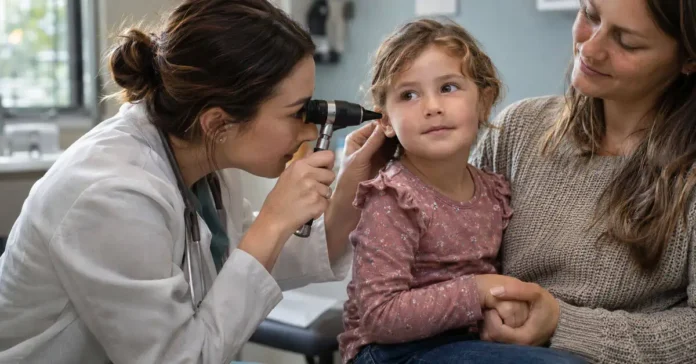
When I practiced primary care in Revere, parents sometimes came in expecting an antibiotic for a child’s earache. A squirming child could give me only a second or two to see the eardrum. That glimpse mattered. I might spend more time getting a look than I would writing the prescription, and the first task was the one that required judgment.
Christopher Hartnick, a pediatric ear, nose, and throat surgeon at Massachusetts Eye and Ear, turns the question around. Before asking whether a child has a middle-ear infection, ask whether there is fluid behind the eardrum. A device that helps a doctor answer that narrower question could keep some children from getting antibiotics they do not need. Hartnick also described work on software that examines images from an otoscope. In one study comparing an AI model with clinicians’ assessments, researchers checked those assessments against what surgeons found during the operation.
The work Hartnick does when a child cannot breathe on his own is a long way from an office ear exam. A premature infant may need a breathing tube while his lungs develop. The tube can keep him alive, yet the scarring it leaves can narrow the airway after the lungs are ready to work. Reconstructing that airway can give the child a chance to breathe, speak, and eat on his own.
In Ecuador, Hartnick recalled being called to see a child with an airway problem while he was doing cleft surgery in Guayaquil. The child was in Quito. Hartnick thought the operation would take two hours, and what stayed with him was what followed. After his team secured the airway, he realized he needed a local team that could care for the child afterward. He spent the next five years helping train surgeons, nurses, and intensive care staff in Quito. In El Salvador, he found another need inside the intensive care unit. Doctors and nurses worked apart, and young physicians were left to manage breathing tubes with too little training.
Through CareWays Collaborative, Hartnick and his colleagues have worked with local teams on the care that surrounds an operation. He described short training videos in several languages, along with simulation programs that let staff practice together. His aim was for the local team to run its own training. He recalled that in El Salvador, intensivists could take a pediatric resuscitation course through the program for free.
Ear tubes came up again when I spoke with anesthesiologist Keith Smith and economist Sean Flynn. Smith recalled families who came to the Surgery Center of Oklahoma and paid the posted price, about $1,600 all in at the time he described. He later learned that some were enrolled in Medicaid. He also told me about a family who borrowed a car in South Carolina and drove to Oklahoma City for a child’s tonsillectomy with the proceeds of a church bake sale. “Your church did their part. We’ll do our part,” he recalled telling them. The center waived the entire bill.
Flynn came to the question by way of Singapore, whose system he examined in The Cure That Works. He also told a story closer to home. When he went to have a small growth removed from his neck, he watched how many people the office needed to schedule, document, and bill for the work. One physician did the procedure. The business of getting paid required its own staff.
I asked Smith what he could take out of a bill. He put it in terms a father from western Oklahoma could use, asking what his six-year-old’s tonsillectomy would cost. Smith could look him in the eye and say $3,145. The figure covered the surgeon, anesthesia, the facility, and pathology. The father could hear the full price before he gave his consent.
Discover more from Randy Bock MD PC
Subscribe to get the latest posts sent to your email.