
Elizabeth Holmes is back on movie screens, this time in Nathan Fielder and Lance Oppenheim’s documentary You Can See Everything. The film arrived in October 2026, renewing the public’s fascination with the young Stanford dropout who promised to revolutionize blood testing, attracted nearly a billion dollars in investment, and ultimately received an eleven-year federal prison sentence.
John Tamny and I recorded our conversation about Holmes roughly a year before the film’s release. We were not chasing celebrities or responding to Hollywood’s latest fascination. Tamny, the editor of RealClearMarkets, had been defending Holmes for years, even as her former admirers distanced themselves from her. I wanted to understand his reasoning, and I had questions of my own.
Tamny begins with a premise that is difficult to dispute. Entrepreneurship depends upon people promising to accomplish things that do not yet exist. Investors finance those promises because the possibility of enormous returns compensates for the probability of failure. If an idea were technically established, commercially practical, and universally accepted, the extraordinary profits would already have been competed away.
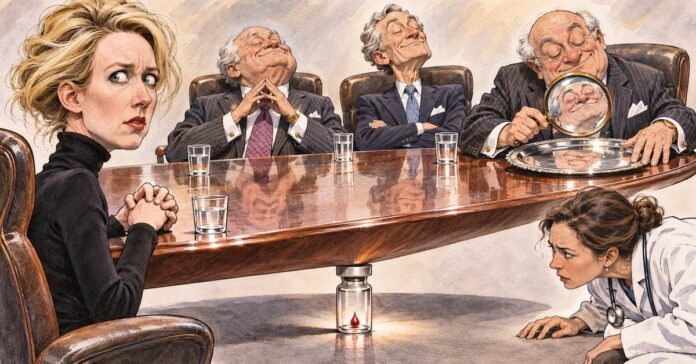
Holmes promised something extraordinary: numerous diagnostic tests from a few drops of blood. Her proposition attracted sophisticated investors, substantial capital, and a board populated by men whose achievements conferred instant credibility upon the enterprise. Among them were former Secretary of State George Shultz, former Defense Secretary James Mattis, and retired Admiral Gary Roughead.
But here is something that has always puzzled me. Where were these distinguished gentlemen when the machinery began to malfunction?
Shultz subsequently acknowledged that he had failed to question Holmes about allegations concerning the company’s technology. He accepted her assurances without probing them. This was particularly striking because his own grandson, Tyler Shultz, had raised serious concerns about Theranos’s laboratory practices and subsequently became a whistleblower.
The board’s collective credentials were extraordinary. Its demonstrated expertise in clinical chemistry, laboratory validation, and diagnostic instrumentation was considerably less impressive. One wonders how many directors could have explained the difference between a conventional automated chemistry analyzer and the miniature testing system Holmes claimed to have invented.
Directorship carries responsibilities as well as prestige. Board members are supposed to exercise judgment, interrogate management’s representations, and supervise the enterprise entrusted to them. Yet the most celebrated names surrounding Theranos largely escaped the opprobrium heaped upon its founder.
I also wonder about the financial incentives. What compensation did these directors receive, whether in cash or equity, and how much did they stand to gain from a rising valuation? The public record does not justify assuming that they knowingly concealed fraud or received additional shares for their silence. Nevertheless, the broader incentive is familiar: when a company’s valuation rises, its directors, investors, and celebrated supporters have little appetite for questioning the assumptions that made them look prescient.
We saw something similar with Sam Bankman-Fried and FTX. Tom Brady and other celebrities lent their names and reputations to the cryptocurrency exchange, while prominent financial institutions invested substantial sums. Brady was a celebrity ambassador and equity investor, not a corporate director. The distinction matters legally, although it does not eliminate the question of what diligence accompanied the endorsements.
When the enterprise prospered, the famous names reinforced public confidence. When it collapsed, their prior enthusiasm became an embarrassment, and attention concentrated upon the founder. It is worth asking whether the public’s distribution of blame corresponds to the distribution of responsibility.
Tamny makes another observation that I find persuasive. At one point, Theranos carried a valuation of $9 billion, giving Holmes a personal stake notionally worth billions. Yet she never sold her shares.
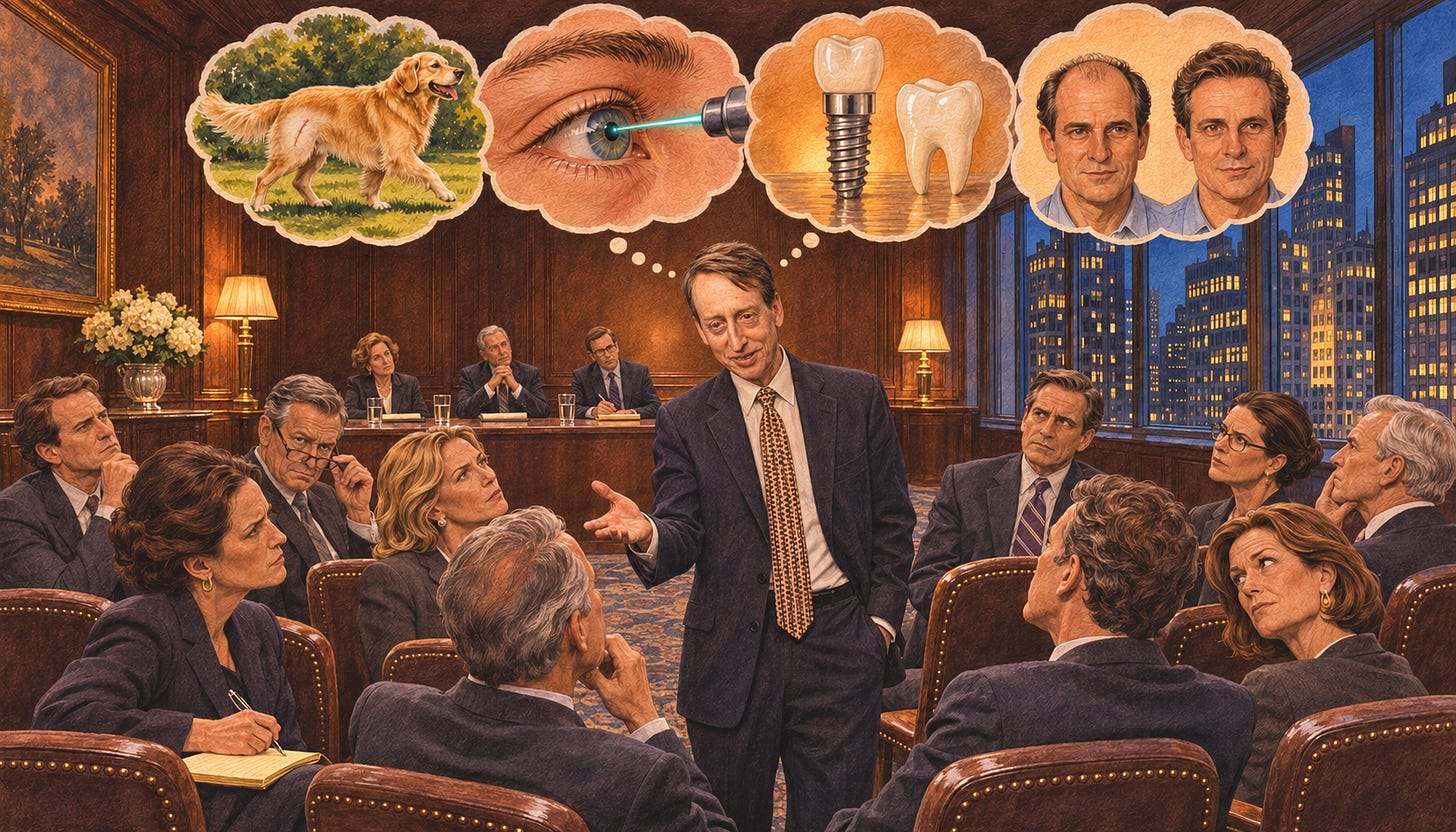
Sherlock Holmes famously solved a mystery by considering the dog that did not bark. Arthur Conan Doyle, himself a physician, understood that an absence can constitute evidence. Here, the missing transaction deserves attention. If Elizabeth Holmes knowingly engineered an immense financial swindle, why did she never convert her extraordinary paper fortune into personal wealth?
It does not prove her innocence. A founder may deceive investors while sincerely believing that eventual success will vindicate the deception. Still, the failure to cash out complicates the conventional portrait of a swindler motivated principally by personal enrichment.
As an angel investor, I am familiar with the rituals of entrepreneurial persuasion. Founders arrive with projections, endorsements, and presentations describing technologies that will supposedly transform established industries. The prospective investor knows that many of these enterprises will fail, and that the most spectacular claims may conceal the greatest technical uncertainties.
We call ourselves accredited investors. Accreditation, however, generally concerns wealth or financial sophistication. It does not certify discernment, scientific literacy, or immunity from fashionable delusions.
I have lost money investing in ventures whose founders I admired. I have also watched prominent investors attract others who assumed that someone with a distinguished reputation must have performed the necessary diligence. When enough recognizable names appear on a capitalization table, reputation itself begins to function as collateral.
Theranos’s directors were extraordinarily accomplished men. But accomplishment in diplomacy or military command does not confer proficiency in hematology or analytical chemistry.
Here, however, I part company with Tamny. I am a physician, and I cannot regard the accuracy of diagnostic testing as a mere entrepreneurial aspiration. Blood tests inform clinical decisions. Their analytic validity matters independently of investors’ willingness to speculate.
Theranos advertised revolutionary testing capabilities but often processed specimens using conventional commercial analyzers, sometimes after modifying or diluting samples. In our conversation, I compared the arrangement to the Mechanical Turk, the celebrated chess-playing automaton whose apparent mechanical intelligence concealed a human operator.
Tamny offered a different interpretation. Perhaps Holmes’s reliance on existing instruments showed that she wanted accurate results while her proprietary technology matured. That is conceivable, but it does not resolve the question of what customers were promised, what the laboratory actually delivered, or whether its results were reliable.
The jury itself drew distinctions. In January 2022, Holmes was convicted on four investor-related counts, acquitted on four patient-related counts, and faced a deadlock on the remaining three. An acquittal on a criminal charge does not establish that a laboratory’s practices were medically sound. Conversely, unreliable technology alone does not establish every element of criminal fraud.
Our discussion eventually returned to a subject I know more intimately: Purdue Pharma and the opioid epidemic. In my essays Methadone Maintenance Ignited America’s Opioid Crisis and The Purdue Paradox, I have examined how public institutions, physicians, regulators, and commercial interests contributed to a catastrophe subsequently attributed overwhelmingly to a highly visible pharmaceutical company.
The analogy is imperfect, as analogies usually are. Nevertheless, the temptation is recognizable. When an enterprise collapses, or a public-health policy fails, we prefer an identifiable villain to a careful accounting of the many people and institutions whose decisions made the outcome possible.
Tamny is especially impatient with the retrospective certainty of those who once admired Holmes and now pronounce her obvious guilt. His defense extends beyond her particular conduct. He fears a society in which ambitious failure becomes a criminal matter and the capital needed for speculative innovation retreats accordingly.
I share some of that concern without accepting every element of his defense. Investors must accept the risks they knowingly undertake; entrepreneurs remain responsible for material misrepresentations. Patients, meanwhile, have a legitimate expectation that laboratory results meet established standards of accuracy.
The latest film invites audiences to examine Holmes’s personality and decide whether she is still manipulating those around her. That is an entertaining psychological question, but I find the institutional questions more interesting.
Why did so many sophisticated people believe her? Why did her distinguished directors fail to scrutinize the science? Why do we applaud investors and celebrity endorsers during a company’s ascent, then assign responsibility so selectively after its collapse?
Holmes never sold her shares. Her directors did not adequately interrogate her claims. Her investors made their own decisions, and many suffered substantial losses.
Tamny continues to defend her. I remain less certain about her conduct toward patients, although considerably more sympathetic to his arguments about investor responsibility and the criminalization of entrepreneurial failure.
The public has had years to condemn Elizabeth Holmes. It might now devote a little more attention to the men who sat around her boardroom table. For selected quotations and video excerpts from our conversation, see my earlier Substack essay, Holmes Never Sold; Tamny Never Wavered, published October 22, 2026.
Discover more from Randy Bock MD PC
Subscribe to get the latest posts sent to your email.