

America spends more on healthcare than almost any other country, yet the question of what medical care actually costs is often surprisingly difficult to answer.
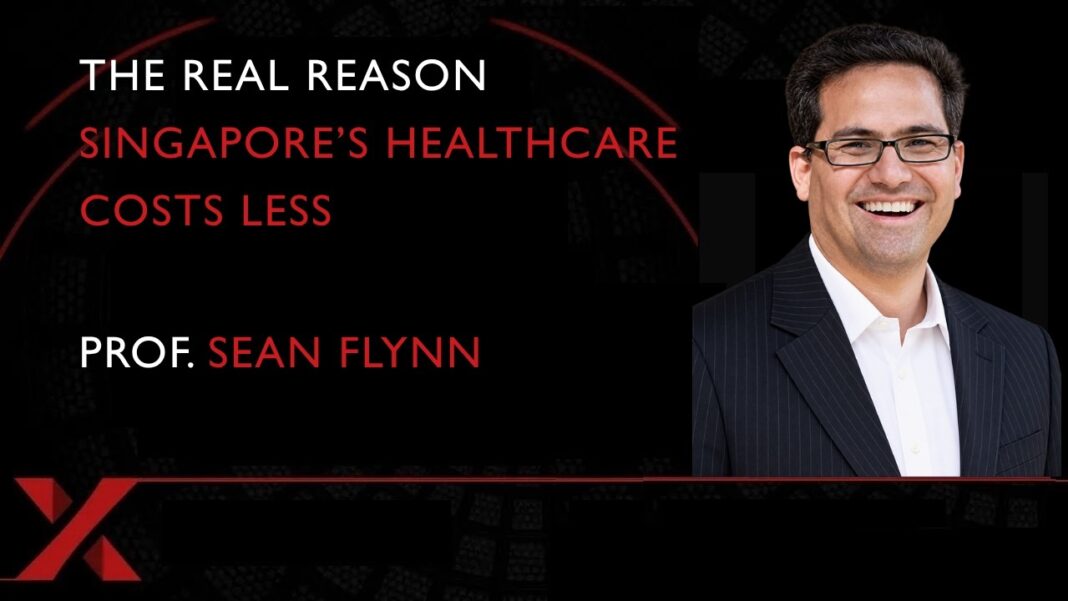
For economist Professor Sean Flynn, that is not a minor inconvenience. It is at the center of the American healthcare problem.
In an interview about his book The Cure That Works, Flynn argues that the United States has built a healthcare system in which the person receiving care is frequently separated from the price of that care.
The patient may not know the price.
The provider may not know what the patient will ultimately pay.
An insurer, government program, employer, or another third party may ultimately pay the bill.
Flynn believes that this arrangement weakens competition and allows a large gap to develop between price and cost.
His proposed alternative is built around a simple economic idea:
Give patients more control over the money, show them the prices, encourage competition, and protect them against catastrophic medical expenses.
Table of Contents
Sean Flynn and the Search for Lower Healthcare Costs
Flynn says his interest in Singapore’s healthcare system began almost accidentally.
In 2009, shortly before the Affordable Care Act was passed, he was asked to give a presentation to a Rotary Club in Claremont.
An opinion piece in The Wall Street Journal had suggested Singapore as an alternative healthcare model worth studying.
Flynn investigated.
He says the international data he examined surprised him because Singapore appeared to combine relatively low healthcare spending with strong health outcomes.
That led him to study the Singapore system in much greater detail. He eventually visited Singapore as a guest of its government and spoke with officials at its Ministry of Health.
His conclusion was that Singapore had not simply copied one foreign healthcare model.
Instead, it had assembled different ideas—including price transparency, health savings, government assistance, and competition—into a system designed around different incentives.
Flynn’s argument is not that America should copy Singapore line for line.
It is that Americans should examine why certain incentives appear to produce different results.
The Central Problem: Price Versus Cost
One of the most important ideas in Flynn’s argument is the distinction between price and cost.
In a highly competitive market, Flynn argues, prices tend to move closer to the underlying cost of providing a product or service.
Where competition is weak, the difference can become much larger.
He uses familiar consumer markets to illustrate the principle.
A supermarket operating under intense competition may have relatively small margins because customers can easily choose another store.
A company with greater market power may be able to maintain a much larger gap between what something costs to produce and what consumers pay.
Flynn believes American healthcare frequently resembles the latter situation.
The patient often does not behave like a conventional consumer.
Instead of asking:
What does this cost?
the patient may simply ask:
Is it covered?
That distinction matters.
If someone else is paying most of the bill, the patient’s incentive to compare prices is reduced.
And if providers are not competing directly for consumers who control the money, their incentive to compete on price may also be weaker.
Why Third-Party Payment Changes Healthcare
Flynn repeatedly returns to the problem of the user and payer being different people.
He compares healthcare with other industries in which the consumer does not directly control the purchasing decision.
In healthcare, government programs, insurers, employers, pharmacy benefit managers, and other intermediaries can all become involved between the patient and provider.
That creates an unusual market.
The person consuming the service may not know the price.
The person choosing the service may not be responsible for paying the bill.
And the organization paying the bill may not be the organization delivering the service.
Flynn argues that this creates room for inefficiency and for intermediaries whose financial interests may not always align with the patient’s interest in obtaining affordable care.
Singapore’s Healthcare Model
Singapore is the central case study in Flynn’s work.
According to Flynn, Singapore deliberately rejected simply copying either the British or American healthcare model.
Instead, it created a system incorporating personal healthcare savings, insurance for larger risks, government subsidies, and public assistance.
The result, in Flynn’s interpretation, is a system where individuals have a financial stake in ordinary healthcare spending while government remains involved when people cannot afford necessary care.
This distinction is important.
Flynn is not arguing for a healthcare system in which sick or poor people are simply left alone to pay their own bills.
Quite the opposite.
He emphasizes Singapore’s safety net as an important part of the model.
His argument is that lower prices make that safety net more affordable.
If competition pushes the underlying price of healthcare closer to its actual cost, government assistance can purchase more healthcare with the same amount of money.
Competition Can Lower Prices Without Cutting Care
One of Flynn’s strongest arguments is that reducing healthcare spending does not necessarily mean reducing the amount of healthcare people receive.
That may sound counterintuitive.
If a country spends less, shouldn’t patients receive fewer services?
Flynn says that depends on why spending is falling.
If spending falls because people receive fewer medical services, then access could indeed decline.
But if spending falls because prices and markups fall, the situation is different.
A healthcare system could theoretically deliver the same number of services—or potentially more—while spending less money if the prices paid for those services are substantially reduced.
That is the distinction Flynn believes is frequently missing from American healthcare debates.
The LASIK Example
The interview turns to several areas of healthcare where competition has already produced dramatic changes.
LASIK is one of Flynn’s examples.
Because LASIK has historically been outside ordinary insurance coverage, patients often pay directly.
That gives them an incentive to compare providers.
Flynn argues that the result has been a combination of:
- Lower prices
- Improved quality
- Greater consumer choice
- Stronger competition
The same basic pattern, he says, can be seen in other areas where consumers directly purchase healthcare.
These include dental implants, hair transplants, and veterinary orthopedic procedures.
The broader point is not that every medical procedure can operate like LASIK.
It is that healthcare markets can behave differently when patients actually control the purchasing decision.
Surgery Center of Oklahoma and Transparent Prices
Flynn also discusses Keith Smith and the Surgery Center of Oklahoma.
The center became known for publishing procedure prices and operating outside conventional insurance arrangements.
Flynn describes the center as an example of what can happen when providers know that patients are comparing prices.
Instead of forcing patients to navigate a complicated network of insurance contracts, a transparent cash price can make the transaction much easier to understand.
The Surgery Center of Oklahoma itself publishes procedure prices publicly, making it one of the clearest examples of price transparency in American healthcare.
The significance for Flynn’s argument is straightforward:
A price cannot influence consumer behavior if consumers cannot see it.
Direct Primary Care Changes the Incentives
Another major example in the interview is direct primary care.
Flynn discusses physicians who charge patients a fixed monthly fee instead of relying on conventional insurance billing for every primary-care interaction.
He specifically mentions Dr. Josh Umbehr and Atlas MD in Wichita, Kansas.
The model creates a different financial incentive.
If a physician receives a predictable monthly payment, the doctor’s financial interest can become more closely connected to keeping patients healthy rather than maximizing the number of billable encounters.
Flynn illustrates this with the story of an ancient Chinese payment model—while explicitly noting that he has never independently verified the historical anecdote.
He then connects that story to modern direct primary care.
The basic idea is:
Pay the doctor to keep the patient healthy rather than primarily paying the doctor for individual medical transactions.
That is a fundamentally different incentive structure.
What About Cancer, Accidents and Catastrophic Illness?
This is where Flynn’s argument moves beyond simply saying “let the free market handle healthcare.”
He recognizes the concern that patients have about catastrophic medical expenses.
What happens if someone gets cancer?
What happens after a serious accident?
What happens when someone needs a major operation?
A purely routine cash-pay model does not solve those problems.
Flynn therefore argues for catastrophic protection.
His proposal separates ordinary healthcare spending from catastrophic medical risk.
Routine services could increasingly operate through patient-controlled money and competition.
Large, unpredictable expenses would remain protected through insurance and public assistance.
That distinction is central to his proposed healthcare reform.
Why Flynn Rejects Single-Payer as the Answer
Flynn is highly critical of single-payer healthcare.
He argues that simply replacing America’s current insurance structure with a government-controlled single-payer system would not necessarily solve the underlying incentive problem.
In the interview, he points to Canada and Britain as examples of systems that, in his view, have faced problems involving waiting times, investment, and access.
He also argues that attempting to create an American single-payer system could result in powerful healthcare interests influencing the structure of the new system.
Importantly, this is Flynn’s interpretation and argument in the interview, rather than an uncontested description of international healthcare performance.
His broader economic objection is that changing the payer does not automatically create competition.
The central question remains:
Who controls the money, and who has an incentive to care about its price?
Why “Free Markets” Alone Are Not Flynn’s Answer
Flynn is also critical of the idea that simply announcing “free markets” would solve American healthcare.
He argues that people have a legitimate concern about catastrophic financial risk.
A person facing cancer does not want to hear that the market will eventually work everything out.
Someone involved in a serious accident needs treatment immediately.
That is why Flynn believes healthcare reform needs both competition and protection.
His model attempts to combine the two.
Patients would have more control over routine healthcare spending.
Competition would put downward pressure on prices.
Government would maintain a safety net for people unable to afford necessary care.
And catastrophic insurance would protect people against expenses they could not reasonably finance themselves.
The Hidden Cost of Healthcare Inefficiency
Flynn also argues that America’s healthcare system has accumulated layers of administrative complexity.
One example comes from his discussion of electronic medical records.
He describes his mother’s experience as an eye surgeon using an electronic billing and coding system with a large number of fields and dropdown menus.
According to Flynn, the system ultimately required additional workers, known as scribes, to help complete the documentation.
His point is not that electronic medical records are inherently bad.
Rather, he uses the example to question whether healthcare technology actually reduces costs when it is implemented inside a system already burdened with complex billing requirements.
The larger argument is that technology alone cannot fix bad incentives.
A more efficient computer system can still support an inefficient payment structure.
The Problem of Opaque Prices
Flynn describes an American healthcare environment in which the same medical service can produce very different payments depending on the payer.
He gives the example of different Medicaid reimbursement rates and different insurance payments for essentially the same service.
This creates a difficult environment for consumers.
If two hospitals perform the same procedure, but the prices vary dramatically depending on insurance arrangements, the patient cannot easily behave like a conventional shopper.
Flynn argues that this opacity helps preserve the gap between price and cost.
He believes the system has developed incentives for many participants to keep pricing complicated rather than transparent.
Medical Price Transparency Could Change the Market
For Flynn, one of the most important reforms is remarkably simple:
Put a price tag on healthcare.
He argues that consumers should be able to search for:
- The price of a procedure
- The provider offering it
- The quality metrics
- Complication rates
- Relevant outcomes
- Whether the provider is appropriately qualified
The goal would be a trusted source where a consumer could enter a ZIP code and compare available providers.
This concept is increasingly relevant to the broader healthcare policy debate. Current federal hospital price-transparency rules are specifically aimed at making pricing information more actionable and comparable for patients.
But Flynn goes further than simply publishing data.
He wants the information to be usable.
A giant spreadsheet of negotiated rates does little for an ordinary patient if the patient cannot determine what the final procedure will cost.
The Healthcare Price Tag
Flynn’s proposed reform therefore starts with something that seems almost embarrassingly ordinary in other industries:
Tell the customer the price.
When buying a car, people can compare prices.
When buying a computer, people can compare prices.
When choosing a hotel, people can compare prices.
When shopping for many elective medical procedures, Flynn argues, patients should be able to do the same.
Price transparency is not sufficient by itself.
Consumers also need information about quality.
A cheap procedure is not necessarily a good deal if the outcome is poor.
That is why Flynn pairs price tags with trusted quality metrics.
Health Savings Accounts Put the Patient in Control
Flynn’s most concrete proposed reform comes near the end of the interview.
When asked what single change he would make, he proposes redirecting healthcare subsidies toward individuals rather than maintaining the current structure.
His model would place the money into health savings accounts.
The patient would then control the money.
Instead of a bureaucratic system deciding how healthcare assistance should be spent, individuals would decide when and where to spend it.
Flynn compares this idea to Milton Friedman’s support for education vouchers: give individuals the purchasing power and allow them to make choices.
The principle is simple:
Put healthcare dollars closer to the person who actually consumes the healthcare.
Catastrophic Coverage Would Remain
Flynn’s model does not eliminate government involvement.
He proposes a government-backed catastrophic safety net.
Routine healthcare would increasingly rely on patient-controlled money.
Large medical risks would remain protected.
That distinction addresses one of the strongest objections to consumer-driven healthcare.
People cannot predict every medical emergency.
They cannot reasonably save enough money to self-insure against every possible cancer diagnosis, major accident, or catastrophic illness.
But they can potentially make more informed decisions about routine care if they control the money and can see the prices.
A Trusted Healthcare Marketplace
Flynn also proposes a trusted national source of healthcare information.
A consumer could enter a ZIP code and search for a procedure.
The system could theoretically show:
Price + Provider + Quality + Outcomes
That would create something much closer to a functioning marketplace.
Flynn acknowledges that any government-created system could itself be manipulated or “gamed.”
His proposal therefore depends on trustworthy and transparent information.
The technology is not the difficult part.
The difficult part is creating reliable information and incentives that consumers can trust.
Let Doctors Practice Across State Lines
Another reform Flynn mentions is allowing physicians greater ability to practice across state borders.
His argument is that modern technology makes geographic restrictions less necessary for many forms of medical consultation.
If an expert only needs a short amount of time to diagnose a routine condition, Flynn believes the healthcare system should make it easier for patients to access that expertise.
Expanding the potential pool of providers could also increase competition.
More providers competing for patients can potentially mean greater choice and downward pressure on prices.
Standardization Could Reduce Costs
Flynn also makes an interesting observation about medical treatment.
He argues that many diagnoses have relatively standardized treatment protocols.
That creates an opportunity for greater efficiency.
If millions of patients receive essentially the same treatment for the same diagnosis, Flynn asks why every transaction needs to be treated as a completely bespoke process.
His analogy is industrial production.
America pioneered assembly-line manufacturing.
Flynn believes healthcare can potentially use similar principles where appropriate without eliminating professional judgment.
The goal would not be to turn every doctor into a factory worker.
It would be to identify procedures and treatments where standardization can improve efficiency without compromising quality.
The Third-Party Payment Problem
Perhaps the most important economic concept in the entire interview is this:
The user and the payer are different people.
Flynn argues that this structure has created incentives throughout American healthcare.
If a government agency, insurer, employer, or other organization pays the bill, the patient has less reason to compare prices.
And if providers are paid according to complicated reimbursement formulas, they have less reason to compete directly for consumers.
This can produce an ecosystem of billing departments, coding specialists, administrators, intermediaries, pharmacy benefit managers, and other organizations.
Flynn’s proposed solution is to reduce the distance between the consumer and the money.
Healthcare Reform Through Competition
Flynn does not suggest that competition automatically solves every problem.
His argument is more specific.
Competition works when consumers can:
- See the price.
- Compare alternatives.
- Choose between providers.
- Control enough of the purchasing money.
- Evaluate quality.
- Walk away from providers offering poor value.
Healthcare frequently violates several of these conditions.
Flynn believes reform should restore them wherever practical.
The Direct Primary Care Example
Direct primary care provides one of the clearest examples of what Flynn has in mind.
Instead of paying for every individual encounter through insurance, a patient can pay a predictable membership fee.
The physician receives recurring revenue.
The patient receives ongoing access.
The doctor’s incentive can shift toward keeping the patient healthy and preventing expensive problems.
Flynn describes Atlas MD in Wichita as an example of this approach.
That does not mean direct primary care can replace hospitals or specialist care.
It illustrates a different way of financing routine primary care.
Hospitals Still Have a Role
The interview does not suggest eliminating hospitals.
In fact, the discussion recognizes that hospitals have an important role in catastrophic medicine.
A major stroke, aortic emergency, transplant, severe trauma, or complex surgical crisis can require enormous resources.
Those situations are different from routine primary care, elective surgery, or other services where patients may have time to compare providers.
Flynn’s argument is therefore partly about separating these categories.
Routine care can become more competitive.
Catastrophic care can remain protected.
What Would Healthcare Reform Actually Look Like?
Putting Flynn’s argument together produces a fairly clear framework.
1. Put More Money in Patients’ Hands
Redirect healthcare subsidies into individual health savings accounts.
2. Make Prices Visible
Publish meaningful, usable prices before care whenever possible.
3. Publish Quality Information
Patients need outcomes and complication information alongside prices.
4. Encourage Competition
Reduce barriers that prevent providers from competing for patients.
5. Expand Direct Payment Models
Allow direct primary care and cash-pay healthcare to operate more freely.
6. Protect Against Catastrophic Expenses
Maintain insurance or government-backed protection for major medical risks.
7. Reduce Administrative Complexity
Remove unnecessary layers of billing, coding, reimbursement, and middleman activity.
8. Increase Provider Mobility
Allow qualified physicians to serve patients across state boundaries where appropriate.
Together, these changes represent Flynn’s alternative to both traditional American third-party payment and a centralized single-payer system.
The Cure That Works
Flynn’s book is titled The Cure That Works, with the subtitle “How We Can Have the World’s Best Healthcare for a Quarter of the Cost.”
That is a deliberately ambitious claim.
The interview’s central argument is that the United States does not necessarily need to choose between expensive private healthcare and centralized government healthcare.
Flynn proposes a third approach.
Give individuals more control.
Make healthcare prices visible.
Use competition to push prices toward costs.
Keep a strong safety net.
Protect people from catastrophic expenses.
And let providers compete for patients based on both price and quality.
The Deeper Economic Lesson
The healthcare debate is often framed as a question of ideology.
Should healthcare be private?
Should healthcare be public?
Should government pay?
Should insurers pay?
Flynn approaches the question differently.
He asks about incentives.
Who pays?
Who chooses?
Who knows the price?
Who bears the financial consequences?
Who benefits from keeping someone healthy?
Who benefits from another procedure?
Who has an incentive to reduce costs?
Those questions can produce a very different discussion.
A healthcare system does not merely distribute money.
It creates incentives for millions of people and organizations.
Change those incentives and behavior can change with them.
The Cure That Costs Less
Sean Flynn’s proposal ultimately comes down to a simple reversal of the conventional healthcare payment model.
Instead of putting most healthcare dollars behind layers of third-party payment, put more of the purchasing power directly in patients’ hands.
Instead of hiding prices, publish them.
Instead of relying primarily on reimbursement negotiations, encourage providers to compete.
Instead of leaving people exposed to catastrophic expenses, maintain strong insurance and public protection.
And instead of assuming that lower spending must mean less healthcare, ask whether some of the savings can come from eliminating excessive markups, unnecessary administrative costs, and weak competitive pressures.
That is the central idea behind The Cure That Works.
Give patients the money.
Show them the price.
Let providers compete.
Protect people from catastrophe.
For Flynn, that combination—not simply more government or simply more insurance—is the potential path toward lower healthcare costs and a more responsive American healthcare system.
Frequently Asked Questions
1. What is Sean Flynn’s healthcare reform proposal?
Sean Flynn proposes giving individuals greater control over healthcare spending through health savings accounts, increasing price transparency, encouraging competition, and maintaining catastrophic protection for major medical expenses.
2. Why does Sean Flynn focus on healthcare price transparency?
Flynn argues that patients cannot behave like informed consumers when they do not know what medical services cost. He believes transparent prices would make it easier to compare providers and create stronger incentives for competition.
3. How do health savings accounts fit into Flynn’s healthcare model?
Flynn proposes directing more healthcare subsidies into individual health savings accounts so patients control more of the money used for routine healthcare rather than having third parties make many spending decisions.
4. What does Singapore’s healthcare system demonstrate according to Sean Flynn?
Flynn uses Singapore as an example of a system combining health savings, competition, government assistance, and catastrophic protection. His argument is that America could learn from some of those principles without copying Singapore’s entire system.
5. Does Sean Flynn want to eliminate health insurance?
No. Flynn distinguishes routine healthcare from catastrophic medical expenses. His proposal would use greater patient control and competition for ordinary care while retaining protection against major medical costs.
Final Takeaway
The most important question raised by Sean Flynn is not simply “Who should pay for healthcare?”
It is:
“Who should control the healthcare dollar?”
Flynn argues that when patients control more of the money, see the prices, and can compare providers, competition can become a force for lower prices and greater efficiency.
His proposed healthcare reform therefore combines market competition with public protection.
The objective is not to abandon people when they become seriously ill.
It is to make ordinary healthcare more transparent, more competitive, and more responsive to the person actually receiving the care.
That is the economic case Flynn makes in The Cure That Works—and why he believes the cure for America’s healthcare costs may begin with something remarkably simple:
Give the patient the money and show the patient the price.
📚 Related Resources, Videos, and Links
- https://www.scrippscollege.edu/offices/profile/sean-flynn
- https://www.regnery.com/9781621579533/the-cure-that-works/
- https://www.simonandschuster.com/books/The-Cure-That-Works/Sean-Masaki-Flynn/9781621579625
- https://www.moh.gov.sg/managing-expenses/schemes-and-subsidies/medishield-life/
- https://medishieldlife.moh.gov.sg/
- https://www.mheducation.com/highered/events/on-demand/2026/bringing-econ-to-life.html
- https://surgerycenterok.com/surgery-prices/
Discover more from Randy Bock MD PC
Subscribe to get the latest posts sent to your email.