
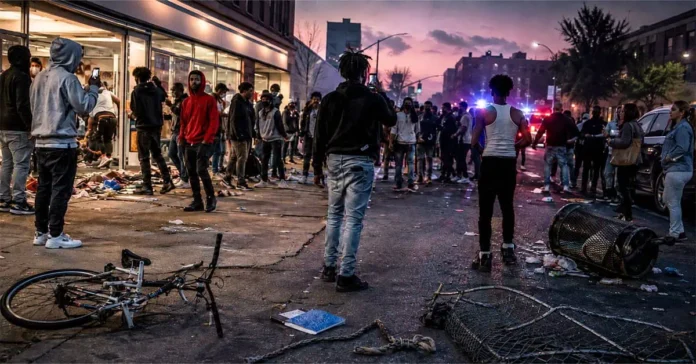
Heather Mac Donald has been reporting on the mobs that assemble by social media and take over a street, a store, or a stretch of beach for an evening. Her City Journal article is The Scourge of Teen Takeovers. She says the press covers these events in vocabulary built to leave the participants unnamed, and she names them: “This is a racially charged, racially tinged issue, because these are overwhelmingly, almost without exception, black teenagers.” The euphemism performs the work the reporting will not.
The favored explanation is the pandemic. Reporters and at least one fellow at the American Enterprise Institute trace the violence to lockdown isolation and a longing for connection. Mac Donald answers that white American teenagers lived under stricter household rules and are not rampaging, and that Europe locked down harder and produced nothing similar. She dates the behavior well before 2020, to Freaknik in Atlanta and to the mobs that moved through Chicago in the 1990s, looting stores and beating pedestrians.
Poverty is the second explanation, and she dismisses it by pointing at the equipment. The participants film one another and post the footage, because the viral video is much of the point. “Anybody in my view who has a smartphone has no claim of poverty.” The stores get looted late at night because they are open, thinly guarded, and staffed by cashiers who can be frightened. What is scarce is not money: “There’s a poverty of social capital, a poverty of parenting, a poverty of self-control.”
Behind the excuses she finds the doctrine of disparate impact, which treats any standard that black Americans meet at lower rates as proof that the standard is discriminatory. Medical schools soften the entrance scores. Prosecutors decline whole categories of crime, and juvenile courts in liberal jurisdictions have been rebuilt until consequences are nearly unavailable. She says the message reaches the kids intact, and that they learn to expect absolution.
The deeper cause, in her telling, is the collapse of the black family. Daniel Patrick Moynihan issued his warning when the illegitimacy rate stood near 23 percent, and it now runs close to 70. She repeats the success formula that conservatives have argued for decades: finish high school, hold a job of any kind, and marry before having children. Poverty in America today tracks single parenthood, she says, and the norms that prevent it are not color coded.
She dates the cultural break to the 1960s. Ella Fitzgerald and Duke Ellington dressed for the stage and worked inside the Great American Songbook while the country still barred them from its hotels and restaurants. That aspiration was traded for an oppositional culture, and the elites applauded the trade, which is the scene Tom Wolfe recorded when Leonard Bernstein gave his party for the Black Panthers. Mac Donald blames the flatterers as much as the flattered.
Asked about the sexual marketplace, she describes a marriage script that has been torn up. A young man once had to become employable, defer gratification, and swallow his temper at work in order to be chosen, and young women held the gate. Feminism disparaged those male virtues, she says, and the American Psychological Association eventually classified masculinity itself as toxic. The civilizing transaction ended, and the community with the most damaged relations between men and women absorbed the worst of it.
On remedies, she is not optimistic. Welfare reform passed in 1996, but the more radical proposals died with it, among them Charles Murray’s plan to end additional cash for additional children born outside marriage and Robert Rector’s suggestion that the hungry be given food rather than food stamps. Government has abandoned order and property, she says, and turned itself into a machine for moving money to favored groups.
She declines the theory that foreign actors stoke American disorder, and calls the appeal to it a cop-out that lets conservatives skip the domestic accounting. Freaknik did stop, and she credits police who shut it down while indifferent to being called racist, though the crowds moved on to Miami Beach. The universities have renamed their diversity offices and kept the preferences, and she expects the apparatus to return whole if the Democrats take the White House in 2028.
Her most recent book is When Race Trumps Merit, reissued in paperback with a new introduction, and it carries the argument into museums, the arts, and classical music. The Diversity Delusion and The War on Cops came before it.
Discover more from Randy Bock MD PC
Subscribe to get the latest posts sent to your email.