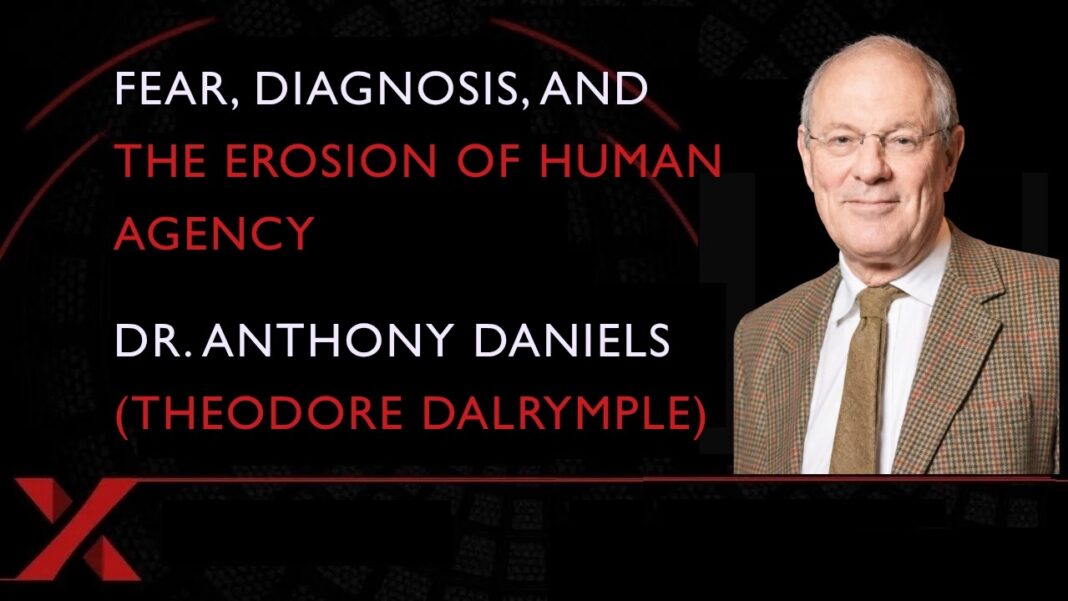


At my squash club, I was speaking with a mother about vaccination and her teenage daughter. Another physician overheard us and began shouting that I was killing people. He had credentials; what he offered in that moment was an accusation, not an answer. That encounter came to mind when I spoke with British clinical psychologist Gary Sidley in July 2022. He described a method of persuasion that made compliance a measure of personal goodness. Once officials attach virtue to a policy, questioning the policy becomes evidence against the questioner’s character.
Sidley spent 32 years in Britain’s National Health Service, first as a psychiatric nurse and then as a clinical psychologist. His research concerned suicide risk; he understood both the difficulty of predicting harm and the damage caused by attempts to eliminate every risk. A life organized entirely around avoiding danger can become a life scarcely lived.
The pandemic brought those concerns into public policy. Sidley watched frightening advertisements and began examining behavioral “nudges,” techniques that exploit our habitual responses, emotional reactions, and desire to belong. As he explained, these are “psychological techniques of persuasion that act upon us largely below our level of consciousness.” The recipient need not recognize the intervention for it to work.
The documentary evidence deserves reading. A March 22, 2020 paper prepared by the government’s behavioral advisory group stated: “The perceived level of personal threat needs to be increased among those who are complacent, using hard-hitting emotional messaging.” The next sentence called for giving people actions they could take to reduce the threat. The document also recommended positive messaging and warned against scapegoating. Those qualifications belong in the account; so does the explicit recommendation to increase fear. GOV.UK
A physician ordinarily tries to help a frightened patient judge danger accurately. Deliberately increasing his fear requires a separate justification. An official’s believing that a behavior serves the public does not settle whether manipulating the citizen’s emotions is an acceptable means of obtaining it.
Sidley distinguished several methods. Authority gives a message weight; a familiar institutional logo can do some of the persuading before anyone considers the evidence. Moral appeals enlist our desire to regard ourselves as decent people. Conformity supplies another pressure, since few people enjoy standing conspicuously apart from a crowd.
Masks, he argued, made compliance immediately visible. Whatever their intended medical function, they also allowed strangers to identify who followed the rule. His interpretation concerned their social function; it did not establish why every official adopted them. It did help explain the eagerness with which some citizens corrected others.
I saw that eagerness outdoors while walking my dog. A masked woman, some distance away, pointed out my uncovered face. Distracted by her objection, she stepped awkwardly and fell. She was fortunately unhurt, but she did not want my approaching to help her up.
I also asked people who continued masking how long they expected to do so. Ten more years sounded absurd to them; five sounded excessive. One year produced hesitation. My question exposed an absent stopping rule: what change in evidence or circumstances would permit their stopping?
Sidley’s objection was more specific than a demand to abolish persuasion. He accepted that behavioral techniques could have legitimate uses. His questions concerned the methods, the goals, transparency, and consent. In his published appeal for an inquiry, he and other signatories asked for scrutiny of those ethical questions. HART
When someone defended nudging as getting people to do the right thing, Sidley’s response was direct: “Who decides what the right thing is? I don’t remember being consulted about that.” The question becomes especially pressing when the proposed behavior carries costs that officials minimize or leave unmeasured.
Medicine requires our explaining benefits, risks, and alternatives. Public health officials exercise authority over far more people; that scale increases their obligation to explain themselves. Citizens deserve the evidence behind a recommendation, the uncertainty surrounding it, and an account of the psychological methods being used to obtain their agreement.
Discover more from Randy Bock MD PC
Subscribe to get the latest posts sent to your email.