
A time capsule from 2022: the lockdown years, examining government power, medical judgment, and the pressure to conform.
{On July 14, 2022, I interviewed Jeffrey Tucker, founder of the Brownstone Institute.}
Tucker founded Brownstone.org; he expected lockdowns to produce consequences extending far beyond infectious disease. Economic disruption would become political conflict; beneath both lay a question about the relationship between individuals and government. He wanted an institution where those questions could receive a hearing.
His starting objection was concrete. An economy consists of people whose work depends on other people’s working, buying, delivering, and planning. Closing those relationships by decree would carry costs that reopening orders could not simply erase. Tucker described the belief that an economy could be switched off and restarted as a profound misunderstanding of human society.
I approached the same problem through medicine. A physician treats particular patients, with different ages, conditions, and circumstances. Population policy can obscure those differences. I objected to treating everyone as though the danger were uniform; Tucker argued that public understanding of differences in risk had been badly confused.
Government structure mattered, too. I pointed to the American states’ ability to pursue different policies. Their differences allowed comparisons that a single national directive would have foreclosed. My concern was the ease with which governments adopted a common prescription while narrowing the room for competing judgments.
Tucker was reading Deborah Birx’s memoir, Silent Invasion, and examining her account of the pandemic response. He saw an official convinced that sufficient control over behavior could bring a respiratory virus under command. His criticism concerned both the policy and the confidence with which its author interpreted events as evidence of her success.
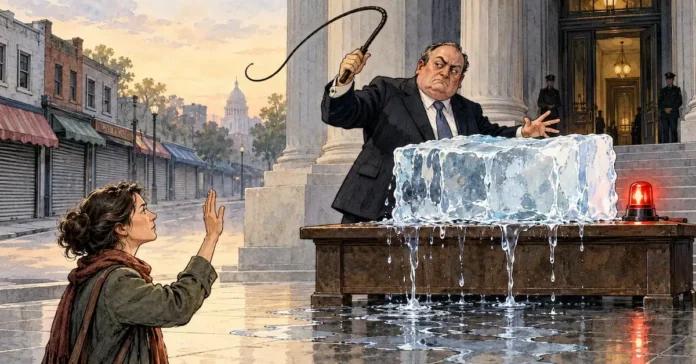
I offered a childhood dream that had stayed with me. On a sweltering day, I stood beside a block of ice with a lion tamer’s whip, trying to stop its melting. Each new trickle sent me around the table to intervene again. The work exhausted me; the ice continued to melt.
Tucker recognized the comparison immediately. The question was how officials responded when events failed to obey their plans. A policy could acquire another extension, another justification, another demand for compliance. The original promise of a brief intervention could recede while the authority claimed for it remained.
Our political explanations were not identical. Tucker emphasized hostility toward Donald Trump; I emphasized the attraction of power itself. “People love power, and power brings money,” I said. “Money brings power.” My argument concerned incentives that can bring people into agreement without their having planned every event together.
That concern carried into pandemic preparedness. Tucker argued that an industry supported by enormous expenditures could develop an incentive to turn each emerging pathogen into a global emergency. I raised the financial and professional interests surrounding research. The question was whether those interests received the same scrutiny as the people challenging their conclusions.
The treatment of dissent brought that question into focus. We examined the response to the Great Barrington Declaration, whose authors proposed focused protection for vulnerable people while allowing those at lower risk to resume ordinary life. Tucker also recalled a lengthy attempt to persuade him to stop writing against lockdowns. He described pressure for a united front at precisely the time he believed competing arguments needed examination.
When I asked whether he had stopped, his answer was immediate: “Of course not.” He traced his commitment to liberty to his reading as a college student. He had pursued economics because he wanted to understand human freedom and the arguments offered for restricting it.
His closing statement contained an admission that deserves to remain in the recording. He was still trying to piece together what had happened. He wanted to understand the decisions, the institutions, and the public’s acceptance of them. In July 2022, he regarded that investigation as unfinished work; he expected it might consume the rest of his life.
For readers following these questions beyond the interview, my later Brownstone essays include “The China Covid Narrative: What We Missed in 2020”, published March 13, 2025, and “ASPR and BARDA: Bureaucratic Dysfunction in Biodefense”, published February 9, 2025. Both were written after this recording; they extend the inquiry into China’s pandemic narrative and the institutions responsible for American biodefense. I have contributed more than a dozen articles to Brownstone; my author archive collects that work.
Discover more from Randy Bock MD PC
Subscribe to get the latest posts sent to your email.