
Evidence-based medicine is supposed to help doctors make better decisions. But what happens when evidence becomes a slogan, peer review becomes a substitute for critical thinking, and professional authority is treated as proof?
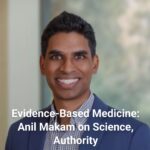
In a wide-ranging conversation about medicine, science, health policy, and the production of knowledge, physician and health-services outcomes researcher Anil Makam argues for something more demanding than either blind trust in institutions or blind rejection of them.
His principle is simple:
Be passionate about the question, but not the answer.
That distinction goes to the heart of evidence-based medicine.
Makam’s argument is not that expertise is worthless, that guidelines are useless, or that published research should be ignored. Quite the opposite. Evidence, expertise, and institutional knowledge are indispensable. The problem begins when authority replaces the scientific process—and when clinicians forget that evidence must ultimately be interpreted in the context of an individual patient.
The result is a difficult but important question:
How should we decide what to believe when scientific evidence, institutional authority, clinical experience, and patient circumstances do not point neatly in the same direction?
Table of Contents
Who Is Anil Makam?
Anil Makam describes himself as a hospital medicine physician and a health-services outcomes and epidemiology researcher. His clinical experience informs the questions he asks, while his research work gives him another way of evaluating evidence.
In the interview, Makam explains that clinical intuition drives many of his professional impulses, but intuition does not replace evidence. Instead, it helps determine which questions deserve investigation and how evidence should be interpreted.
He describes his work as focusing on evidence, medicine, health policy, and emerging research. The interview therefore begins from a useful position: the goal is not to choose between experience and science, but to understand how they should interact.
That distinction becomes increasingly important in an age when medical information is everywhere.
The Real Problem Is Not Expertise
Modern medicine contains competing sources of authority.
On one side are entrepreneurs, wellness personalities, longevity advocates, supplement sellers, and other public figures who may build an audience around a particular thesis.
Their conflicts of interest can sometimes be obvious.
If someone tells you that a particular supplement, program, or product will improve your health—and then sells that product—the financial incentive is relatively easy to identify.
Makam argues that this obvious form of conflict is not necessarily the most important one.
The more difficult problem can arise when authority is institutional.
Experts may occupy senior positions in hospitals, universities, health-policy organizations, guideline committees, research institutions, and other influential organizations. Their incentives may be less visible, while their ability to shape policy and public understanding may be considerably greater.
The transcript describes this phenomenon as intellectual conflicts of interest.
The concern is not that experts are secretly dishonest. Rather, people can become deeply attached to hypotheses, frameworks, institutions, or conclusions that have become intertwined with their professional identities.
Once an answer becomes part of someone’s identity, challenging the answer can feel like challenging the person.
Makam argues that this can distort the scientific process.
Published Does Not Automatically Mean Reliable
One of the most important themes in the interview is the difference between science as a body of knowledge and science as a process.
A published paper is part of the scientific literature. But publication does not mean that the question has been permanently settled.
Peer review matters. Research quality matters. Replication matters. Study design matters. Statistical methods matter. Caveats matter.
And all of those things require judgment.
Makam challenges what he sees as an increasingly common intellectual shortcut: treating “published” as synonymous with “reliable,” and “peer-reviewed” as synonymous with “settled.”
Science does not work that way.
Scientific knowledge changes because evidence changes. Studies contradict one another. New methods expose old weaknesses. Replication can strengthen or weaken previous findings. Researchers discover limitations that were not obvious when an original study was published.
The transcript emphasizes that even well-designed studies contain caveats, while poorly designed studies can contain fundamental problems that deserve scrutiny before their conclusions are amplified to enormous audiences.
This is why medical evidence must be evaluated rather than merely cited.
Science Is a Process, Not a Priesthood
There is a subtle but profound difference between respecting science and treating scientific authority as infallible.
Science is powerful precisely because it allows existing conclusions to be challenged.
A scientific claim should therefore be understood as part of an ongoing process rather than a decree from above.
This is where Makam’s statement—“be passionate about the question, but not the answer”—becomes particularly important.
Researchers should want to discover what is true, even when the result contradicts their expectations.
If someone begins research by saying, “I want to prove X,” the question becomes what happens if the evidence shows not-X?
Makam argues that research should instead be approached with a willingness to be surprised. The objective is the pursuit of knowledge, not the defense of a predetermined conclusion.
That principle sounds obvious.
In practice, it can be extraordinarily difficult.
Intellectual Conflicts of Interest Can Be Harder to See
Financial conflicts of interest are relatively easy to understand.
If a person makes money from selling a product, readers can factor that incentive into their evaluation.
Intellectual conflicts are different.
A scientist may have spent decades developing a theory. A specialist may have built a career around a particular framework. A professional organization may have invested enormous resources in a particular policy.
None of this automatically makes their conclusions wrong.
But it creates the possibility of confirmation bias.
The transcript describes a situation in which people’s professional identities become attached to hypotheses or answers. When evidence threatens the narrative, the threat may therefore become personal.
This is one reason scientific disagreement should not automatically be interpreted as hostility toward science.
Disagreement can be part of science.
Indeed, the ability to challenge an accepted conclusion is one of the mechanisms by which science corrects itself.
What Is Evidence-Based Medicine?
This question becomes central later in the interview.
Makam argues that evidence-based medicine has sometimes been reduced to something much simpler than it was intended to be:
Study says X. Guideline says Y. Therefore, do Y.
That approach has advantages.
Standardization can raise the floor of medical care. It can reduce dangerous variation and give clinicians a baseline approach when evidence and experience are limited.
But standardization has a ceiling.
Makam makes the striking observation that he could see the same disease in apparently similar patients and potentially treat them in very different ways while still practicing evidence-based medicine.
Why?
Because evidence is only one part of the decision.
The U.S. National Library of Medicine similarly describes evidence-based medicine as integrating the best available research evidence with patient values in decisions about medical care.
That distinction is critical.
Evidence + Expertise + Patient Context
Evidence-based medicine is not simply a library of studies.
It requires the clinician to understand the evidence and then determine how it applies to the person sitting in front of them.
Makam describes three overlapping elements:
- What is known from the available evidence
- What is happening in the individual patient’s circumstances
- What the patient values and wants to achieve
The evidence may suggest a treatment is beneficial on average.
But averages do not describe every individual perfectly.
A patient’s prognosis, priorities, competing illnesses, lifestyle, circumstances, and goals can all affect the appropriate decision.
For example, a treatment intended to provide benefits many years into the future may make little sense for someone whose circumstances make those future benefits irrelevant.
A guideline cannot anticipate every possible combination of patient circumstances.
The clinician must therefore interpret the evidence rather than simply execute it.
This is consistent with established definitions of evidence-based practice, which emphasize the integration of best available evidence, clinical expertise, and patient values and preferences.
Guidelines Raise the Floor—But They May Not Raise the Ceiling
This may be one of the most useful ideas in the interview.
Guidelines can establish a minimum standard.
They can prevent clinicians from making obviously unsupported decisions. They can provide structure, particularly in common clinical situations.
But a guideline cannot completely replace judgment.
Makam argues that algorithmic medicine may raise the floor of care while potentially lowering the ceiling for a particular patient if clinicians stop thinking beyond the algorithm.
This does not mean guidelines should be discarded.
It means they should be understood correctly.
A guideline is a tool.
It is not the patient.
It is not the totality of medical knowledge.
And it is not a substitute for clinical reasoning.
The Danger of “The Science Says…”
Few phrases sound more authoritative than:
“The science says…”
But what does that actually mean?
Does it mean one study?
A systematic review?
A clinical guideline?
A professional consensus?
A collection of observational studies?
A randomized controlled trial?
A mechanistic hypothesis?
A statistical association?
These are not equivalent forms of evidence.
The phrase can become a rhetorical shortcut that ends discussion rather than advancing it.
The transcript discusses what the speakers call epistemic bullying—using credentials, expertise, institutional position, or superior knowledge as a way of shutting down disagreement.
That is a dangerous habit because authority and truth are not identical.
An expert can be right.
An expert can be wrong.
And sometimes the most valuable contribution of an expert is not knowing everything, but knowing where uncertainty remains.
Peer Review Is Valuable—But It Is Not a Magic Stamp
Peer review is an important part of scientific publishing.
But a peer-reviewed study can still be limited by its methodology, population, statistical analysis, assumptions, or interpretation.
A publication therefore should be the beginning of evaluation, not necessarily the end.
This matters because modern information systems can amplify a scientific claim far beyond the audience that originally evaluated it.
A questionable study can become a headline.
A headline can become a social-media post.
A social-media post can become a widely repeated “fact.”
The chain from publication to public belief can therefore strip away much of the uncertainty and context contained in the original research.
Research on science misinformation similarly recognizes that scientific institutions and communication systems can contribute to the spread or amplification of inaccurate information, including through publication and communication failures.
The solution is not to reject scientific literature.
It is to become better at reading it.
The Marketplace of Ideas
Another major theme in the interview is the marketplace of ideas.
Historically, scientific and medical knowledge could be heavily filtered through professional institutions, journals, editorial systems, committees, and established networks.
The internet changed that.
Researchers, physicians, independent writers, patients, and members of the public can now participate in discussions that once occurred largely behind institutional walls.
Makam describes the modern public square as an important source of knowledge because it can expose people to perspectives from outside traditional academic channels.
But there is an obvious danger.
An open marketplace does not guarantee good information.
It creates more competition between ideas—but also more misinformation, exaggeration, sensationalism, and ideological tribalism.
The answer cannot simply be:
Trust the institution.
Nor can it be:
Trust the outsider.
The better question is:
What is the quality of the evidence?
Medical Freedom Requires Intellectual Humility
This distinction has important implications for medical freedom.
Medical freedom does not require believing every alternative-health claim.
It does not require rejecting doctors, universities, journals, or professional organizations.
And it does not require assuming that every institution is corrupt.
Instead, intellectual freedom in medicine requires room for questions.
Can a guideline be challenged?
Can a published study be criticized?
Can a clinician disagree with a consensus?
Can a patient ask why a particular treatment is recommended?
Can new evidence change established practice?
If the answer to these questions is yes, then disagreement becomes part of the scientific process rather than a threat to it.
Why Clinical Judgment Still Matters
Medicine is not an automated system.
A doctor encounters a person, not merely a diagnosis.
Two people can have the same disease while having radically different circumstances.
They may have different risks, priorities, prognoses, resources, preferences, and tolerance for uncertainty.
That is why clinical decision making cannot be reduced to memorizing guidelines.
The National Library of Medicine defines clinical decision-making as the process of formulating a diagnosis and choosing an appropriate intervention based on clinical information.
The evidence provides a foundation.
Clinical expertise helps interpret that evidence.
The patient’s values determine what outcomes matter.
The decision emerges from the intersection.
The Difference Between Certainty and Confidence
One of the most important lessons from Makam’s discussion is that confidence should not be confused with certainty.
A physician can be highly confident in a recommendation while acknowledging uncertainty.
Conversely, an authoritative presentation can create an impression of certainty even when the underlying evidence is weak.
That is why patients and clinicians should ask questions such as:
- How strong is the evidence?
- How well was the study conducted?
- Has the finding been replicated?
- What are the limitations?
- Does the evidence apply to this particular patient?
- What alternatives exist?
- What are the patient’s priorities?
- What would change our minds?
These questions do not undermine medicine.
They are part of responsible medicine.
A Better Model of Medical Authority
Perhaps the best lesson from the interview is that authority should be earned repeatedly through reasoning, rather than treated as a permanent possession.
Credentials matter.
Experience matters.
Research matters.
Institutions matter.
But none of them eliminates the obligation to explain, question, test, and revise.
The strongest medical authority should therefore be comfortable saying:
Here is what we know.
Here is how strong the evidence is.
Here are the limitations.
Here is what we don’t know.
Here is how this applies—or may not apply—to you.
That approach is more intellectually honest than pretending every difficult medical question has a simple answer.
Be Passionate About the Question, Not the Answer
Makam’s most memorable principle deserves to stand on its own:
Be passionate about the question, but not the answer.
It is a powerful rule for scientists.
It is also a powerful rule for doctors, journalists, patients, researchers, and anyone trying to navigate today’s enormous health-information ecosystem.
If we become emotionally attached to an answer, contrary evidence becomes threatening.
If we remain attached to the question, contrary evidence becomes useful.
That difference can determine whether science remains a living process or becomes merely a collection of approved conclusions.
The Space Between Evidence and Authority
The central tension in Makam’s interview is not really science versus anti-science.
It is more subtle.
It is the space between:
Evidence and authority.
Research and interpretation.
Guidelines and individual patients.
Expertise and uncertainty.
Consensus and dissent.
Knowledge and judgment.
Good medicine has to operate in that space.
The goal is not to eliminate authority.
The goal is to prevent authority from becoming a substitute for evidence.
The goal is not to reject guidelines.
The goal is to prevent guidelines from becoming substitutes for clinical judgment.
The goal is not to distrust science.
The goal is to preserve the scientific process that makes knowledge trustworthy in the first place.
Final Thoughts
Anil Makam’s argument ultimately calls for a more mature understanding of evidence-based medicine.
Evidence matters.
Expertise matters.
Guidelines matter.
Peer review matters.
But so do uncertainty, replication, context, patient preferences, clinical judgment, and the willingness to change one’s mind.
The greatest threat to science may not always come from people who openly reject it.
Sometimes the greater danger is the temptation to turn science into an authority system—where credentials become arguments, publication becomes proof, consensus becomes closure, and disagreement becomes disobedience.
Medicine deserves something better.
It needs rigorous evidence without intellectual rigidity.
It needs expertise without infallibility.
It needs guidelines without algorithmic thinking.
And it needs clinicians who can look at the evidence, look at the patient, acknowledge uncertainty, and still make a thoughtful decision.
Be passionate about the question—not the answer.
That may be one of the most important principles for preserving both scientific integrity and good medicine.
Frequently Asked Questions About Evidence-Based Medicine
What is evidence-based medicine?
Evidence-based medicine is an approach to medical decision-making that integrates the best available research evidence with clinical expertise and the values and preferences of the individual patient.
Does evidence-based medicine mean following medical guidelines?
No. Guidelines can provide an important baseline for care, but evidence-based medicine also requires clinical judgment and consideration of the individual patient’s circumstances and preferences.
Why doesn’t peer-reviewed research automatically settle a medical question?
Peer review is an important quality-control process, but published studies can still contain methodological limitations, uncertainty, conflicting results, or findings that require replication and further investigation.
What does Anil Makam mean by “be passionate about the question, but not the answer”?
Makam argues that researchers should pursue knowledge while remaining open to being surprised. Research should test hypotheses rather than simply attempt to confirm predetermined conclusions.
What is clinical judgment?
Clinical judgment involves applying medical knowledge and evidence to the circumstances of an individual patient. It includes interpreting available evidence while considering the patient’s condition, prognosis, circumstances, values, and goals.
What is epistemic bullying?
In the context of the interview, epistemic bullying refers to using superior claims of knowledge, expertise, credentials, or institutional authority to pressure others into accepting a conclusion rather than engaging with the underlying evidence.
Can medical experts be wrong?
Yes. Expertise increases the likelihood that someone can evaluate a complex question effectively, but expertise does not make a person infallible. Scientific knowledge remains provisional and open to revision.
Why are conflicts of interest important in medicine?
Financial conflicts of interest can influence incentives, but the interview also highlights intellectual conflicts of interest, in which professional identity becomes connected to a particular hypothesis, framework, or answer.
What is patient-centered care?
Patient-centered care recognizes that medical decisions should account for the individual patient’s circumstances, preferences, values, and goals. Evidence-based medicine and patient-centered care can work together rather than being treated as competing approaches.
Why does clinical context matter?
Research generally describes populations, while clinicians treat individuals. The patient’s prognosis, circumstances, competing conditions, values, and goals can change how evidence should be applied to a particular decision.
📚 Related Resources, Videos, and Links
Discover more from Randy Bock MD PC
Subscribe to get the latest posts sent to your email.